
CityAthletes.com published "A Walk Examining Points of Interest in the Presidio" on their website in July, 2003.
A Walk Examining Points of Interest in the Presidio
By Daniel Brockman
|
|
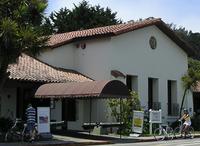
Visitors' Center (Old Officers' Club) at the Presidio of San Francisco, 2003
|
One of the fine things about architectural review and points of interest is that they give you pretext to indulge the grand sport of taking a walk on a nice afternoon.
A friend asked me whether I might write summary descriptions for the San Francisco Mountain Biking website http://www.sfmtb.com/ of points of interest along the SUORT (Shared-Use Off-Road Trail). What�s SUORT? It�s a system of largely unpaved trails suitable for mountain biking, pending appropriate regulatory decisions. The system of trails connects all neighborhoods of western San Francisco. I had to think his request over, you see, because although I am a cyclist and card-carrying member of the San Francisco Bicycle Coalition http://www.sfbike.org/, what do I know about mountain biking? Bicycling in San Francisco is one of my unfulfilled loves. I gave Doug a bike, and he used to keep it for me over at his place, and we�d go out riding from time to time. He sold the bike for $50 at his garage sale when he moved back east. I use the lame excuse that the layout of my apartment and building leaves no room for a bike. Anyway, bikelessly I agreed, "Sure! I�ll write it."
I thought I�d review the Presidio SUORT loop first. I checked the Presidio website http://www.nps.gov/prsf/home.htm for info I could verify by on-site visual inspection, but found only a few notes about some old buildings. For example, Buildings 86 and 87 were constructed in 1862 and are the oldest wood frame structures at the Presidio. They exemplify the Greek and Italianate Revival architectural styles, which were fashionable around 1840-80. I could start with those and a few other numbered buildings anyway. I called up Doc and asked her voicemail robot if she wanted to go with me, but she didn�t call back. I always think she doesn�t love me any more when she doesn�t call back.
Saturday morning, I downloaded the Presidio SUORT map from the net http://www.sfmtb.com/sheets/MAP/presidio_loop.htm, and printed it off, grabbed my backpack and headed out. Blue sky, bright sun, 68F, a 10-knot breeze, and it was yet another perfect day in San Francisco. I disembarked from the 30 Stockton bus at Chestnut and Broderick.
You might be asking yourself at this point "What does all this have to do with taking a walk?" I�m glad you asked.
I�m sure you�ve had the experience of a song that won�t leave your mind however much you might wish it would. The song "Walk Away, Rene" kept looping through my mind. Walking up to the Presidio Lombard Gate from the bus stop, I composed a nearly recognizable arrangement of the tune for the cellphone. Doc told me "Rene" was her favorite song when she was in junior high.
Entering by the Lombard Gate, I followed the signs to the Visitors� Center with hopes to get some more lore. Those signs led me to the old Officers� Club, which houses the Visitors� Center, near Moraga and Graham Streets at the southern and upper end of the parade ground. A couple of mountain bikes were parked outside. (According to the SFMTB site http://www.sfmtb.com/ , mountain bikes can�t legally be used off-road in the Presidio, yet.) A piece of SUORT runs right behind this building, which is number 50. This is the oldest building in San Francisco, originally constructed as El Commandante�s Quarters.
You can get a sandwiches, soup, and salad at the little caf� here, and I had a nourishing chicken Caesar salad. I�d have liked some fresh fruit, but the caf� had none.
At the Visitors� Center, I picked up a map that showed me buildings 0-99 were somewhere in quadrants K5, K6, L6, L7 and M5, all of which were just adjacent to the northwest portion of Inner Presidio SUORT Loop 2. I set out to find buildings 86 and 87, keeping alert for certain others along the way.
Right across Moraga Street from the Officer�s Club stand buildings 40-41, classic examples of WW2 structures, built fast with standard parts. After giving them a thoughtful moment, I continued searching for 86 and 87.
Bearing east and north, I came to the corner of Funston and Presidio Streets. The houses here, such as building number 10, were constructed as officers� quarters in the Queen Anne architectural style popular circa 1880-90. But still I saw no 86 and 87.
I began to wonder how these buildings got their numbers. I imagined a scene where some officer called a junior into his office. "Lieutenant! We have to keep better track of the buildings around here. For that I want an organized list. I want you to take a map and five men and find every building on the base that�s more substantial than a shed or an outhouse. Number the buildings 1, 2, 3, 4, etc. Make a list containing the number and description of each, and mark the location of each on the map." And then the lieutenant went wandering around the Presidio. I suppose once you get to the building you seek, you know you are there, and it does help you distinguish the otherwise identical buildings 40 and 41. I can�t help but think, however, that a conventional street address would have helped you find and identify the building. 86 and 87 for instance. I wondered what became of the Lieutenant�s map.
Traveling west, I came to building 35, said to exemplify the Mediterranean and Italian Renaissance Revival structures of 1920-40. One must, of course, experience bad architecture to recognize good. I therefore value having seen building 35.
But where were buildings 86 and 87? I walked the 100 yards back to the Visitors� Center, seeking enlightenment there. The volunteer staffing the information desk gave me some maps and said "I don�t know." I went back outside, unenlightened.
If you stand on the porch of the Officers� Club gazing at the bay and look a little to the left of straight ahead, you see a line of red brick buildings descending the slope. These are the Montgomery Street Barracks, built just before the Spanish American War in the Colonial Revival style that was popular from 1880 to 1940. I walked a loop around them and came back up to the intersection of Moraga and Arguello without spotting buildings 86 and 87.
I gave up on 86 and 87 and set off to find some other points of interest. Heading over the hill toward Mountain Lake, I continued southward up Arguello Street. I passed a group of grand houses to my right, which must have been where the generals lived. Just uphill from these houses, I spotted what might be a trail leading off to the west, or maybe not a trail. But it seemed someone had been there before. So I went up that way, though it wasn�t on the SFMTB map. Indeed it was a trail of sorts. I stepped over the guardrail at Washington Street where the asphalt is patched, about 50 yards east of the intersection with Deems Road. This part of Washington Street lies on Loop 1.
Continuing westward here, I soon left Loop 1 as Washington Street passes among apartment houses at the northern end of the Presidio Golf Course. Then I came to a concrete road and turned left onto it and into the golf course. On the right was a little store with snacks and cooked food and drinks. And they had fresh fruit. The lady there sold me a banana for $1.09, which I thought must be very fresh, being pricey as it was. I asked the lady whether, considering the price, she would guarantee the quality of the banana. She shook her head. "No guarantees," she said. I took the risk. The banana was just right.
The concrete road continued on down and southerly, and I continued on it, passing building 351, the highest numbered building I could remember encountering all day. I took the next left, an asphalt road with an open gated entrance. The asphalt road, which is part of Loop 1, goes around the eastern shore of Mountain Lake. This area is planted with Monkey Orange Flower and Beach Strawberry and other natives. The road meets up with the end of West Pacific Avenue, where Loop 1 goes left, and I turned right and west on the trail into Mountain Lake Park.
In a little meadow just east of the tennis courts in Mountain Lake Park is a bronze plaque marking where Juan Bautista de Anza and his crew made camp on March 27, 1776. With 30 families, a dozen soldiers and 1000 livestock, de Anza had left Horcasitas, Mexico on September 28, 1775. His purpose was to find an overland route to the Golden Gate and there establish a mission and a fortress. De Anza reported good water and pasturage, but no trees. The Presidio�s forest of cypress and eucalyptus descends from trees planted there during the 19th century. Within three weeks Juan had returned to Mexico, leaving the others behind to build San Francisco.
Mountain Lake had another famous visitor 200 years after de Anza departed. Confirming rumors, police officer Edward Chow and zookeeper Chris Willers made an official sighting of a small alligator in the lake on July 24, 1996. Wetsuited editor Phil Bronstein of the Examiner hunted the gator. Not to be outdone, the Chronicle sent out their representative, too. You may recall a newspaper photo showing a National Park Service ranger and a zookeeper in a small aluminum boat bearing the legend "U.S. Army". One of the newspapers brought in a trapper from Florida who departed after no success. The alligator, though occasionally captured in photographs, eluded physical capture for months. Then on October 8, using raw fish valued at $1.47, the intrepid John Aiken and Woody Petersen of the San Francisco Zoo got the gator, who was subsequently sent to a nice home in Louisiana.
The dirt trail down the middle of Park Presidio Boulevard, at the southwest corner of Mountain Lake Park, forms the SUORT connector to Golden Gate Park. Leaving Mountain Lake Park, and traveling along this route, you will cross Lake Street, California Street and Clement Street, where you may wish to stop for rest and refreshments.
On Clement Street, just to the east of Park Presidio Boulevard, are an Ace Hardware (in case you need to fix something) and several places to eat that were open on Saturday afternoon (no recommendation implied):
* K T Food Shop, Clement at 12th. A corner grocery.
* Louvre Caf�, Clement between 11th and 12th.
Espresso, Internet, snacks, techno music.
* Tong Palace Sea Food Restaurant, Clement between
11th and 12th.
* Seven-Eleven, Clement at 10th. Convenience store.
* Coriya Hot Pot City Restaurant, Clement and 10th.
Sushi, Hot Pot, Bar-B-Q. All you can eat for $10.99.
* All-Stars Donuts, Clement at 10th.
* Kwong Shing Market, Clement between 9th and 10th.
Hot food to go by the pound.
I went to All-Stars for a coffee and a cinnamon roll for dessert. I heard the high-pitched warble of a badly arranged "Walk Away, Rene". It was Doc on the phone. She still loves me after all.
--end--
1864 words.
[
Home
]
