| recort architects:
The Bunker Project
Berliner Strasse, Bremen:
(Conversion and roof- extension of a World War II Bunker into a house
for a family of four)
|
In
June 2002 good friends of ours bought a three storey World War II
Bunker in the middle of their favourite quarter of Bremen, Germany,
in order to convert and extend it into a house for themselves and
their two children. Their idea was to build a two-storey ‘penthouse’
on top using this massive structure as a plinth for their new home. |
|
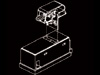
This
bunker is not a cellar buried in the ground as often imagined,
but a big concrete block, 25 x 10 metres on plan, 8m high above
the ground imitating its three storey neighbours.
The site was chosen, because in this old and well-established
part of Bremen no empty plots of land exist anymore.A conversion
of the common and available typology of the Bremer-Style-House,
which is similar to the English terraced house, would have limited
the freedom to challenge conventional domestic arrangements
and perceptions of space drastically.
|
It
was the wish of the clients to live central and urban, but being able
to walk around their house as usually possible in a suburban or
countryside setting.
They dreamed of views and sunlight and being ‘closer to the
sky’. They wanted space, space to breathe, the feeling of having
space, but without actually needing a lot of rooms and without
wanting to build a huge expensive palace. They are ‘obsessed’
with light, but the bunker had no daylight at all. The
site and the bunker together with the client’s ambitions provided
us with some interesting contradictions.
|
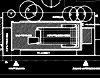 |
The
bunker with its 1.1 metre thick walls has three storeys; two and a half
above ground level, while the lowest one – the basement -
is build half into the ground.
| |
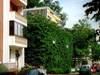
Its rough concrete inside with several smaller scale
rooms, low ceilings and neon light generated the opposite impression
than its completely overgrown and therefore green and friendly outside.
Appearing as an out of scale hedge this green block disguised itself
(again) very successfully. Bunkers are leftovers of the war,
a reminder of horrible times, filled with memory of death and disaster. |
Architecturally they
represent a pragmatic approach to building, fascinating and depressing
in their functionality – beautiful and ugly at the same time. Most of
them are owned by the state –as this one until 2001 –and many of them
remain unused. There is a certain attraction to inhabit these leftovers,
niches, commercially not viable, unthinkable and well-hidden spaces. They
are holes, cast into concrete and planted into the urban fabric. Forever.
And some of them might even grow…
Starting
to share the fascination of our clients we quickly convinced
them to not just build on top of this green hill, but to use
and incorporate the space inside the bunker to a whole concept
of living in and on top of it.
Ideas to penetrate the concrete mass, to carve it out, to cut
holes into the green block, to play with the 3-dimensionality
of the existing versus the light weight structure, we were allowed
to build on top, inspired the design process.
|
 |
Questions arose about
how a highly insulated and compact space could inhabit a cold and quite
uncontrollable mass like the bunker. Where to draw the line between the
outside and the inside was a crucial decision to the developing concept.
| |
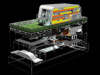
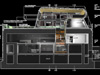
A
strategy emerged in which part of the house occupies part
of the existing structure -like an inlay, insulated from inside,
‘eating’ its way through to the surface and the light - and connects
through the roof with the ‘penthouse’ space built on top. A compact
three-storey house plugged into another three-storey structure describes
the basic configuration. |
We tried
to get the most out of this space without filling it up with new structure,
however, aiming to use and dramatise its mass, its size and its roughness.
The
size and position of the holes, which we cut into the walls and
the massive roof, had to respect the mechanical constraints of
the diamante-saw cutting procedures and had not to jeopardize
the structural integrity of the building. Planning Regulation
Law prescribed a maximum outline of the visible extension, while
new and strong energy saving regulations forced us to work with
high quality and therefore expensive materials. At the same time
the budget asked for a small and compact building and an inexpensive
construction method. |
 |
the design:
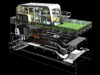
One enters the house via the existing main entrance to the bunker on the
mid level. A third of the floor of the
| |
top
storey has been removed, allowing the light from the new large opening
in the roof and through the new stairwell to reach the entrance
level. At the same time it offers stunning views of the house inside
the house the moment you enter through the heavy metal door. The
existing staircase connects to the upper bunker floor, where the
new structure starts. |
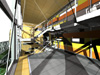
| A
steel gallery bridges over the hole in the floor, leading to the
entrance door of the warm part of the house. The new staircase
hanging down from the steel structure above completes the transition
from dark to light along the new cut through the 1.6meter thick
concrete roof. The linking element, giving the house on top its
campervan type shape is an approximately 33 metres long facade-roof-floor-wall.
|
. |
This
element, timber clad from the inside, fulfils many functions.
It starts inside the bunker, climbs through the
| |
hole
and another story up, separating the most private bedrooms and bathrooms
from the open stair and living areas, bending over to form the kitchen
floor, folding over at the north end to serve as curved wall, then
roof and finally south façade towards the garden.
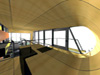
The main living
areas are one spacious and open hall with loosely defined zones
with different characters. |
The cooking, sitting,
dining area overlooks the whole inside space like a cockpit as well as
the adjacent roofs
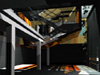
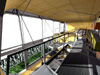
A gallery
made out of steel mesh cuts through the main double height space
(view 4) and penetrates the garden facing façade to form
a balcony capturing the best river views.
The main
bunker ‘hall’ stays raw and exposed leaving room for future
extensions and providing a playground for more ideas and big
performances and parties.
|
|
A deeper discussion
about domesticity might reveal or consider the driving factor behind
this effort for being so different and for expressing individuality
through architecture and the home in a very critical way. But we ignored
this loaded territory of domestic dreams and the social and sociological
implications of their fulfilment, purposely focusing only on the playful
exploitation of all offered difficulties and constraints. Guided by
enthusiasm about the spatial opportunities and understanding the economical
constraints as a helpful hand not to overload the design, the brief
seemed like a conundrum promising pleasure and joy in finding its ‘solution’.
As one discovers thoughts while writing and designs while drawing, all
four of us have more ideas than before while building. Besides having
more ideas on how to design the house, we also have more ideas how one
could live … - in it.
Christoph RECktenwald
Dipl.Ing. (Arch), Architect (arb)
Esther ORTmann
Dipl.Ing. (Arch) MA (AA), Architect (aknds)
|