|
|
||
|
|
Of all women rebels, Joan of Arc is
no doubt the most well-known and the most celebrated. Joan of Arc, or in
French, Jeanne d'Arc, also called the Maid of Orleans, was a patron
saint of France and a national heroine. She led the French resistance
against the English invasion in the Hundred Years War.
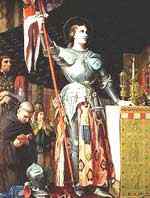
When Joan was about 12 years old, she began hearing "voices" of St. Michael, St. Catherine, and St. Margaret, believing them to have been sent by God. These voices told her that it was her divine mission to free her country from the English and help the dauphin gain the French throne. They told her to cut her hair, dress in a man's uniform and pick up arms. Joan convinced the captain of the dauphin's forces, and then the dauphin himself of her calling. After passing an examination by a board of theologians, she was given troops to command and the rank of captain. At the battle of Orleans in May 1429, Joan led the troops to a miraculous victory over the English. She continued fighting the enemy in other locations along the Loire. She has since become a role model for girls and women everywhere as a female conqueror of seemingly indomitable odds in a world of men. Charles VII was crowned king of France on July 17, 1429 in Reims Cathedral. At the coronation, Joan was given a place of honor next to the king.
In 1456, a second trial was
held and she was pronounced innocent of the charges against her. She was
beatified in 1909 and canonized in 1920 by Pope Benedict XV. Joan of Arc is considered one
of the most influential women in the history of the world. During recent
years, she has become a role-model for feminists and equal-rights
speakers everywhere. She has inspired both past and present leaders to pursue
equality in all areas. We can only but wonder how the world would be like had
Joan not become the legend that she is today. |
|
 In
1430 she was captured by the Burgundians while defending Compiegne near Paris
and was sold to the English. She was tried for witchcraft and heresy. Much was
made of her insistence on wearing male clothing. She was told that for a woman
to wear men's clothing was a crime against God. Joan was convicted after a
fourteen-month interrogation and on May 30, 1431 she was burned at the stake
in the Rouen marketplace. She was nineteen years old at the time.
In
1430 she was captured by the Burgundians while defending Compiegne near Paris
and was sold to the English. She was tried for witchcraft and heresy. Much was
made of her insistence on wearing male clothing. She was told that for a woman
to wear men's clothing was a crime against God. Joan was convicted after a
fourteen-month interrogation and on May 30, 1431 she was burned at the stake
in the Rouen marketplace. She was nineteen years old at the time.