|
|
|
|
Researches
show that the development of the Pug as a breed probably begun in ancient
China with a low-set, short-mouthed dog named “Lo-Sze.” Although it certainly
didn't look the same as the modern day Pugs! Dogs known as "short mouthed"
dogs are described in writings that date to about 600 BC and were probably
the forerunners of the modern breed that we call the Pug. Emperor Kang
Hsi, about AD 950, commissioned a dictionary of all the Chinese characters,
and in it there are two references which could describe the Pug: "dogs
with short legs" and "a dog with a short head." During the 1300’s,
there were three main types of dogs that are identifiable as founders of
breeds of today: the Pekingese, the Japanese Spaniel, and THE PUG. Pugs
are believed to have been introduced to the world by Dutch traders. In
the Philippines, the first Pugs came from Australia in the early 1960’s
and then mainly from the United States of America in the late 1970’s and
to the present.
|
 |
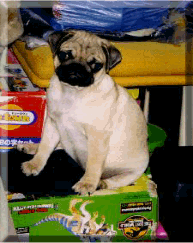 |
Pugs are the most adorable and loving little creatures that God ever made! For many people, they are the cutest breed around. However, some consider them ugly because just don't see the beauty in the breed. If you are looking for a dog that can and will make you laugh? Then a Pug is the best choice for you, this is mainly due to the fact that Pugs are natural clowns and show-off’s. If you are looking for a dog that is good with children? Then a Pug is the best choice for your family as they seem to consider children to be "Pug-sized" people. Actually, some say that Pugs think children were especially created for them! |
|
In general, the boys are more laid back, people-oriented and loving than girls. The latter, are more aloof and independent. They are said to be better ”watch dogs.” Both sexes tend to be more gentle and laid back as they age. Thus, if you are looking for a couch potato type of a dog, get a male. Females are better suited for those looking for dogs that are self-ruling and not as demanding. However, these are generalities and boys can be pretty independent while girls can be more people oriented. |
 |
 |
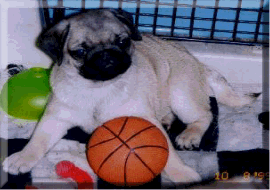
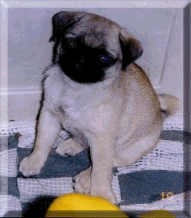
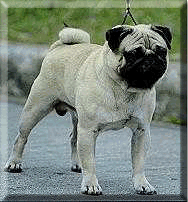
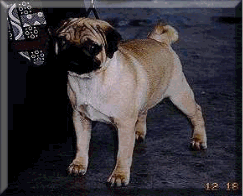
According to the breed standard, Pugs come in two colors: fawn and black. Both are acceptable but fawns are more popular. These fawns come in a number of shades, namely, "apricot fawn," "silver fawn," "stone fawn," however, they are all still just fawn Pugs. Apricot fawns range from a cream tan to a peach or apricot tint while silver fawns has a mixing of black-tipped guard hairs in it, making the dog appear darker. Again both are acceptable but those with a very dark coloration over the entire body is said to be "smutty" and are undesirable. Either color can have a few white hairs on the chest (but not bigger than a ten centavo coin), and both colors will turn grey in the muzzle as they age. |
|
Corneal
Ulcers
The common health concerns affecting Pug legs include: Hip Dysplasia
Pugs also
have a high incidence of demodectic mange which affects the skin. Other
skin problems include fungal infections and “hot spots.” Hypothyroidism
is also being noticed. For malignancies, lymphomas (that is, cancer
of the
|
 |
 |
Pugs do not require that not much care. One should just brush their coat, keep their faces clean and check their eyes for problems at least once every other day. This will take just 20 minutes per dog. Trimming their toe nails, and bathing can be done at least once a month. Since Pugs do shed a lot, using a shedding comb can work wonders in reducing the amount of coat shed on carpets and furniture. |
|
YES, Pugs shed tons and tons of hair! These dogs have both a top coat and an undercoat, with the top coat having long straight hairs and the undercoat having softer fluffy straight hairs. Normal hair length on a pug is about 3/4 of an inch, although they can be longer. Don't let anyone tell you that Pugs do not shed - they are more interested in getting you to take one than telling you the truth! |
 |
|
|
Being
very social animals, Pugs need to be in a reassuring environment such as
INSIDE a loving home. Besides, they cannot tolerate high heat and
humidity for a long time. Ordinarily, dogs cool off by panting and their
long
|
|
On the
average, a healthy Pugs can normally live up to 12 to 14 years, but some
have been reported to even live for many more years. Becoming a
|
 |
 |
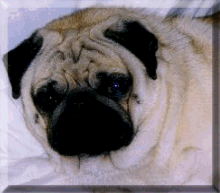
With all those wrinkles, what special care do Pug faces need? Generally,
wrinkle care is as simple as using a tissue paper (which is preferred over
cotton balls as one may poke harder with the latter) dipped in sterile
saline solution and wiping out the wrinkles at least once weekly. Pugs,
while having no-noses, are some of the nosiest dogs out there, and tend
to gather a lot of unwanted stuff especially underneath the overnose wrinkle.
If they do trap moisture and dirt, then this combination can easily lead
to infection which is usually fungal in etiology and would need to be treated
right away.
|
|
Not
usually but some Pugs may alert you that someone is nearby by barking gently
(Pugs are not known to bark loudly, in general, because it is
|
 |
 |
YES! Most
Pugs do snore but usually not as loud as a person, however, it can be easily
mistaken for someone snoring. Pugs do snort and snore and often will even
pass a lot of gas, too. They maybe noisy dogs as a breed BUT they are not
barkers.
|
|
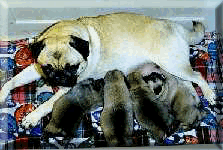
NO! This is an absolutely precarious proposition. The cost of raising Pugs are quite expensive. Start with the breeding: Pugs should be at least two years old, and ideally need to be tested for eye problems, hip problems, and brucellosis before they are bred. Your bitch MUST BE up to date on all her vaccination shots and wormed before the breeding. Then there is the stud fee, for a descent, well-bred champion, this will usually be the price of a puppy or more. Then there is the waiting time (average of two months!), and hoping she is in whelp. If she is, consider that she may require a C-section which is very common in this breed! Many Pug bitches have narrow hips through which the puppies’ big heads will not fit. If you are lucky, you can have an average litter of three or four puppies. But if they were born by C-section, the dam may not be able or willing to nurse the pups. So, you will need bottles and formula, a way to keep the pups warm, PLUS round the clock feedings for at least the first two weeks! Will you and can you be able to take a couple of weeks off from work to raise the puppies? Add that cost into the figures. Then being a RESPONSIBLE BREEDER, you will offer a health guarantee on your puppies, and take them back if anything is wrong with them, right? There is so much more than putting a girl and a boy dog together. It is very seldom for responsible breeders to have a significant amount of profit in this endeavor especially when they count up time, labor and actual expenses. |
 |

back to Main Page