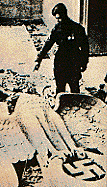
The Holocaust at Dresden: Feb. 1945
"They seemed to me completely to have forgotten that the concentration camp was originally a Communist idea, copied by Hitler, and that the further the Red armies were allowed into Europe the more certain its perpetuation became. [...] Wartime propaganda is the most insidious poison known to man... I think most of them thought the human remains they saw were those of Jews, for this was the suggestion hammered into their mind by the press day by day. They constantly read of 'Nazi gas chambers for Jews . . . Nazi crematoria for Jews', and few of them in later years troubled to read the stories of inmates and find out who these victims truly were."
--Douglas Reed; "The Controversy of Zion," p. 405
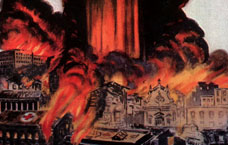
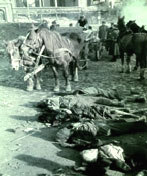
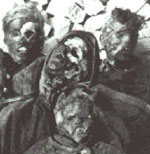
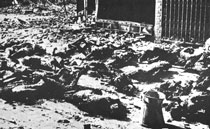
Civilians in Dresden hit
by the Allied "firestorm"
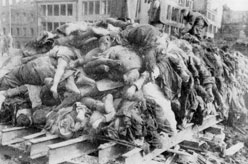
Streets full of corpses of women
and children"The real issue is whether civilian bombing is appropriate. It was happening. We were doing firebombing in Europe, in Dresden and so forth, we were doing firebombing in Japan. In spite of all the reconstructed history, I'm convinced that [the atomic bomb...] certainly shortened the war and I believe probably saved more lives than it took."
--William Spindel, physical chemist and Los Alamos alumnusA doctor in a postwar propaganda film, supposedly at a camp, recognized himself at a scene burning corpses... of dead gentiles after the firebombing of Dresden!
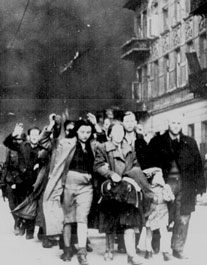
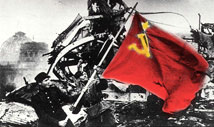
Soviet occupying Germany in 1945"One of the first acts of the Allied High Commissioners was to enact a law 'against anti-semitism'. Thus they extended into the West the law which identified the nature of the first Bolshevist administration in Russia, the 'law against anti-semitism' introduced on July 27, 1918. Under this British-American edict Germans were being imprisoned and their property confiscated ten year later, in 1955; and in 1956 a Jew from Austria, by that time domiciled in England and a naturalized British subject brought action against a German under a Western German law (inherited from the Allied High Commissioners) which made it a n offense 'to utter anti-semitic remarks or be unduly prejudiced against Jews'.
These laws prevent public discussion, but cannot suppress thought. Their object, plainly, was to suppress all public enquiry about the nature of the régime, west of the 'Iron Curtain' as east of it."
--Douglas Reed; "The Controversy of Zion," pp. 403-4