"Greuelmeldungen" is a German word. In English it means "atrocity stories." Its history in Germany is somewhat long. During World War I (1914-1918) Germans were accused of horrible crimes which was later acknowledged as false. The German Nazis got to know the word early - and experienced it for long - even before the rumors of a Jewish Holocaust.
Atrocity stories is nothing new as war propaganda. But the Jewish leadership used it early in history as a way of mental war against gentiles, to awake sympathy for something exaggerated or completely false.
For example it was used in Tsarist Russia. Jewish radicals hated the gentile Tsar more than anything in this world. Economical boycotts were used against the gentile leadership of Russia - and the Tsar. To justify these boycotts one used the Russian word "pogrom." Pogroms, anti-Semitism and opposition against Jewry has been "beneficial" to the policy of the leadership group. This is very bizarre thing for the gentile mind, but that doesn't mean it isn't true. The success of "Jewish policy" is in the non-gentile way of thinking. This has everything to do with the news of the Holocaust after WWII, wars and the New World Order in general.
"I did not in the least suspect that there could be such a thing as a systematic anti-Semitism. . . . The memory of certain events which happened in the middle ages came into my mind, and I felt that I should not like to see them repeated."
--Adolf Hitler; "My Struggle," Vol 1, ch. II, 1925
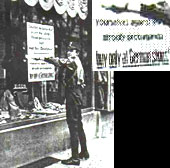
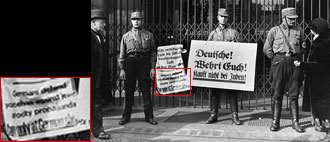
Boycott of Jewish stores April 1, 1933Sign partly in English:
"[Defend] yourselves against [Jewish] atrocity
propaganda - buy only at German stores"(Text also appearing on other photos.)
Quite remarkable that this was in 1933 - the first year the Nazis governed the country! Many Germans ignored the official (anti-)boycott and bought stuff from these stores anyway.
"[Hitler] told me that a boycott day was to be fixed for 1 April and that I was to organize it. [...] So I undertook the organization of the boycott and issued a directive... I gave instructions that no attempts should be made on the lives of Jews, that one or more guards should be posted in front of all Jewish premises - that is to say, in front of every Jewish store - and that these guards should be responsible for seeing that no damage was done to property. [...] Except for minor incidents the boycott day passed off perfectly."
--Julius Streicher, 26 April 1946; Nuremberg Trial Proceedings Vol. 12"I hope that is has not been forgotten yet that the anti-Semitism in Tsar-Russia was very common among the farmers, the middle-class bourgeois of the city, the intelligentsia and the more retarded part of the working class. 'Mother' Russia was well-known, not only for her periodically reoccurring Jewish pogroms, but also for its substantial amount of anti-Semitic periodicals, which had a large circulation. The October revolution dismissed the Jews' status as lawless. It didn't mean however that one with a single blow exterminated anti-Semitism"
--Leon Trotsky-Bronstein, in exile about 1940, "Termidor and anti-Semitism""The Tsarist government, acting surreptitiously through its secret police, did promote pogroms; but it did so only when it was particularly weak (after the assassination of Alexander II in 1881, and in the period immediately before and after the 1905 revolution) and even then took care to contain the breakdown of 'law and order'. During the time of its greatest strength - for example, under Nicholas I or in the latter part of the reign of Alexander III, when the opposition had been smashed - pogroms were not tolerated by the Tsarist regime"
(Israel Shahak, "Jewish history, Jewish religion")Jews were more involved in revolutionary activity in Russia than the Russians themselves. Also in the assassinations and assassination attempts. Jews felt discriminated and Russians felt threatened by this strong "minority group."
This finally escalated into what became known to the world as the "Russian revolution," i.e. Bolshevik takeover of Russia. The new system became known as "Soviet" or "Council" and was built on a Jewish Kahal (Council) model. Jews were predominant in the Soviet. The first established Council had 12 members, as the 12 apostles or tribes of Jacob-Israel. Lenin was half-Jewish and all others were Jews or Jewesses.
"In the beginning the Tsarist regime blamed the revolutionaries for starting the pogroms. [...] As much as the regime feared the disturbances, the more the revolutionaries threid to use it. [The Jews...] were blamed for managing the disturbances."
(Salomon Schulman, "Jiddishland," 1996)"The [Russian 1903] Kishinev pogrom [with...] its bloodshed and destruction to property it exceeded any single previous pogrom in modern times: Forty-five [45] Jews were reported killed... Jewish sources initially reported over 700 dead... some Jews make false claims in hopes of getting relief money from western Europe and America."
(Albert S. Lindemann, "Esau's Tears: Modern
Anti-Semitism and the rise of the Jews," p. 291, 1997)"[N]inety percent of them [Jewish males] hid themselves, or fled to
safer parts of the city for refuge [during the Kishinev pogrom]."
(Reporter quoted in Davitt, "Pale," pp. 170-1)"[T]he Jews in southern Russia constitute
ninety percent... of all revolutionaries."
--Count V. K. von Plehve, Russian Minister of the Interior,
complaining to a Jewish delegation from Odessa, 1903"The 1882 [Russian] May Laws had been passed with a special concern to prevent Jews from exploiting the peasantry. The laws decreed that Jews were not to settle in peasant villages, and they were forbidden to buy more land."
(Albert S. Lindemann, "Esau's Tears: Modern
Anti-Semitism and the rise of the Jews," p. 287, 1997)"[T]he tsarist autocracy [has...] made paupers, beggars,
sick, weak, and feeble wretches out of the Jews."
(Official comment by the Yiddish Bund party in Russia)The Russians became no more nicer toward Jews when they got to know about the Jewish pressure from abroad.
"If the Czar will not accord our people these desired liberties, then a revolution will bring about a republic which will assure us our rights."
--Jacob Hirsch Schiff; quoted in Count Witte's Memoirs, Vol. 1, pp. 394-395"A most tenacious enemy of tsarist Russia was Jacob H. Schiff, the American financier. Schiff played a crucial role not only in denying the Russians the bonds they sought in the international market to finance the war [the Russian-Japan war] but also even more decisively in providing financial support for Japan, which then so humiliatingly defeated Russia. In Great Britain, Lucien Wolf, joined by the English Rothschilds and, in central Europe, Paul Nathan, led the efforts to isolate Russia both economically and diplomatically. [...] When Count [Sergej] Witte arrived in the United States to negotiate the peace treaty with Japan, he was contacted by Simon Wolf, another American Jewish leader and long-time confidant of presidents, who told him that Russia needed two things, money and friends. He added:
'The Jews of the world, as citizens of their respective countries, control much of the first... There is no use in disguising the fact that in the United States the Jews form an important factor in the formation of public opinion and in the control of finances. [...] By virtue of their mercantile and financial standing in this country they are exercising an all-potent and powerful influence.' [The Tsar...] Nicholas was an attentive listener to those who spoke of a worldwide Jewish conspiracy against him. Especially after 1905 he was haunted by a fear that the Jews, their non-Jewish agents, and a network of Jewish financiers who had intimate contact in the corridors of power in the West were out to undermine tsarist Russia, destroy his empire, and even to kill him personally."
(Albert S. Lindemann, "Esau's Tears: Modern
Anti-Semitism and the rise of the Jews," p. 302, 1997)"The Russian May Laws [regulating Jewish influence] were the most conspicuous legislative monument achieved by modern anti-Semitism [...] Their immediate result was a ruinous commercial depression which was felt all over the empire and which profoundly affected the national credit. The Russian minister was at his wits end for money. Negotiations for a large loan were entered upon with the house of Rothschild and a preliminary contract was signed, when... the finance minister [Count Witte] was informed that unless the persecutions of the Jews were stopped the great banking house would be compelled to withdraw from the operation" (Encyclopaedia Britannica, Vol. 2, p. 76, 1947)
"In Tsarist Russia the most terrible thing that could happen to a Jew was being recruited to the army. [...] Besides, for every Jew in the world it was simple: Tsarist Russia was the Jews' worst enemy and located there was the worst enemies of Judaism [i.e., Christians]."
--Nahum Goldmann, famous Zionist leader; "The Jewish Paradox," pp. 22, 25, Sw. edition; Goldmann doesn't mention any (other) reasons in his book! But he did like the new Soviet state"[T]he ghetto [has] historically seen... been a Jewish invention. It is incorrect to state, that the goyim [non-Jews] has forced the Jews to separate themselves from other societies. When the Christians gave their confirmation of the ghettos, the Jews were already living there."
--Nahum Goldmann; "The Jewish Paradox," p. 77, Sw. edition"After the seizure of power the foreign press published so many atrocity stories, which turned out to be rumors, that I would have had no reason to believe anything like this"
--Julius Streicher, 29 April 1946; Nuremberg Trial Proceedings Vol. 12"Six million men and women are dying [in Ukraine]; eight-hundred-thousand children cry for bread. And this fate is upon them through no fault of their own, through no transgression of the law of God or man; but through the awful tyranny of war and a bigoted lust for Jewish blood. In this threatened holocaust of human life . . . six million human beings are being whirled toward the grave."
--Martin Glynn, governor of New York; "The Crucifixion of the Jews Must Stop," The American Hebrew, No. 582, Oct. 31, 1919
Work equals annihilation?
"[T]he truth shall set you free."
(Jesus; John 8:32, the New Testament)"Wahrheit macht frei"
(Jesus; John 8:32, the New
Testament; in German)No matter what one would think evidence show that the Nazis was very inspired by both the New Testament and the work of Martin Luther.
The is some indications that Martin Luther's work in 1543 was an inspiration to the choice of words: Arbeit macht frei (Work will set you free).
"Especially you pastors who have Jews living in your midst, persist in reminding your lords and rulers to be mindful of their office and of their obligation before God to force the Jews to work"
--Martin Luther; "On the Jews and their lies," p. 274"[F]orce them to work, and deal harshly with them, as Moses did in the wilderness, slaying three thousand lest the whole people perish."
--Martin Luther; "On the Jews and their lies," p. 292
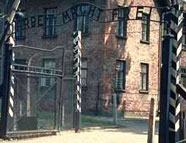
"Gates of hell" or entry to
Auschwitz concentration camp?
Front gate of Theresienstadt; luxurious
town-like place for rich old Jews; today
described as a "false facade" - since it
doesn't fit the big picture
These concentration camps of the Nazis are today said to be both labor camps and (in some cases!) also extermination camps. First workers had to work until they almost fell down dead. Then they were secretly gathered in groups for "gassing". And then their remains were burned in ovens.
It is also the "burning part" which is said to be the origin of the choice of the word "Holocaust", meaning "sacrificial offering to God by fire" in ancient Greek!
But their are some information left out. The Nazis supposedly printed their own currency for the inmates (at Auschwitz for example). And the camps had theaters, soccer courts (where inmates played with guards), a swimming pool - and even a brothel. Sounds like a fictional story, but is absolutely true.
Jewish soup and shrunken heads
The story of Jewish fat being used in Nazi soup is a story that goes around even today. But for the experts it is known as a myth. No serious person still believe that this was the case.
The Communist Soviets supplied anti-Nazi evidence at Nuremburg 1945. One of these items was a shrunken head! It was supposedly found at the Buchenwald camp. What is odd is that people still claim it is a head of an inmate, and not recognize what is obvious - that it is an African head.
WWW: Holocaust Pictures Exhibition
A shrunken head of a prisoner, discovered at BuchenwaldThe head is investigated more thoroughly at THIS PAGE.