| Quick Info
Variants
Tempest F.Mk II The Tempest
was a redesignation of the Typhoon Mk II, but since the number of changes
and the impact of those chages were so big, you could speak of a new aircraft.
The Mk I never took to the air beacause Napier discontinued the engine
on which it was based shortly after the prototype reached the flying state.
So the list starts with the Mk II in stead. The Mk II was powered by 1
× Bristol Centaurus V radial, rated 2,520 hp (1.879 kW). The production
was delayed in favour of the Mk V, so when production finally started the
War was almost over. (450 built)
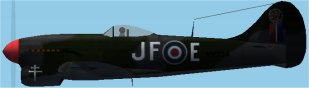
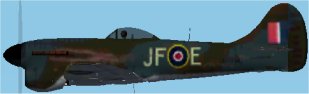
Hawker Tempest F.Mk V This is the only
version that really saw action during Wolrd War 2. See details above. Contrary
to the F.Mk I which had no Chin radiator, the F.Mk V had one. Nevertheless
it had a remarkable increase in performance and handling because of other
changes. The F.Mk V is most well know for it's incredible speed at low
and medium altitudes, and for their successes against the Fieseler Fi 103
V-1 Flying Bomb. Two sub series were produced:
- Tempest F.Mk V Series 1 This subversion
was armed with 4 × 20 mm Hispano Mk II cannons with slightly protruding
barrels. (100 built)
- Tempest F.Mk V Series 2 This subversion
was armed with 4 × 20 mm Hispano Mk V cannons with shorter barrels,
a detachable rear fuselage, smaller main wheels, and other small changes.
Early aircraft were powered by 1 × Napier Sabre IIB, rated at 2,200
hp (1.640 kW), the rest was powered by 1 × Napier Sabre IIC, rated
at 2,260 hp (1.685 kW)
(705 built)
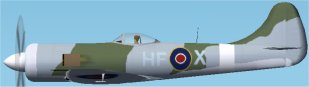
Hawker Tempest F.Mk VI This is the tropicalised
version of the Tempest F.Mk V, and was powered by 1 × Napier Sabre
VA, rated at 2,340 hp (1.745 kW). The inlets for the oil cooler and carburetor
were moved from the nose to the wing roots to accomodate a larger radiator.
This version was introduced after World War 2, and were exported to Pakistan
and India. (142 built)
|