| Quick Info
Variants
Ju 87 Versachs Prototypes
Ju 87A-0 Pre-production version,
powered by Jumo 210Ca inverted Vee, slightly modified wing, gun for the
rear-seater 1 × 7.92 mm MG 15 trainable rearward-firing for defense,
and an Askania autopilot. (10 built)
Ju 87A-1 First production
version.
Ju 87A-2 Powered by Jumo 210Da
with two-stage supercharger and 3-blade metal propeller with wider-chord
blades.
Ju 87B-0 Pre-production, powered
by Jumo 211A, although not very clear, Ju 87B series was almost completely
redesigned, only the wings and horizontal tail were retained, the rest
of the airframe was completely redesigned, resulting in better aerodynamical
figures, and greater structural strength, cockpit canopy was redesigned,
resulting in a rearward sliding canopy, as opposed to hinged one of Ju
87A-series, vertical tail unit was enlarged once more, and landing gear
was braced, not strutted, amrmament was doubled to 2 × 0.312 inch
(7,92 mm) MG 17 guns in the leading edges of the wings, one on each side.
Ju 87B-1 Identical to Ju 87B-0,
but fitted with Jumo 211Da with fuel injection, this enabled the Stuka
to carry a 1,102 lb (500 kg) bomb in addition to the second crew member,
alternatively 1 × 551 lb (250 kg) bomb under the fuselage crutch
and 4 × 110 lb (50 kg) bombs under the wings. (557 built)
Ju 87B-1/U2 Equiped (retrofitted
actually) with improved radio equipment.
Ju 87B-2 Differed in having
individual ejector exhaust stubs for a little extra thrust, hydraulically
operated radiator cooling gills, and the Junkers VS-5 propeller with broader-chord
blades.
Ju 87B-2/U2 Equiped with improved
radio equipment.
Ju 87B-2/U3 Additional armor
protection for close-support purposes
Ju 87B-2/U4 Fitted with Ski's
rather than wheels
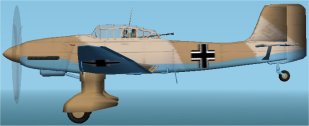
Ju 87B-2/Trop Intended for
use in North African Theatre of Operations, fitted with sand/dust filter,
desert survival pack
Ju 87C-0 Carrierborne version,
based on the Ju 87B-2, manually folded outer wings, catapult attachments,
an arrestor hook, flotation equipment, and a jettisonable landing gear
in case the aircraft had to ditch into the sea
Ju 87C-1 Planned version,
ellectrically folding wings, increased fuel tank capacity, and provisions
to carry a torpedo
Ju 87D-1 Powered by Jumo 211J-1
inverted-Vee, aerodynamical cleaner installation, big chin of the Ju 87B
series for the water cooling radiator relocated to under surfaces of inner
wings, in it's place a small oil cooler was fitted in a much smaller chin,
redesigned cockpit canopy to reduce drag, improved main landing gear fairings,
internal outer-wing fuel tanks like those of the Ju 87R versions, more
and thicker armor for the crew, the replacement of the defensive 1 ×
0.312 inch (7,92 mm) MG 17 gun to a 1 × 0.312 inch (7,92 mm) MG 81z
two-barrel gun, and a strengthened lower fuselageand crutch to enable a
maximum bombload of 3,968 lb (1.800 kg).
Ju 87D-1/Trop Intended for
use in North African Theatre of Operations, fitted with sand/dust filter,
desert survival pack
Ju 87D-2 Identical to the
Ju 87D-1, except for strengthened rear fuselage and tailwheel unit that
later incorporated a tow hook for cargo gliders.
Ju 87D-3 First version that
was fully optimised for the close-support role, retained it's dive-brakes,
however.
Ju 87D-4 Designation was used
for a number of Ju 87D-1 and Ju 87D-3 aircraft that were converted for
use as a torpedo bomber. However, they were never used operationally, and
were later converted back to the Ju 87D-3 standard.
Ju 87D-5 Wingloading was reduced,
the resulting Ju 87D-5 had extended outer wings, main landing gear was
jettisonable, and later aircraft had the dive brakes no more.
Ju 87D-7 Night operations
version, night-flying instrumentation, flame damper tubes, powered by Jumo
211P inverted-Vee, fixed forward armament was increased to 2 × 20
mm MG 151/20 cannons, in other ways identical to
Ju 87D-5 with larger wing and jettisonable main
landing gear.
Ju 87D-8 Built in parallel
to the Ju 87D-7, but as daylight version, no night-time instruments or
flame damper tubes.
Ju 87G-1 Anti-tank version,
had a converted high-velocity 37 mm Flak 18 anti-aircraft cannon (BK 3,7)
installed in underwing pods.
Ju 87H-1 Ju 87D-1 conversions
to dual-control trainers, all armament stripped, rear canopy received a
couple of blisters so the rear-seated instructor could have a better forward
view.
Ju 87H-3 Ju 87D-3 conversions
to dual-control trainers, all armament stripped, rear canopy received a
couple of blisters so the rear-seated instructor could have a better forward
view.
Ju 87H-5 Ju 87D-5 conversions
to dual-control trainers, all armament stripped, rear canopy received a
couple of blisters so the rear-seated instructor could have a better forward
view.
Ju 87H-7 Ju 87D-7 conversions
to dual-control trainers, all armament stripped, rear canopy received a
couple of blisters so the rear-seated instructor could have a better forward
view.
Ju 87H-8 Ju 87D-8 conversions
to dual-control trainers, all armament stripped, rear canopy received a
couple of blisters so the rear-seated instructor could have a better forward
view.
Ju 87R-1 Developed parallel
to the Ju 87B series. 'R' stands for 'Reichweite', or range, essentially
a Ju 87B with an extended range for anti-shipping duties, outer wings were
restructured to accomodate 2 × 33 Imp gal (40 US gal, 15 liters)
additional tanks to supplement the standard set of tanks in the inner wings
of 53 Imp gal (63 US gal, 240 liters) each. Also the outer wings had 2
hardpoints to carry a droptank each of 66 Imp gal (79 US gal, 300 liters),
bomb under the fuselage was restricted to 551 lb (250 kg).
Ju 87R-2 Identical to the
Ju 87R-1, except some other (unspecified) equipment
Ju 87R-3 Identical to the
Ju 87R-1, except some other (unspecified) equipment
Ju 87R-4 Identical to the
Ju 87R-1, except some other (unspecified) equipment
Total Production: 5,709 built
|