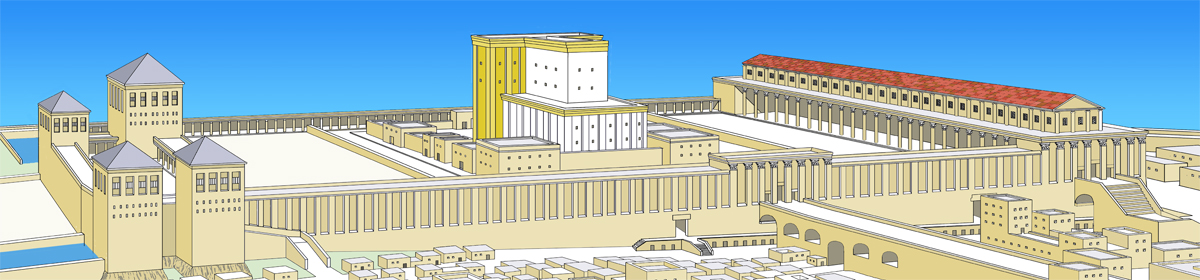
A significant miracle was accomplished at the Temple's Beautiful Gate, according to the New Testament. A man who was obviously born lame was begging at this gate. Peter and John greeted him and explained that they were poor and had nothing of value in the world. Instead, they prayed to Jesus Christ of Nazareth for his healing. He then "joined them in the temple courts, walking and jumping and praising God." Oh, what a happy event that must have been, and surely many people were there to see it. Jesus had previously healed the blind and the lame, but now his disciples could do the same.
Momentum of the miracle's execution was crucial. It was 9 o'clock, the hour of prayer when the evening sacrifice was offered in the Temple.
There was a psalm written by David just for this moment. This was the exact time that Jesus was crucified. The evening sacrifice was also the moment when Elijah presented his offering. And it was at this time that Gabriel was dispatched to answer Daniel's plea. This is when Cornelius was visited by the angel. The prayers of the devout are heard and answered by God, although it seems that some requests are answered only at certain times.
The miracle occurred at the Beautiful Gate, but which gate is it, and how can it be identified, according to the Bible? Herod's Temple Mount had at least seven gates in its outer walls, but only one of those gates has been decorated.
Some academics have suggested Nicanor Gate or Shushan Gate as the most deserving contenders for the Beautiful Gate, as we discussed in an earlier piece. We have, however, maintained that a lame man would not have been welcome to beg at either of these gates.
According to my book, The Quest: Revealing the Temple Mount in Jerusalem, the most likely site would have been the Double Gate in the Southern Wall of the Temple Mount.
The ceiling of the double corridor is adorned with intricately carved domes that have endured to the present day. A group of Muslim officials granted me access to examine these domes in 1973. Scaffolding had been set up below the southwest dome at the time so that it could be touched and measured. What transpired there was very remarkable. In addition to directing the photography of the domes, I also conceived of and oversaw the execution of the drawings, which were executed by Nili Cohen in pencil and my late sister Martha in ink.
The majority of worshipers entered the Temple Courts through this stunning entrance. Effective begging techniques, as indicated on page 74 of the aforementioned book, were also made possible. It is written in Mishnah Middot 2.2, "whomever it was that ascended the Temple Mount came in on the right, walked round, and came out on the left, save any whom aught befell, for he went round to the left."
Carved floral and geometric decorations intertwined in elaborate patterns adorn two of the west domes.
We hypothesized that an earthquake or faulty construction led to the collapse of these two eastern domes. Even though they were reconstructed during the Herodian era, they lacked ornamentation because of this.
But it was a gate, and its elaborate domes are still standing, despite having been destroyed by the Romans. Thus, we estimate that after Peter and John healed the lame man at the Double Gate, the man "walked and jumped" the rest of the way to Solomon's Porch in the Temple.
For more information about this article, visit Bible Gateways.