
The whole Exodus event actually dates back to the time of Joseph in the latter part of Genesis, the book before Exodus.
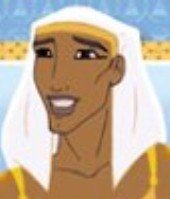
and chosen by God to lead the Hebrew people out of slavery. Thus, the Exodus happened.
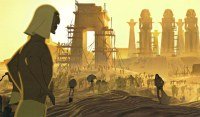
Even as the Hebrews lived in misery and oppression, they still continued to multiply as rapidly as before. Pharaoh still feared that they were overwhelming the Egyptians and take over the land. So, he ordered the Hebrew midwives to get rid of the baby boys, but to spare the girls. Yet the midwives refused to do so because they knew it was wrong. So then, Pharaoh ordered a cruel decree: every first-born Hebrew male must be culled and thrown to the crocodiles of the Nile.
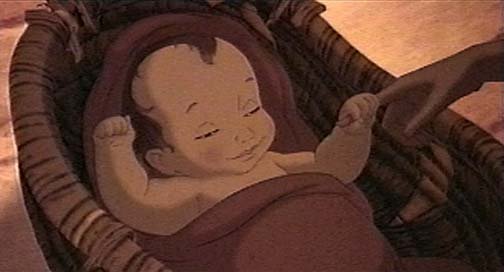
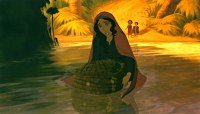
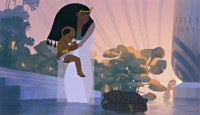
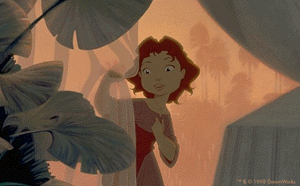
It is not certain how Moses came to know of his true origins, nor is it certain if he ever came to know who his real mother was, unlike in the movie where it is revealed to him in a hieroglyphic nightmare. But apparently, he eventually did. Because one day, he went out and noticed an Egyptian overseer beating up one of the Hebrew slaves. He looked to see if there was no one looking and when he was sure of that, he came to the slaves defence and killed the Egyptian.
Some time after, Moses saw two Hebrew slaves fighting and asked why they were doing such. And then they confronted him with their knowing that he had killed an Egyptian. This really scared Moses, because then he knew it was obvious that everyone knew of his crime.
When Pharaoh heard about it, he ordered that Moses should be executed as a penalty. So Moses fled from Egypt and into the barren deserts of Midian. There, he saw a well and stopped by it to rest.
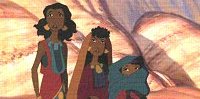
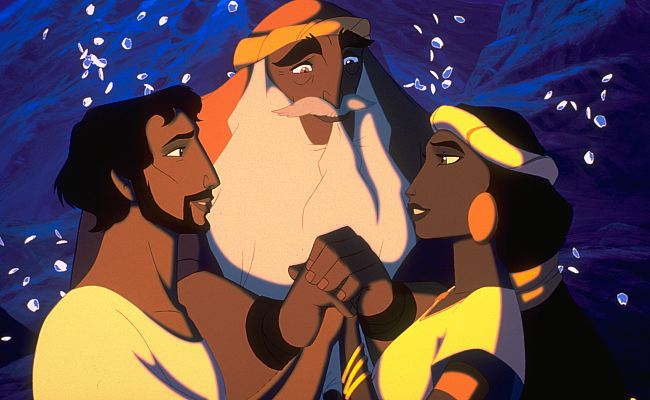
When they told their father Jethro, the high priest of Midian, about what Moses had done, he ordered them to bring Moses back to the tent so that they could hold a celebration in honour of him. That they did, and Moses was thankful for it. Jethro was grateful to him as well and as a token of his gratitude, he gave his eldest daughter, Zipporah (no, this is not a typo, that was the original spelling of her name), to Moses for his wife. Not like in the film where it is their personal decision to marry. Thus for many years, Moses lived in peace and contentment with the Midianites.
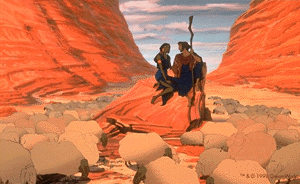
One day, Moses was out tending to his flock near Mt. Horeb when one of the sheep went astray. While going after it, Moses suddenly noticed a strange and awesome sight: a burning bush whose flames did not consume the branches. Moses then heard God's voice, ordering him to remove his sandals because he was standing on holy ground. Here, God spoke to Moses and commanded him to deliver the Hebrews from Egypt. When Moses asked God who He was, God said to Moses:
Then he promised Moses that He would be with him and informed him that he would meet Aaron on his way back. Aaron was to be Moses' mouthpiece to Pharaoh, for Moses had a speech impediment: stammering. (Though in the movie, his voice is as clear as a church bell.) Thus, Moses was filled with a new sense of inspiration and prepared for his journey to Egypt.
After he returned from his uplifting encounter with God, he informed his in-laws that he would be returning to Egypt, and Jethro wished him well. So he left, taking Zipporah and his two sons, Gershom and Eliezer, with him. In the middle of the night, Zipporah tried to kill him for some strange reason but God had sent an angel to protect him. So Zipporah and the kids returned to Midian, while Moses continued to Egypt and indeed, met Aaron along the way. Now they were ready to face Pharaoh.
So as you can see, there was a brother team in the actual event instead of a husband-and;-wife team. Still, the story lies very similarly with the film.
Moses and Aaron then approached Pharaoh and pardoned with him to free the Hebrew slaves because it was the will of God. Because Pharaoh was the most powerful man in the land and did not even know the Hebrew God, he refused and even doubled the workload of the slaves. When the Israelite foremen saw Moses and Aaron, they cried out to them in righteous anger. Moses, in turn, cried out to God, and God said in effect, ' Now you stand back and watch!'
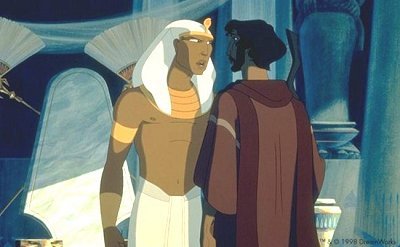
God's first sign to Pharaoh was the 'morphing' of Moses' staff into a snake. But Pharaoh refused to see the power of God and thus ordered his own magicians to do the same. They succeeded in doing so, but in the end Moses' own snake ate the magicians' snakes. Though Pharaoh regarded Moses' mission as futile, he was far from correct, as this was only the beginning.
After the staff-snake incident, God brought down a series of plagues onto Egypt, so that Pharaoh would be compelled to let the Hebrews go. The plagues greatly affected the Egyptians and brought misery throughout the land, but the Hebrews did not even feel the plagues. In the middle of the plagues, Pharaoh devised a cunning pattern in his dealing. Whenever Moses released another disaster upon Egypt, Pharaoh promised to let the Jews go. When the disaster stopped, Pharaoh went back on his promise. Yet, he did not know the sorrow that would soon befall him.
The plagues came as follows:
Frogs
Gnats
Flies
Death of Livestock
Boils
Hail
Locusts
Darkness
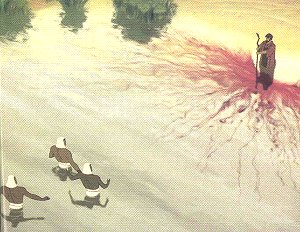
The tenth and final plague was the most terrible and devastating of all. Before it struck at night, Moses told the Hebrews that the Angel of Death would come and strike down every first-born Egyptian. In order to keep the Hebrews safe, they were instructed to take blood from fresh, slaughtered lambs and put it on the lintels and posts of their door as a sign for the Angel of Death to pass over them. That was why this was called the ' Passover.' Before that, they ate unleavened bread mixed with spices to commemorate the bitterness of their slavery, which became known as the Passover Meal. Even today, the Jews still celebrate this.
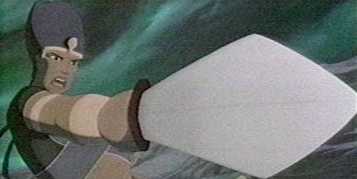
A great cry of joy sounded through the Jews as Moses told them that they were finally free. With no more fear of Pharaoh, the former slaves marched triumphantly through the gates of Egypt and out into freedom while singing songs of joy. There were about six-hundred thousand of them leaving Egypt, in addition to their families and livestock.
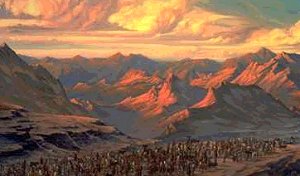
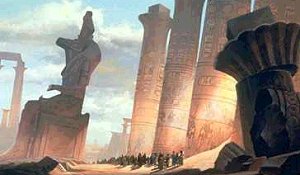
wilderness!'
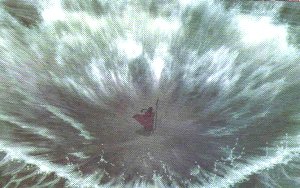
the horse and his rider are thrown into the sea.
Sing to the Lord for He is my refuge;
My God and my strength He shall always be.'
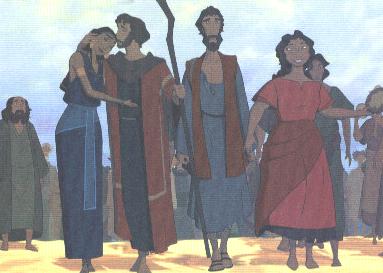
So what happened in between the huge Red Sea event and the giving of the Ten Commandments? Well, the Israelites went through a lot, and it wasn't easy for them at all. For three months before the Ten Commandments, the Israelites wandered in the desert with Moses as their guide. After some time, they grew hungry and complained like anything. They even began to compare their present life with their life back in Egypt. Finally, God fed them with manna, a frosty white bread-like kind of food (I guess it would have been similar to Frosted Flakes, only softer.) Aside from that, He sent flocks of quail as well. Moses also threw a log into some pools of water, and the water turned from bitter to fresh. To show the Jews that He was with them, God travelled with them in the form of a great cloud of fire. As they went deeper into the wilderness, they began to complain again of thirst. So God told Moses to strike a rock by Mount Horeb, and doing so the water gushed out of it.
It had been three months since they had left Egypt. From there, Moses led them to the foot of Mt. Sinai at last. The people prepared themselves to receive it and at the Lord's bidding, Moses climbed up the mountain to receive two tablets of stone on which the Ten Commandments - the laws for living a moral life - were carved. More laws were given by God as well, but the Ten Commandments were the principle ones.
2. You shall not make yourself an idol...
3. You shall not take the Lord's name in vain.
4. Remember the Sabbath Day by keeping it holy.
5. Honour your father and mother so that you may live long in the land God is giving you.
6. You shall not murder.
7. You shall not commit adultery.
8. You shall not steal.
9. You shall not give false testimony against your neighbour.
10. You shall not covet.
Meanwhile, at the foot of the mountain, the people grew impatient and arrived to a conclusion that Moses had abandoned them - and therefore, God had abandoned them as well. So they pleaded to Aaron to make them a new god. Aaron couldn't really control the angry mob, so he ordered all the women to donate their jewellery. These were melted and moulded into the shape of a golden calf. For many days and nights, the Hebrews danced around it, making sacrifices to it and worshipping it as if it were some god. They also started to live very immoral lives: perverse, dishonest, and cruel.
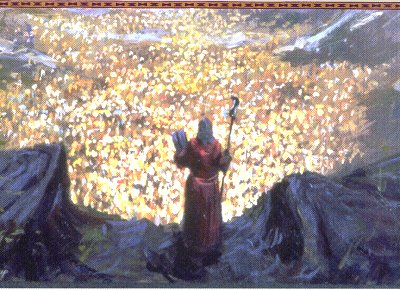
Moses then went back up to Mt. Sinai and stayed there for forty more days. He then asked God if he could see Him in all His glory. God told him that if one were to see Him, he would die, so Moses was only able to see his back instead. Then, he carved two new tablets of stone and went back down to his people. There, he stood tall, with his face shining brightly, as he had literally seen the glory of God. And the people took him with honour and respect.
After their departure from Sinai, the people built the Ark of the Covenant following Moses' instructions from God, and when it was finished, God covered it with a cloud. During the journey, the people grumbled (as the Bible puts it) and complained for the nth time on how tiring and tumultuous the journey was. They also complained about the food, saying that they had nothing but ' boring manna ' here while in Egypt, they had a variety: fish, cucumbers, watermelons, leeks, onions, and garlic. God grew so angry that he gave them contaminated quail meat, and many of them died from it.
From here, a debate arose: whether to go into Canaan and fight them anyway, in the knowledge that God would be present; or whether not to go, since the men in Canaan were invincible. The Israelites were so furious about the whole thing that they even talked about having someone that would lead them back to Egypt again!!
Moses was also in the same boat as them. You see, even though was the chosen leader by God, he was no better than the people he led. At one point, he disobeyed God as well. When the Hebrews complained of short water supply, God told him to speak to a rock. But instead of speaking to it,
Moses struck it with his staff. Though water came out, God was displeased that Moses did not do as He commanded, and told Moses that he, too, would never be able to see the Promised Land.
After realizing their sins, Moses again pleaded with God and God told him to make a serpent out of bronze so that anyone who touched it would be healed.
Next, they encountered the kingdom of the Amorites. These people sought to destroy the Hebrews, but the Hebrews won the battle and actually settled in their kingdom for a while. Then there was King Balek, the king of Moab. When he heard that the Hebrews were coming, he asked Balaam, a holy man from Midian (I'm not sure if he could have known Jethro), to put a curse on the Hebrews. But God made Balaam do otherwise, so no harm fell upon them. He filled Balaam with these words:
how good is the place where you lie--
Like long rows of palms
Like gardens by a river
Like fruit trees that God has planted
Like cedars beside the water!
What its curved horns are to a wild bull
God is to you, the nation he has brought out of Egypt
You shall eat up all your enemies
crunch their bones
And no one will dare interfere with you
A star shall come out of your nation
A comet shall arise from Israel
And do great deeds. '
And soon, Moses' time came. God called him and another man named Joshua to the tabernacle, so that he could give Moses his last instructions and appoint Joshua as Moses' successor. There, he appeared to him in a pillar of cloud and told Moses to write down His words in a book that was to be placed beside the Ark. Then, He told Joshua what his job was to be, as well as promising him that He would be there with him.
So then, Moses did exactly what God said, and placed the book in which he had written God's words beside the Ark. Then, he told the people to continue obeying God. He also blessed each of the twelve tribes and gave praise to God.
Bow down all you gods, before Him,
For the Lord will give His people justice
And have mercy on His chosen servants
He will say
There is no god but Me.'
