|
RICH'S COMMENTS
Remember those "hip" clothes you wore when you were a young teen, that
now, years later in retrospect, made you look like a complete dork??
And how you used to try to achieve some sort of "one-upmanship" over
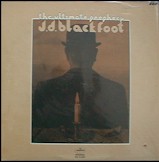
your buddies by "discovering" that great unknown or obscure LP or artist that was really cool??. I bet that J.D. Blackfoot's "Ultimate
Prophesy" was one of those "cool" LP's for alot of people back in the day. It was given FM radio play in isolated markets across the
Midwest, including heavy play in St. Louis. Unfortunately, some 30 years later, it's exposed as a shallow attempt at rural prog
rock............ Now I must admit that 15-20 years ago I thought this album was the shit, one of the best. So I may have
entered this with high expectations......maybe too high. "One Time Woman" is a mediocre mid-west bar rocker with a dumb,
tiresome chorus. The next cut "Angel" was/is still my fave on the LP. Sounds like a stoned Pure Prairie League/Ozark Mtn. Daredevils meets
Arthur Lee & Love....brilliant!! By the third and fourth cuts I began
to realize just how one dimensional the guitar playing was, not bad, just boring. "Good Day Extending Company" features more than a few of
J.D.'s patented shouts of "Ugh!!" or some such....decent use of echoed vocals and effects...one of the better cuts on the LP. "I've Never
Seen You" has a countrified/Byrdsy flavor and sounds like what I always hoped the "Spur" LP sounded
like (another over-rated St. Louis band...imo).
"The Ultimate Prophesy" begins a 5 cut "song cycle" that describes the process of birth and death as if narrated by an
American Indian with a profound olde English accent...... HUH!!!??? (plenty of hath's, doth's and thou's). Lots of time changes, acoustic
and electric dispersed pretty evenly, and I am a sucker for J.D.'s vocals when run through
various effects. But overall it's GOOFY!!!
Almost a parody of itself. I can certainly understand why I was once a fan of this LP, and
why many folks, upon first listens will dig it as well. But like those red, white and blue bellbottoms and the t-shirt with
Nixon/Agnew tap dancing across the front of it that I wore in the 7th grade, this LP just doesn't hold up in 2002. And by the time I got
through side two I swore that if I heard him yell "Ugh" just one more time I was gonna send Mr. Blackfoot some Ex-Lax.
And now I digress.....
Jack Black is one of my favorite actors. Many of you saw him as the cynical, over the top record clerk in "High Fidelity". He's also
a musician, one half of the "band" Tenacious D. While the "D" has a loyal, cult-like following, they are not much more than a novelty
act. A one joke band with the joke being overly dramatic, exaggerated satire of 70's rock. The
punch line to this joke is J.D. Blackfoot's "Ultimate Prophesy". (For a reference point go listen to
Tenacious D's "Greatest Song In The World"). If Mr. Black doesn't have a copy of "Ultimate Prophesy" in his
collection I'll buy all 300+ of you a round of black and tans. It's a shame that Jack Black has sold infinitely more CD's doing J.D.
Blackfoot's shtick than J.D. did LP's.
Overall I give it a 6 on a scale of 1-10...it's better than many major label LP's of that period, but not nearly as good as I
remembered.
STAN'S COMMENTS
The Ultimate Prophesy is a record whose reputation is built upon the
21:19 title track in a market that, in general, worships at the alter of
10 minute-plus fuzz guitar-based tracks. Listening to the first side for
the purpose of this exercise I realized that I have probably played this
side at most once or twice since first hearing the album in the late 80s.
The opener, "One Time Woman" rests on the border between forgettable and
clichéd and reminds me of concert footage from the movie "Almost Famous." Not a good start. "Angel" works better; interesting vocals and
a good melodic hook and a very welcome change of pace between the bar band tracks it's sandwiched between. I'd like to hear the raw tapes to
see what happens after the kind of abrupt fade at the end.
"Good Day Extending Company" has some decent dual hard rock guitar moments mixed with some quirky vocal interludes and pretty solid drums
and bass anchoring the whole affair. Unlike many tracks in this style, at 4:46 it doesn't outstay its welcome.
The side-closer, "I've Never Seen You" is, well, nothing to write home about.
As for the side-long opus.... Aw hell, I'm just glad I don't do this for
a living. I can't get through this dreck. I tried, I really did, but it's just that The Moody Blues-meet-The Moody Blues writing and
melodramatic delivery is SO horrible that I just couldn't wait any longer for J.D. to shout "I AM THE GOD OF HELL FIRE!!!!" Yeah, the
guitars seem to be in tune and there are fuzzy guitar solos throughout, OK; but they'd have to be accompanied by Catherine Deneuve with "yes
yes" in her eyes for me to sit through all 20+ minutes of this over-blown pretentious paisley
crapola.
So... a couple of C- tracks on side one and a title track in reserve for
the next time I get high on cough syrup and can't find the Black Oak records. And, as J.D. says: "Death, in it's finality, is life...
ahhhhhhh ahhhhhhh ahhhhhhh." Uh... OK.
On 1-10 with 10 = good... hmmm... which number corresponds to "I'm never
going to listen to this again as long as I live."? 2.
SCOTT'S COMMENTS
Here's my review of the LP (this is the first time I've listened to it in
about three years ...)
To my ears the LP's always sounded like it was recorded by two separate bands. With future Pure Prairie League/Little Feat singer/guitarist Craig
Fuller responsible for most of side one, tracks such as "One Time Woman",
"Angel" and "We Can Try" offer up attractive if unexceptional country-rock.
Think Poco and Fuller's forthcoming Pure Prairie League catalog and you're in
the right ballpark. In contrast, with namesake Blackfoot writing most of the
material on the flip side, selections such as the title track, "Death's Finale" and "Waiting To Be Born" display a darker, psychedelic bent (complete
with some great fuzz guitar). As you've probably guessed, though the lyrics
are occasionally on the clunky side ("Pink Sun"), the flip side's far more
interesting. Perhaps not the brain melting psych masterpiece dealers would
have you believe, but all-in-all not a bad addition to one's catalog.
PATRICK'S COMMENTS
"The Ultimate Prophecy" falls into the frustrating category of LPs
that sound good, or even great, during the first few plays, and then begins a slow descent in appreciation until you have no idea what you
originally saw in it. I had this experience once with the second Trees LP, "On the shore", which I initially thought was one of the
best albums I had heard, only to dismiss it as bland and unoriginal a few weeks later. And it may be no coincidence that Ohio band J D
Blackfoot's 1970 LP, despite some hopeful nods to the US west coast sound, does have a strong British undercurrent, apart from the
immodest title.
But first there is that California thing that jumps up in your lap like a cat wanting to be pet, a disguise seemingly inspired by the
song-oriented school of 1970 Grateful Dead, as well as Neil Young's early solo work; these were two beacons of inspiration for many young
white US musicians at the time. J D Blackfoot gets some of the outward aspects right, the loose "rural" sound built around a
skillful drummer and appealing guitar tapestries, and a vocal style that occasionally hits the right unpretentious harmonies. But only
occasionally. Most of the time the vocals float around in the music like a rudderless boat, trying this style, then that style, and then
another style. The listener quickly senses a lack of direction, or more precisely a lack of center.
As the LP progresses, you discover that underneath the fake Marin County country-rock something very different lurks: Jethro
Tull. And Moody Blues. And other commercially oriented UK progsters. During
side 1 of "The Ultimate Prophecy", which consists of 5 snappy songs with nice melodies and hooks, this is more of a vague presence you
can't put your finger on, but as the sidelong title track takes wings on side 2 you realize the true nature of the beast.
Now, when Moody Blues introduced the concept of spoken bits of poetry on rock records it almost worked, because they had a trained actor
read the lyrics, and they selected words that sounded archaic and potentially poetical, and their whole music was a bit of a half-serious flirt with highbrow culture anyway. When J D Blackfoot tries
the same thing, it's not exactly a success. The "rebirth"-theme poetry is vague and banal, it doesn't even sound like acid trip
product, more like what you get out of Quaaludes, a six pack of Bud, and the back cover blurb of a Frank Herbert fantasy novel.
Blackfoot's reading is worse, sounding at times like what he must have imagined a Shakespeare actor on stage sounded like, at other
times like a Midwest teenager reading out of book he doesn't understand.
The unfortunate spoken segments reappear throughout the "suite", and work as dividers between its different "movements". The music itself
isn't terribly different from side 1, some nice hooks and refrains, a bit more ambitious and a bit more hard-rocking perhaps. Apart from a
flute-less Tull I'm reminded of Black Sabbath at their most proggish and least heavy, which isn't really a good thing. There is a constant
movement forward that keeps you from losing interest altogether, and this could be entered on the plus side of Blackfoot's UK prog balance
sheet. The album ends, no intellectual insight whatsoever has been reached, but you did get to hear some nice
guitar work and a drummer who comes out the actual hero.
To single out some highpoints, I thought the "Cycles" section had a nice psychy flow for a spell, as did "Angel" over on side 1 - the
latter track is perhaps the one indication that J D Blackfoot could have made a good LP if they'd listened to the music inside themselves
rather than the one played on FM Radio. The talent undeniably on display in the melodic structures and guitar arrangements throughout
the LP is the reward the listener brings home, but they also make the album's problems the more frustrating.
JON'S COMMENTS
Side 1 might not be psych enough for the purists, but instrumentally
speaking, it has a solid West Coast vibe with some nice Southern-fried guitar riffing. The heavy yet countrified riffing makes the record perfect
for classic rock FM deejays from 1973 who need to come down after going one
toke over the line. (Since I grew up in a "classic rock" town, this is intended as a compliment, although I'm sure some of you will read this as a
dire warning.) The real Achilles heel here is the weak lead vocals. The
battles between the drums and guitar (especially on "Good Day Extending Company"), the
multi-tracked harmonies, and occasional studio knob-twirling cover up some of the vocal deficiencies, but the vocal problems still come
to the fore on cuts like "I've Never Seen You." My ideal would be to have
Side 1 of this album performed by Bull of the Woods-era 13th Floor Elevators, but generally speaking the vocals fall much shorter of this
ideal than the music.
Side 2 is a five-part song cycle with some linkage to hippie fascination
with the American Indian. It definitely beats XIT's output on the Rare Earth label, but JD Blackfoot would definitely lose a battle of the bands
to Lincoln Street Exit, although side 2 still has some tasty West Coast-style jamming and propulsive drumming. The pseudo-profound lyrics
are a mélange of imagery about sperm, wombs, pink suns, and how death is
merely "life reborn," or some nonsense like that. Ultimate Verdict: the
decent West Coast riffing can't hide that band needed a better lead vocalist/lyricist.
Score: 6 out of 10.
GEOFFREY'S COMMENTS
I love the suite on side 2 of the JD Blackfoot album because it's silly
and overblown (and clumsy) in a way that I find charming. Side one sort fits a
similar description for me, except for the overblown part being replaced by
a West Coast vibe that I find not quite as charming. I don't find the songwriting or lyrics to be particularly distinguished on this or 99% of the other stuff discussed here. There are some good hooks, but the overall
structure is quite unfocused. What I get out of my favorite obscure records s a strong personality, a unique point of view, a sense of time and place that more "produced" records usually succeed in removing. On these
levels, both sides of the JD Blackfoot succeed. If I got "The Ultimate Prophecy" as a demo, I would tell the guy to forget trying to sell his songs & go teach guitar (is he the guitar player?)
Score 2.5 out of 10.
|