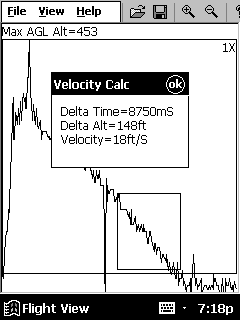
This is a screen dump of the current software
I wanted to build a more advanced altimeter than my stamp based altimeter.
These are some of the things I wanted out of my altimeter.
1) To sense pressure and acceleration.
As you can see I wanted more than an altimeter. I wanted a flight controller.
If you see anything that could be improved, please, let me know.
I started off the design with the PIC16f84. This is the brains of the outfit
and because I have yet to finish the design I hope it can do all I am asking of
it. I picked this chip because I have a programmer that will program it. Also it
is very versatile and user friendly.
I decided to go with the 24LC256 eeprom
because it was the biggest one I could find. It was a very scientific scan of
the available parts and looking for the biggest one currently available. Even
with that I only found 1 vendor with stock of the surface mount version of this
chip.
To this I added the ADS8344. This is a 16 bit analog-to-digital converter. It
has a built in multiplexer that will handle 8 inputs.
It is fast enough so I
can get the 200 sps(100 from each of the sensors) that I want. Because the ADC
has an interrupt output to tell the controller that the conversion is done it
makes programming easier.
By default for the sensors I used the MPX4115 and the ADXL150. Both of these are commonly used for rocketry electronics. Theoretically using 16bits I can resolve about half a foot with the pressure sensor. Factor in noise and I would be happy with 15 feet. The accelerometer can resolve to .001g with 16 bits. Here again adding up the noise I would be happy to get .1g.
Having the higher accuracy ADC will make the data really interesting. Especially considering that most of my rockets fly under 2000ft. With that low a ceiling the 12bit data from my other altimeter was really crunchy. Especially if it was only a 500ft flight.
On to the unique part. I found this little chip the CS8130. This chip takes a standard RS232 serial input signal and converts it to IrDA compliant infrared signals that can communicate with just about any laptop or Palm PC. As for the palm pilot, I don’t know if it uses any "standards" besides I need something with capabilities.
I will be able to interface to my camera for taking pictures using the AUX output channel and the AUX input channel. The output will tell the camera to take pictures. The input will be used as feedback to know exactly when the shutter opened and mark that altitude as having a picture. This way I can know the altitude of each picture just like on my old design.
I will modify the flight view software that I wrote for my Pocket PC so it will control the rocket and also use the IR port.
This is a screen dump of the current software |