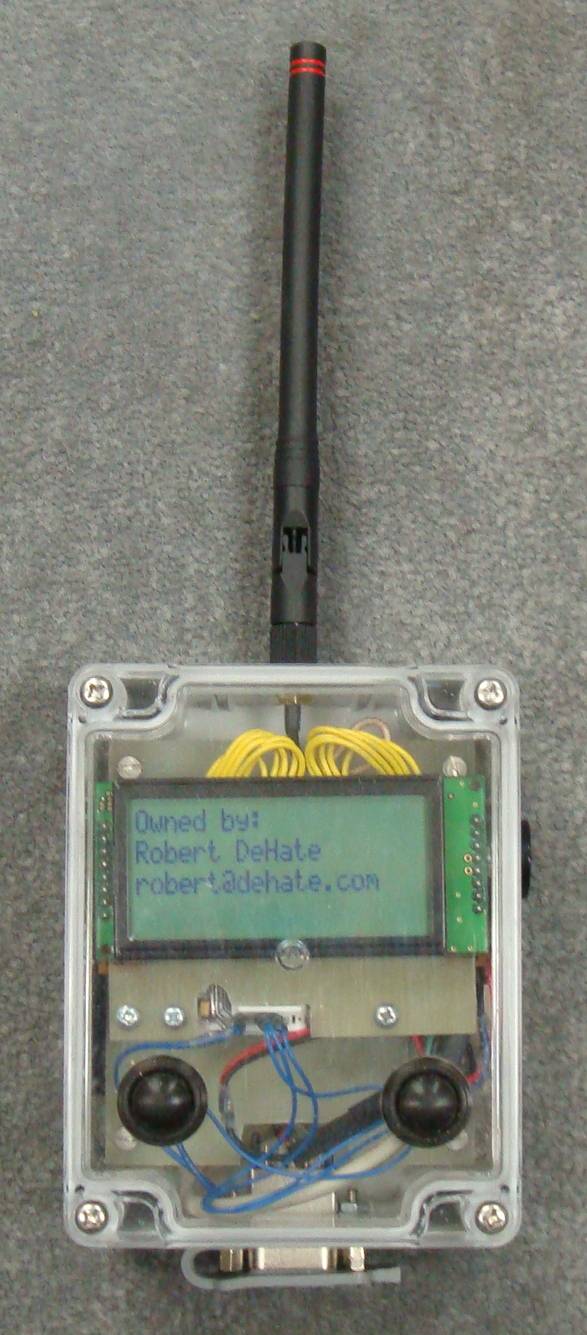
Splash screen
After using several different solutions for APRS telemetery I decided I wanted something that fit my needs better.
I decided to make my own with a few requirements.
With these goals in mind I set out building.
I started by desiging a 2in x 2in circuit board that had
a CC1000 chip from TI.
This is a tranciever chip that works in the 70cm
band.
To this I added a couple PIC microcontrollers. One 16F688 dedicated to
running the display and a 16F88 for everything else.
16Meg of flash memory
gives me plenty of storage.
An FTDI USB chip will run my USB interface and a
MAX3221 will convert 3V to RS232 levels.
With all the peripherials I was left with just two pins for input buttons.
The initial implementation receives APRS packets at 1200baud AFSK. I have plans to expand this to receive 9600baud FSK and 1200baud manchester encoded data.
Code space gets tight when you start adding the menuing system with all
it's strings.
But I wanted a stand alone system that I could use to fetch the
last few packets received.
And thats what it does.
At power on it displays the owner info in case I
misplace it.
It then automatically goes into packet receive mode.
If you
hold down the select button at power on it goes into the menu system.
Here
you can change the mode to review data or place it in digipeat mode.
You can
also change some configuration settings like the way data is displayed or output
on the serial port.
There are 3 display modes for data. The first one
displays the whole packet received which normally fits on the 20x4line
display.
The second mode is just the info field of the AX25 packet. This is
great with the packets I send since I send the raw GPS data and anything
displayed is also sent out the USB and serial ports so any software capable of
displaying GPS data works. The third I call parsed. This one displays just the
call sign and coordinates to make it easy to locate the rocket. This mode also
outputs on the serial port different data than it displays. It outputs a NMEA
formatted waypoint that can be displayed on an attached GPS unit.
All
packets received are stored in raw format so simply changing the display mode
changes the way stored packets are displayed.
I partitioned the Flash memory into banks. It's capable of recording over 8000, 256 byte packets. That's good for over 2hours at 1 packet a second.
Hardware:
I liked the box that housed my PICPAC so I decided to build it to fit inside this box.( Mouser part 563-PN1323-C)
I also picked up a
display(Mouser
part 763-0420H1Z-FL-GBW-3V), power switch(Mouser part 107-1258R), switch(Mouser
part 850-47-1111), sealed DB9(Mouser part 523-MDB-E09PA-760), sealed USB(Mouser
part 523-MUSB-A311-30), antenna(Digikey
part ANT-433-CW-HWR-RPS-ND) and cable(Mouser part
888-JF1R6-CR3-4I).
The cost for just these parts comes to $85. No wonder
commercial telemetry units are so expensive.
As it turned out I was able to fit the LCD sideways in the box. I had to make
a custom carrier board out of G10 with some perfboard glued to it.
I mounted
the Rx board on the backside of this so the wires would be easier to
control.
Below that I mounted a G10
sheet to hold the battery in place in the bottom of the box.
Splash
screen
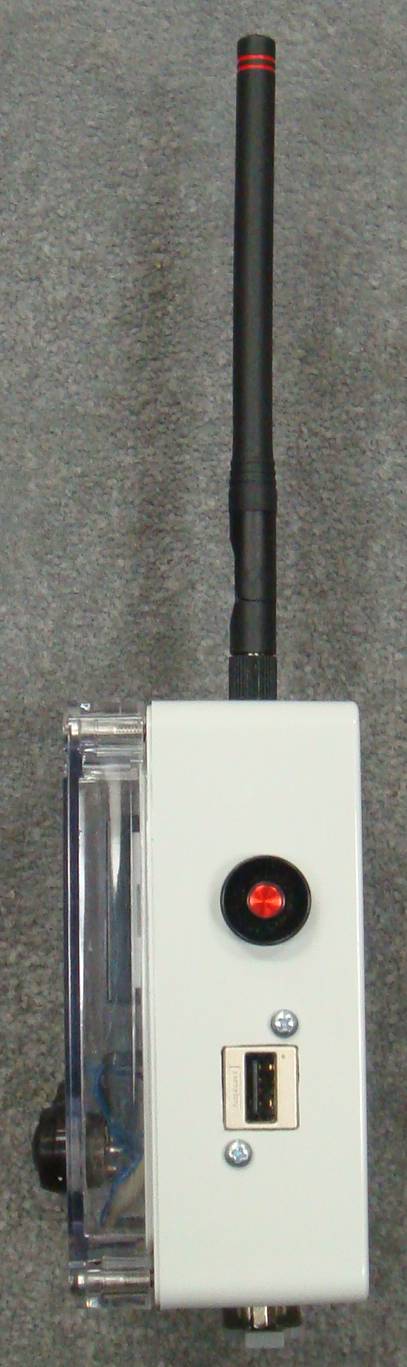
Power and USB
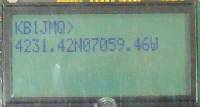
Decoded packet