| "How well did they Shoot?" |
| by |
| Bill Skillman |
 |
|
|
| Confession time: Okay, how many times have you fired your trusty Sharps at a Rebel only to have them ignore you and fire back. You most likely growled to your partner: "Guess he must be wearing one of them Kevlar drawers we been ahearing 'bout". |
| In reality, the marksmanship on both sides during the Civil War was deplorable. Although the muzzle-loading infantry rifles were accurate upwards of 500 yards, very few men consistently achieved hits at this distance when on the battlefield. |
| For the vast majority of Union soldiers basic training comprised of mastering the manual of arms, facings, and how to maneuver in company and battalion formations. It was not until 1864 that the Army of the Potomac received orders to issue to 3 rounds per man for target practice. Hardly enough ammunition to instill the most basic aiming and trigger control (with trigger pulls averaging 8-10 pounds) for a veteran soldier, let alone a raw recruit. |
| The bottom line: If you didn?t know how to shoot in civilian life you sure weren?t going to learn it in the Army. Most Union recruits did not learn this critical skill until they arrived on the firing line at the Wilderness, Spotsylvania or Cold Harbor. Hardly the place to recall how to load and fire "in 9 movements" which Army Regulations stressed. |
| However, poor marksmanship was by no means limited to the Civil War soldier. By all statistics, U.S. marksmanship has progressively declined in every war since. With the advent of large capacity magazine, selective fire rifles, and a doctrine of ?neutralizing zones? of enemy fire this century, we may have finally realized Civil War Ordnance Chief Jas. Ripley?s admonition (originally directed towards the USSS) "breechloaders will spoil" our troops. While I don?t advocate we go back to muzzle-loading smoothbores like he did, read on. |
| At the height of the Vietnam conflict Robert McNamara?s whiz kids (in DOD) calculated that U.S. forces expended upwards of 100,000 bullets (not to mention 105mm-155mm artillery shells, napalm canisters, 250-1000 pd bombs, cluster-bomb units, 2.75 inch rockets), for every VC/NVA soldier killed. I recall one comedian of the day suggest that if the Government used all the dollars spent on ordnance to bribe the NVA troops to go home and disband instead, we would win the War in a week. |
| By comparison the USMC scout-snipers and Army snipers, averaged 1.6 bullets for each NVA/VC killed-leading to 6,000 confirmed, and upwards of 3 times ast many unconfirmed kills. While U.S. military records are spotty, most reliable sources suggest no more than 3000 snipers were trained and deployed in this capacity during the 10 year conflict. |
| So what about the best marksmen the Union could muster, Berdan?s Sharp Shooters? While Wm. Fox claimed (1), " the Berdan Sharpshooters probably killed more of the enemy than any other regiments in the Union Army", their marksmanship skills did not guarantee that they piled up Rebel bodies "knee-deep" in every encounter, (as I have overheard a few overly enthusiastic, but research-shy, reenactors claim). |
| Every Berdan reenactor worth his salt recalls the qualifications to gain admission into the USSS. Here is what the Michigan Adjutant General (2) expected from his sharpshooters (June 25, 1861): |
| "No man will be accepted who cannot, when firing at a rest, at a target two hundred yards distant, the average distances not to exceed five inches from the center of the bulls-eye to the center of the ball". |
| Berdan spelled out his expectations early on (a standard from which he never wavered): "no man will be received into the Corps, who does not come fully up to my requirements: every man must be good for a 50-inch string. Such a Corps would, I consider it safe to say, be relied upon, firing from a rest, to hit a man of ordinary size: every time at � of a mile, and three out of five times at � a mile. Many of them would do as well, if not better than this off-hand." |
| Remarkably, Berdan?s qualifications match the standards established by today?s U.S. sniper doctrine. The U.S. Army trains its men to consistently hit targets out to 500 yards, while the USMC trains its snipers to consider 880 yards their maximum range for engagement, (but by no means expect their snipers to limit themselves to that distance) (6). |
| However, there is evidence that the entry qualifications of USSS candidates varied slightly from state to state, which allowed a candidate to fire 10 consecutive shots from a distance of 100 yards if the shooter fired from an offhand position. |
| However, the early trials were not always smooth sailing. In a letter to Governor Blair of Michigan, A. B. Stuart (2) complained: "As matters progress the prospect of this (raising a company of SS), is not flattering, only 3 at Detroit, 4 at Adrian, and 3 at Kalamazoo. Now the Grand Secret is in the gun and understanding the regulation sights. There are probably twenty men in this town that can make the string less than 50 inches with my rifle and instruction. I propose to fill the company within 2 weeks by a tour through the countiesof this section provided you can receive a proper compensation for the same?. I have also written to my rifle maker to know how many guns of this class he can furnish." |
| While I haven?t been able to document the weapon which was the source of Stuart?s complaint, I am inclined to believe that it was a military rifle?possibly a Springfield Model 1861 or Model 1855. This would account for the lack of familiarity among the civilian shooters with the ?regulation sight??most target rifles of the day featured globe sights. Captain Stuart was finally successful mustering his company (B-2nd Regiment) of Michigan men, whom he led until being wounded at the Battle of Antietam, and resigned thereafter. |
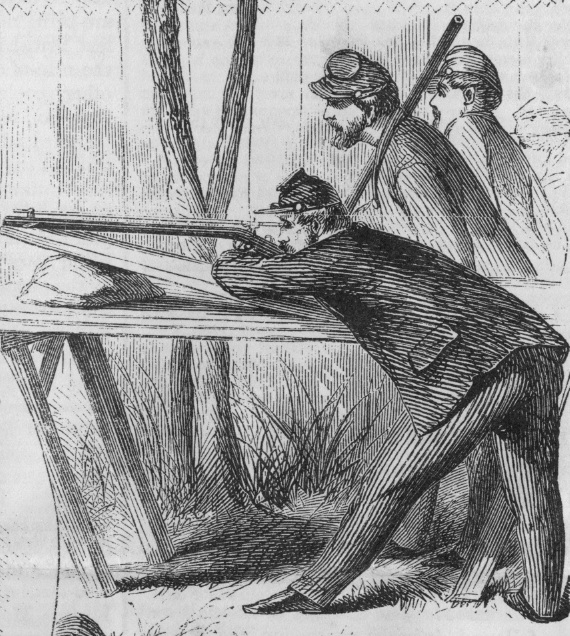
| When the U.S. Sharp Shooters companies arrived at Camp of Instruction outside Washington D.C., their Sunday shooting exhibitions drew large crowds. The following account is from a September 1861 edition of the New York Times(3): |
| "Col. Berdan had a review this afternoon of his regiment (primarily Company?s "C" and "E"-who brought target rifles with them into service) of Sharpshooters, and an exhibition of their efficiency. It was attended by the President, Secretaries Cameron and Seward, the Prince de Joinville, Gen. McClellan and staff, Gen. Mansfield and staff, and a large number of ladies and gentlemen. Something like four hundred shots were fired (or roughly 2 shots per man) at a distance of 630 yards. The target was two figures of Zouaves, the size of life. The men used thirty-five pound rifles, firing by platoon from a rifle pit, at rest, and with globe sights. The firing was nothing extraordinary, only one-forth of the shots hitting the target." |
| Nothing extraordinary?? I struggle to put 10 consecutive shots into the X at 50 yards (using a 9-power scope to boot). Whatever expectations the Times correspondent had I suspect they were not realized until possibly the Creedmore shooting competitions out on Long Island in the late 1870?s. |
| Lets see how the Sharp Shooters performed using their NM1859 Sharps? In his Report of Target Shooting of the 1st Regiment U.S. Sharp Shooters (near Falmouth, Va. January 14, 1863) Lt. Col. Trepp recorded (4): |
| "The average of the targets in all the Co.'s is: 7.10 square feet. |
| The average of (hits from center) the Regiment is: 10.51 inches |
| The targets has been missed by 347 shots" |
| Captain Wilson of Co. B-New York submitted his company's results: |
| Distance 200 yds |
| No. of Men present: 38 |
| No. of Shots Fired: 114 |
| No. struck Target: 34 (33%) |
| No. missed Target: 80 |
| Average measure of shots: 8 12/17 in. |
| "Captain Jack" reassured Trepp; " On account of the limited time for preparation, I had no means to procure a target as large as required to ascertain the average shooting, and can only say that it was with few exceptions (the men shot) remarkably good. With the assurance that in our next practice I will be better prepared and my command give a better account of themselves." |
| Company E-New Hampshire (Capt. W.G. Andrews) |
| Distance: 200yds |
| Men Present: 15 |
| Shots fired: 16 |
| Struck target: 5 (20%) |
| Avg. dist. from center: 10.4" |
| Company D-New York (Capt. Chas. McLean) |
| Distance: 200yds |
| Men Present: 7 |
| Shots fired: 42 |
| Hit target: 21 (50%) |
| Avg. dist. from center: 113/4" |
| Company G -Wisconsin (Jan 15, 1863) |
| Distance: 250yds |
| Men Present: 30 |
| Shots fired: 56 |
| Hit target: 15 (27%) |
| Avg. dist. from center: 8" |
| Captain Marble (of Wisconsin) boasted; "I have the honor to report, also that the target was only 2ft. 3in.by 1 ft. 4-1/2 in. smaller than the prescribed target, but the largest I could get at the time. The shots that missed the target nearly all went to the right but were good line shots (they would have struck a line of infantry). "Day cloudy, with very strong wind blowing from the left, which varied as we shot across a deep ravine." |
| How did our Wolverine Sharpshooters fare? |
| Co. Shots fired Shots in Target Measure of shots Avg. |
| C 70 37 (53%) 438 11 � " I 105 68 (65%) 560 8 3/16" K 73 58 (79% ) 522 9" |
| The Michigan boys had every right to feel pleased with their performances, though Vermont (F) hit their target 76/79 times-a remarkable feat! In terms of the smallest average from center, Company "I" came in second overall, behind Wisconsin Company "G", which averaged 8 inches. New York "B" came in a close third (8 7/8"). However, the size of the targets varied from 20" (Co. F), to 3-4" (Company?s B., E, & G)-which is � the diameter of the 9 to X rings of a NRA 100-yard target. The Sharp Shooters were shooting from twice the distance, truly a remarkable exhibition using open sights. |
| However, these target practice reports might actually disappoint our naïve reenactor/readers out there?our hero?s did not hit the bulls eyes every time they pulled the trigger. The less than spectacular 1863 results may be accounted for as the men were shooting off-hand. Hence the stringent indoctrination of every Sharp Shooter to fire from behind cover and using a rest whenever possible to maximize their long range hit potential. The exact same training is instilled into our modern snipers. |
| Of all the skilled marksmen in the ranks of the USSS in 1861, the one man who initially appeared to have all the qualifications for becoming the most famous ?sniper? of the Civil War was none other than Hiram Berdan |
| From June through September of 1861, the New York and Washington D.C. press raved about Berdan?s shooting exhibitions. Firing off-hand, Berdan would send bullet after bullet from a muzzle-loading Swiss rifle into targets 600 yards away "with almost mathematical precision". |
| During one exhibition Berdan entertained the crowd by placing shots in response to a joker?s challenges (3). As the fellow prepared to sneak away in defeat, Berdan humorously inquired, "Oh, where shall I shoot next?" The reporters noted that from the tip of the man-target?s nose to his breast, each point was ?expertly perforated?. Berdan had clearly demonstrated that he could hit anywhere on the target he chose. |
| However, something happened to Hiram Berdan once he arrived on the Peninsula with the Sharp Shooters. Gradually, disturbing rumors filtered up to Headquarters that Col. Berdan was taking precautions to be well away from the front if the prospect of fighting was in the air. Wiley Sword (4) suggested that Berdan was probably one of the very few officers in the Army of the Potomac perceptive enough to appreciate the dangers if a determined marksman spotted a highly prized target. |
| Ironically this concept was brought to deadly fruition when Major General John Sedgewick was struck down near Spotsylvania by a rebel sharpshooter. He also bears the distinction as uttering for his last words a classic underestimation of a sharpshooters deadly skill: "?those fellows couldn?t hit an elephant at this dist---". A Whitworth bullet whining in from 880 yards away bored a hole just under the General?s left eye. He fell without a sound and his aides who rushed to his side noticed that he still possessed a slight smile from the joke made moments before. |
| During my research I discovered the earliest encounter of Berdan personally coming under aimed rifle fire. Stevens (7) records: " Col. Berdan was ordered to visit the right and left (flanks) alternately, to make such changes in the position of the Sharpshooter outposts and supports as was thought proper. On the day previous to the opening of the Mechanicsville battle, he says he had ridden out to the right and saw the enemy apparently working on their small earthworks, throwing dirt high in the air about twice a minute, which was all they appeared to be doing, so that he suspected it was only for a ruse?Riding further along he dismounted to take another look, and as he raised his glass saw a puff of smoke from some bushes at the creek, the ball passing under his right foot, the ball passing under his right foot, producing a stinging sensation." |
| Stevens does not mention how this close call affected Hiram Berdan psychologically, but in terms of his behavior it is shortly afterward that we can begin to read about his being absent from the front. Ironically, I have never uncovered a single account where Berdan decided to use his outstanding marksman skills to turn the tables on the rebel soldier who fired at him, or others. |
| In his comprehensive book, Inside theCross-Hairs, Snipers in Vietnam; Lanning (6) reported that Hiram Berdan would not be the first or last marksman who ?choked? when making the transition from shooting targets to shooting to kill a human being. Captain Jim Land (USMC) who established the first sniper school in Hawaii in 1960, and subsequently established the 1st Marine Division?s sniping school in Vietnam summed up the differences this way: "When you look through a scope the first thing you see is the eyes. There is a lot of difference between shooting at a shadow, at an outline and shooting at a pair of eyes. It is amazing to put that scope on somebody and the first thing that pops out at you is their eyes. Many men can?t do it (pull the trigger) at that point". |
| However, there were many officers in the USSS who did not hesitate to take a killing shot if the opportunity presented itself. Lt. Col. William Ripley, Berdan's second in command, was one of these leaders. During the early fighting before Yorktown, Ripley observed a long distance duel develop between USSS Private John Ide and a rebel hidden behind a fallen tree. Ide had fired a few shots with no success, and was in the process of drawing bead again when he was struck in the head and instantly killed. Ripley coolly walked out to the dead man?s post (with bullets kicking the dust around him), picked up the rifle and after a quick adjustment to the scope, he fired and silenced the rebel (7). Another, even more remarkable marksman was Chaplain Lorenzo Barber, the ?Fighting Parson? of the 2nd USSS. Barber had no qualms toting his rifle out to the line with the boys, and he was noted for spicing up his sermons by interjecting tips to his listeners on how to improve their marksmanship-truly a ?Christian Soldier?. One of Barber?s last acts on the skirmish line (at Mine Run) was to help fix the distance to some rebel earthworks. He sighted down the scope of his personal target rifle and shot at pig that was rooting near the works. The squeals and the stadia lines (etched in his scope lens) confirmed that the distance was over 600 yards away. The Sharp Shooters rapidly made adjustments to the ladder sights on their Sharps rifles and opened fire, silencing the distant battery and riflemen (4). |
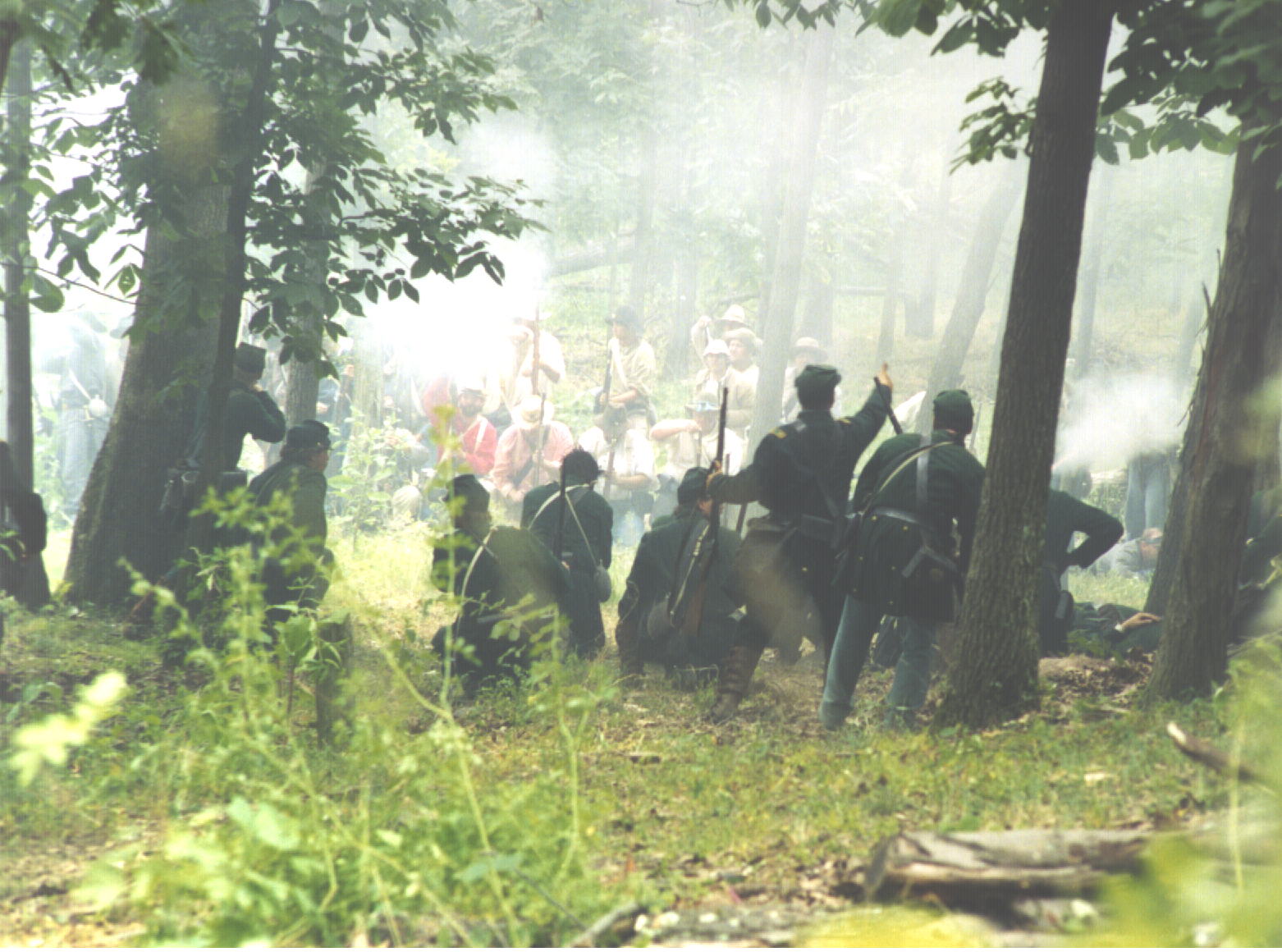
| Certainly the noise, smoke, whirring bullets, and exploding shells (not to mention the sound of bullets striking flesh and bone) conspire to distract all but the coolest of marksmen. Carlos Hathcock, the famous Marine sniper, used a mental process he termed his "bubble", which let him ignore physical discomfort and extraneous distractions while preparing to deliver a critical, well-aimed shot (6). Certainly Ripley and many men of the USSS also possessed a similar skill. |
| NSSA skirmisher, Tony Beck (8), came face to face with how he might react in an actual battle in a truly unique, but non-lethal experiment. Tony and his fellow skirmishers were invited to participate at a NSSA event in Utah called "Hold the Fort". The skirmishers were stationed behind a stockade and instructed to fire at suspended clay targets set up at the edge of some woods about 100 yards away. Sounds pretty easy, hunh? But hidden within the woods were three automated tennis cannons. Once the skirmishers got the signal to open fire, the cannon began chuffing volleys of green tennis balls back at them. Tony admitted that the sight and sound of green tennis balls whizzing past (and occasionally ?thonking?), the heads of his usually unflappable comrades completely unnerved them all. Needless to say, when the smoke cleared there was a lot more targets left hanging than there would have been following a typical NSSA "skirmish". There was also a wiser and humbler band of shooters. |
| Conclusion (so far): While the U.S. Sharp Shooters are regarded as one of the hardest fighting and straightest shooting regiments of the Civil War, it is critical for us to realize and appreciate the challenges they faced on the target range and battlefield. In reality, the Sharp Shooters probably missed more men than they hit. But they also struck down more of the enemy per man than any other regiments in the Union Army. They likely shot killed and wounded more Confederates than they suffered in return, despite their long exposure on both the picket and skirmish lines over the course of three years. Compared to our modern snipers who can radio for anything from infantry support, artillery salvos, to a B-52 strike; the original USSS relied upon their training, officers and fellow marksmen, plus their own skills with a rifle, to survive. |
| The past couple years Bob, Glen and Terry have invited Co. B. members to their shooting club outside Albion, Michigan. Those who attend are invited to ?make the string? for themselves, just like their forebears who participated at similar trials 140 years earlier and a short distance from the modern range. Ever since I began sending things more substantial down the barrel of my Sharps than burning powder and tissue paper, I have gained a much greater appreciation for the shooting skills of the original Sharp Shooters. At reenactments these days I am inclined to admit to my pard: "Dadgumit, I missed. Guess I held that Reb a trifle high, but he won?t be so lucky next time" |
| I welcome your thoughts and comments ~ Bill |
|
|
| Sources: |
| 1. Fox, W. Regimental Losses in the Civil War 1861-1865. |
| 2. Robertson, J.-Letter. In Michigan Company "C" 1st USSS |
| Stuart, A.B.-Letter. In Michigan Company "B" 2nd USSS collections, Michigan Archives, Lansing, Michigan. |
| 3. Marcot, R. Hiram Berdan, Civil War Chief of Sharpshooters. |
| 4. Sword, W. Hiram Berdan, his Famous Sharpshooters, and their Sharps Rifles. |
| 5. Trepp, Caspar: Collected Papers, 1861-1863. |
| New York State Archives. Albany, N.Y. |
| 6. Lanning, M. Inside theCross-Hairs, Snipers in Vietnam. |
| 7. Stevens, C. A. Berdans U.S. Sharpshooters in the Army of Potomac. |
| 8. Beck, T. Shooting accuracy of troops during the War for Southern Independence. (Website) |
|
|
 |
 |
 |
 |
|
 |
 |
 |
 |