 |
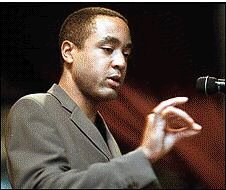
| John McWhorter |
|
| John McWhorter |
| From Barnes & Noble (bn.com): From Our Editors Berkeley linguistics professor John McWhorter takes the controversial stance that, though racial prejudice still exists, African Americans have adopted a self-defeating tendency to overstate its pervasiveness and influence and to enshround themselves in victimhood. Berkeley linguistic professor John H. McWhorter believes that African Americans are damaging themselves when they embrace images of victimhood. In this vigorously argued book, he asserts that black separatism and anti-intellectualism robs African Americans of their ability to succeed in our multiracial society. Losing the Race has won plaudits from conservatives and some of McWhorter's fellow African-American scholars. From the Publisher Is school a "white" thing? If not, then why do African-American students from comfortable middle-class backgrounds perform so badly in the classroom? What is it that prevents so many black college students in the humanities and social sciences from studying anything other than black subjects? Why do young black people, born decades after the heyday of the Civil Rights movement, see victimhood as the defining element of their existence? In this explosive book, Berkeley linguistics professor John McWhorter reports from the trenches of today's college classroom to offer a daring assessment of what's plaguing the children of yesterday's affirmative-action babies. The Civil Rights revolution was the pinnacle of American history, freeing African Americans from centuries of disenfranchisement. Yet, as McWhorter shows, it has had a tragic side effect. As racism recedes as a serious obstacle to black advancement, most black American leaders and thinkers have been misled into a self-destructive ideological detour. Victimhood is exaggerated and enshrined more than constructively addressed. Following from this, young black people are shepherded into a separatist conception of "blackness" defined largely as that which is not "white." This in turn conditions a sense, embedded in black American culture as a whole, that academic achievement is a "white" realm that the "authentic" black person dwells in only for financial gain or to chronicle black victimhood and victories. McWhorter addresses these problems head-on, drawing on history, statistics, and his own life experiences. He shows that affirmative action in university admissions, indispensable 30 years ago, is today an obsolete policy that encourages the counterproductive ideologies of what he calls Separatism, Victimology, and Anti-intellectualism. Most perniciously, it prevents black students from demonstrating the abilities our Civil Rights leaders gave them the opportunity to nurture, and it deprives them of the incentive to strive for the very top. Racism is not dead--but as McWhorter so persuasively argues, dealing it a death blow will require a reinvestment in the strength that allowed black Americans to triumph and survive this far. His pathbreaking book is certain to shock, inspire, and ignite debate among all those who care about race and education today. From the Critics From Library Journal McWhorter (linguistics, Berkeley; The Word on the Street, LJ 9/15/98) argues forcefully that African Americans have mired themselves in self-defeating thinking, speaking, and acting. They have adopted an orthodoxy that casts them as victims of a vastly exaggerated racism and that calls for them to follow ruinously what he describes as the self-indulgent cults of Separatism and Anti-intellectualism. Instead, the author suggests, blacks should achieve true equality through the old work ethic and open, individual competition. Affirmative action, he says, was a necessary emergency measure whose time has passed. Preaching self-reliance, he seeks a candid, fresh discourse in which African Americans confront reality and recognize obstacles to progress that they themselves have created. Contrarian, provocative, and worth a serious read, this stands in a long line of books decrying the state of blacks and of race relations, including Stephen L. Carter's Reflections of an Affirmative Action Baby (LJ 9/15/91), Cornel West's Race Matters (LJ 3/15/93), Tom Wicker's Tragic Failure: Racial Integration in America (LJ 5/1/96), and Earl Ofari Hutchinson's The Assassination of the Black Male Image (LJ 10/1/96). For African American, race relations, or contemporary U.S social science collections.--Thomas J. Davis, Arizona State Univ., Tempe Copyright 2000 Cahners Business Information. From Publisher's Weekly - Publishers Weekly Are African-Americans using past racial injustices as an excuse for not working to take advantage of contemporary opportunities? McWhorter, a linguistics professor at the University of California, Berkeley, thinks he has the answers to this question and others--and he points the finger directly at the black community. Starting with the premise that white racism is no longer the threat it once was, McWhorter singles out "the cult of victimology" and the glorification of white racism as a major cause for several social crises afflicting African-Americans. Offering little that has not been said previously by conservatives like Pat Buchanan and Shelby Steele, McWhorter uses a cookie-cutter approach to explain away recent race pressure points such as the arson directed against black churches, the high proportion of black inmates in America's prisons, the practice of racial profiling and police brutality. In each case, he finds fault with the African-American community's interpretation of these situations, accusing African-Americans of hypersensitivity to racial bias and a reluctance to relinquish the past. Victimology, as well as separatism, in his words, "gives failure, lack of effort and criminality a tacit stamp of approval." Most disturbing, his suggestion that a cultural trait drives the low scholastic performance of black youth borders on the views of those who consider heredity the cause of blacks' poor performance on standardized tests. Like many of the new black conservatives, McWhorter spends much time going after liberal columnists and social critics, attacking both their intent and message. Even his closing segment--"How Can We Save the African-American Race?"--sounds more like a well-worn campaign speech than a call to initiate a dialogue on race in the African-American community and the nation. (Aug.) Copyright 2000 Cahners Business Information.| |
| Moderator: Professor Robert J. Parelius Sociology Dept., Rutgers University |
| March 28, 2002 8:00 p.m. Busch Campus Center MPR |