 |
|
|
000819 Saturday the commandments: part 3... |
|
|
This week I've set four new classes flying as my work resumed, helped one son to prepare for his departure for the dorms and his first year in college, listened to another son's tales from his scuba expedition to Mexico, seen scuba boy and his younger brother off for the first day of school on Wednesday, and battled a noxious summer flu, but not one of those intervening activities is a sufficient reason, singly or in combination, to justify my having put off completing my summary of the controversy in our town over the ten commandments monument. The events themselves wrap up fairly neatly. As I've already suggested, even neighbors (and the commissioners) who were sympathetic to the plaintiffs' cause were a little uncomfortable about paying the legal expenses incurred by Americans United for Separation of Church and State. Wasn't it enough, they asked, that the commission was likely to move the monument from the city's property and to provide a binding agreement not to return the monument or a similar monument to city property? We don't have to use up valuable political capital over something so ignoble as money, do we? Although the amount AU asked for their expenses was no small sum, the fee that they asked for was regarded as usual and customary by several local attorneys that I consulted. AU's request amounted to less than the average price of a new sub-compact car, and probably less than the cost of the new furnishings in the city manager's remodeled office. However, no matter how great or small the request, the opposition regarded any payment as onerous. Sympathetic city commissioners put out feelers to ascertain the plaintiffs' resolve in the matter of the expenses even as they entertained an offer from an organization funded by the radical religious right to defend the city in the suit at no expense to the city. This offer was a great public relations boon to the opposition. If they were going to lose the suit, or if (as seemed likely) the commission was going to vote to settle the matter in the plaintiffs' favor, at least the opposition could make the plaintiffs look bad over the money issue. Although this group had offered to foot the bill for the defense of the suit, the opposition made little mention of the fact that their white knight would not, of course, be liable for any damages that the court might assess against the city. However, the commissioners were aware that the city would remain liable for damages, so they declined (by a majority vote, though not a unanimous vote) to accept outside legal help. And the plaintiffs stood firm in their belief that American's United deserved to be paid by the city. The minutes of our city commission meetings are normally bloodless things, and the minutes of the special city commission meeting at which the commissioners voted to remove the monument are not exceptional in that respect. The mayor allowed plenty of time for public comment, in contrast to the previous mayor, who had been much chastised for limiting comment when the city commission first addressed the issue and voted merely to reposition the monument at the same site. In his minutes, the city clerk records that this citizen spoke in favor of retaining the monument in place and that citizen spoke in favor of removing the monument. The minutes do not tally the pros and cons, but a quick glance will reveal that many more citizens spoke in favor of retaining the monument in place. In the U.S., that outcome does not surprise. Michael Kinsley commented once (I'm paraphrasing) that in America it's still far easier and wiser to stand up in the marketplace and proclaim that Jesus is Lord, than it is to proclaim that God is dead. The trouble is, this wasn't a marketplace. It was a hearing occurring in a government building, before a legitimate governmental body, with the flags of the United States and the state of Kansas flanking the dais -- we were clearly here to render unto Caesar. Yet the minutes do not record that nearly every citizen commenting before the commissioners that evening made a declaration of faith or at least identified a religious credential or a church affiliation before rendering an opinion. City commissioners sat attentively but comparatively impassively as speakers approached the microphone, stated their name and address, proclaimed a faith (or very rarely, an absence of it) and stated their position. Some city staff members, looking on from the dais, were less reserved in their body language, smiling and nodding at those who wished to retain the monument, but averting or hooding their eyes while trying to remain impassive when the speakers expressed a counter opinion. Speakers expressed themselves in two different styles of narrative at the microphone: a biblical, sometimes evangelical narrative, and a constitutional, sometimes quasi-legal one. Yet not all who spoke against removal were fundamentalist and some who spoke for removal were clergy. It would be convenient for the sake of this brief account to draw the line in this issue between fundamentalist and atheist, but the division would be inaccurate. In matters of the religious impulse as in matters of the first amendment, divisions of that sort are rarely as unambiguous as we might wish them to be. The commissioners, however, had to make an unambiguous choice. They voted 3-2 to remove the monument, and return it to the donor organization, whose spokesperson had requested its return in the event of a vote to remove it from city property. Interim Epilogue... City workers promptly removed the monument and returned it to the Eagles. A private ad hoc committee arose to locate and fund a new site for the monument, settling quickly on a site on the Manhattan Christian College campus. When ground was broken at the site, sponsors invited only those commissioners who had voted to maintain the monument in place, I'm told. As I've mentioned in an earlier entry, construction continues on a far grander setting than the monument enjoyed previously, and the monument itself remains in storage elsewhere until construction is complete. Within about six months of the removal of the monument, the city and Americans United settled the money matters. The opposition succeeded in gathering enough signatures on a recall petition against one of the commissioners who voted to remove the monument. The recall election, however, failed. Perhaps because the commissioner defeated the recall effort so soundly, the recall committee declined to proceed with recalls against the other two commissioners allied with her in this issue. In December 1999, the city manager accepted other employment in town, and the city commissioners accepted his resignation.
Rationales and justifications do not wrap themselves up so neatly for me. They are tougher to formulate and express than mere recollections of events. If I must look into the nuances of a constitutional amendment, the first one is a good one to choose, but I think I'll record my thoughts on it outside the format of the journal. |
|
"Religion is a subject on which I have ever been most scrupulously reserved. I have considered it as a matter between every man and his Maker in which no other, and far less the public, had a right to intermeddle." "Said Waldershare, 'Sensible men are all of the same religion.' | |
|
|
PREVIOUS |
ARCHIVES |
NEXT |
Best viewed at 800x600 in MSIE4+ |
|
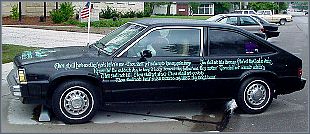 Resentment persists. In late July, a black Chevy Citation appeared in a parking spot in front of city hall. The ten commandments appear in the green lettering around the car. As far as I know, as long as the vehicle moves from the parking area every few days to avoid violating ordinances against long-term, on-street storage, it remains perfectly legal.