 |
|
| � |
000125 Tuesday sunt lacrimae rerum et mentem mortalia tangunt... |
|
In small towns, folks read the police and court news before they read the comics, or the grocery store inserts, or the names of the folks who have written letters to the editor (you don't need to read the actual letters, just the names of the writers, because you already know what the writers think). All of this information is, of course, essential to participation in civil conversation in a small town. Go to most small town newspapers, turn to page two, and there you'll find a listing of the arrests -- for dui, minor in possession of alcohol, bad checks, theft, terroristic threat, gambling, and even rape or murder. Domestic batteries show up there too, more and more often with each party filing charges against the other. On the same page, you'll usually find the births and deaths, and the applications for marriage licenses, a full life's span of legal detritus above and below the fold on a good day. In towns smaller than ours, bowling scores appear side-by-side with these bits of news. In towns larger than ours, the papers might report the bankruptcies on this page too. Court news. Police news. We locals pore over these lists, checking our neighbors and our neighborhoods for scandal, sometimes finding news of our neighbors or their spawn, or of our acquaintances, students, co-workers, fellow churchgoers.
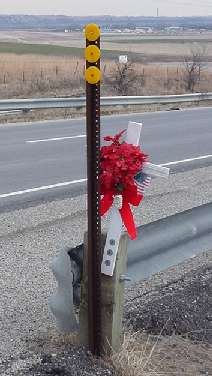
The small town papers list vehicle accidents with injury reports, and the occasional fatality. In the case of fatalities, if the name isn't familiar, we usually just utter a low hmm and note the ages of the victims, calculating our own mortality before we move on to perform the same calculus on the nearby obituaries. We might also note whether the accident victim left survivors -- parents, grandparents, spouses or children. We might ask others in the room whether or not the name might be familiar to them. But if we can make no connections to the deceased, then the name of the newly dead fades from our memories, and we move on. The location of the accident might stick in our local consciousness longer than the name of the deceased does. McDowell Creek Road, for instance, a two-lane country road that winds along the Kansas River and through our low hills, once had a reputation for having a few dangerous twists, because every few years the road would claim the life of another drunk or daredevil. Then, a few years back, parts of McDowell Creek Road slumped into the flooded Kansas River, so the highway department straightened the road when they repaired the damage. I don't think that road has taken any lives since then. The bypass that runs from K-18 to I-70 has claimed a few lives too, but I knew none of the victims. Someone knew them though, placing at this scene a small marker, a white cross festooned with red Christmas decorations from a crafts store. And neither the highway patrol, who park just yards away to monitor speeding, nor any highway workers have removed it, even though a little prying with a tire tool would loose it from the stanchion. I pass this marker almost every day on the way to or from work. It bears no name, but someone visits the marker a few times a year to touch up the paint and to update the decorations. It was still in its Christmas finery yesterday when I photographed it. When will he/she/they visit next? Valentine's? St. Patrick's Day? Easter? Never? I doubt only the last choice. Presumably there is a grave and a headstone somewhere closer to home, where the photographs, flags and (on Memorial Day) the peonies that adorn the headstone can be tended regularly. But someone has chosen to commemorate the accident site as well. The scene might have offered the victim only a flash of terror before the final darkness and the end. Would the victim's survivors erect this little memorial merely to warn others of the danger there? Or would they do it to remind others of the loss suffered both by the victim and themselves in a hellish moment? Have I overlooked a reason? Here's my surmise, a slender fiction fraught with my own heavy biases. The marker was not placed by a friend or a sibling, or even by a lover or a spouse. A spouse or lover, though still grieving, might have wearied of the gesture, a little guiltily, of course, but they might have reckoned (correctly, probably) that the loved one, forever both alive and entombed in memory, was just as revered, cherished, honored without the gesture of the marker. Spouses, lovers, siblings, friends -- all would have allowed their emotional lives to move forward. The marker was placed by a parent. Some parents live under an increased burden of mortality, their own and that of their child. When the natural course that allows the parent to die before the child is disrupted by, say, the stanchion of a highway guardrail, the parent's role as protector persists, but is transformed into a fond wish to deny the fact that the child died alone and in pain. I'm not sure I've put that well. The parent wants to have suffered the blow in the child's stead, an impulse that after the child's death surpasses mere love or loyalty, and that minimizes genetic altruism as well. The marker becomes the ultimate embrace to stave off the thing that goes bump in the night, and at the same time becomes an attempt to transfer the child's pain and final loneliness to the parent, an attempt to save the child from whatever emptiness might not only lie ahead, but exists here. Although everything the parent attempts in these actions is impossible, the parent will persist anyway. We blush, we laugh, we grasp with thumbs, we mate for fun. And we grieve for long periods. Small town newspapers, big metropolitan presses -- they don't report this on page two. |
|
|
PREVIOUS |
ARCHIVES |
NEXT |
Best viewed at 800x600 in MSIE4+ |
|
 Newspapers in larger towns report these items too, I suppose, but I suspect that these lesser items are overshadowed by other front page events and by the advertising inserts from all the big box stores on the new strip on the west side of town. And, of course, by the fact that many metropolitan readers would be less likely to know or to have heard of the arrestees. That lack of familiarity might understandably reduce the urban reader's curiousity about these relatively trivial matters, matters that cannot become fodder for gossip since the parties are strangers, living anonymous lives in unfamiliar parts of the city.