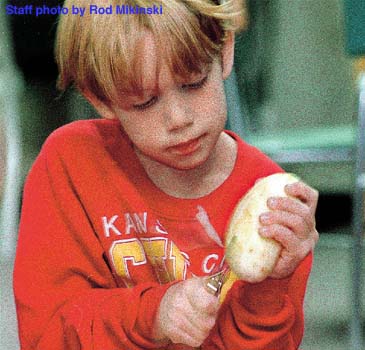
Second grader Erik Ebert peels a potato for Bluemont's
Thanksgiving dinner.
Staff Writer
Call it a potato-peel rug.
That wasn't the ultimate goal - more an accident of creativity - but that's what second- and third-graders at Bluemont Elementary School manufactured this morning. A mound of brownish-grey, white-underneath peels surrounding a cauldron on top of a sheet of bright-orange butcher paper.
Teacher Connie Schwandt tried to control the chaos.
"If you sit down, the potato peels won't flick so far," she called out to one student.
"We don't want the peels in the pot because that's where we're going to cook," she reminded another.
Welcome to Thanksgiving dinner at Bluemont.
For the second- and third-grade students in Schwandt and Dorothy Pesaresi's classes, this 11-year tradition is an exercise in cooking, mathematics, reading, social studies, and manners.
For Schwandt and Pesaresi, it's a lesson in patience.
On Monday and Tuesday they supervised about 35 kids as the students prepared and baked 14 loaves of pumpkin bread, churned their own butter for the mashed potatoes, peeled potatoes and carrots, sliced celery, compiled a fruit salad of apples and oranges and bananas and even wove their own construction-paper placemats.
A parent cooked a turkey for the class and the school kitchen provided an oven for baking and a stove to boil the potatoes. And today at noon, after each child had named one thing he or she was thankful for, dinner was served.
"It's something special for them," Schwandt said. "It's something they'll remember."
And it's educational, too.
Throughout the month, Schwandt and Pesaresi have taught their students about the traditions behind the annual meal, from the history of American Indians to the arrival of the Pilgrims. Each student in Schwandt's class even took on an Indian name through a mock naming ceremony. (For example, third grader Benjamin Stark-Sachs was named "climbing squirrel")
The students also read books about traditions and discussed how traditions can vary from family to family.
With the cooking and dinner preparations, students have learned about measuring, and because each student brought food for the meal (a bag of potatoes, raisins for the bread, a cluster of bananas) they've exercised sharing as well.
"It just about touches on every part of the curriculum, Schwandt said.
And the students were eager. When Pesaresi asked who wanted to peel a banana for the fruit salad, her entire class exhaled a collective, excited "ooohhh" and raised their hands.
(Although a few minutes later when she asked for help cleaning up the potato peels that had traveled off the "rug", the response was less enthusiastic. "Nah, I'm not going to clean up, said second-grader Zoya Brink, crinkling her nose. "Nasty.")
"Climbing Squirrel" (aka Stark-Sachs) said the activity made him feel a bit like a slave. But, he insisted, in a good way.
"It feels like you're a cabin boy on a ship, working for the cook," he said of his potato-peeling experience.
Schwandt said she's introduced a lot of students to foods they've never had before - such as turkey - through the Thanksgiving feast exercise. And she said she believes there are students who go home and help with their family's meals because of what they learn about cooking at school.
So, standing in the center of her classroom, watching the potato-peel rug scatter slowly under desks and having just bandaged up a third-grade finger nicked by a potato peeler, Schwandt said the activity is well worth it.
"By the time the day is over, we'll say, 'why do we do this?'" she said. "But by tomorrow, we'll be making plans for next year."
You can reach Jennifer Detweiler by phone at 776-2300, ext. 248, or by e-mail at [email protected]