Hours of Service Regulations: Provincial / Federal
Each Province has it's own legislation as it pertains to the maintenance of a Daily Log. In Nova Scotia the driver of a commercial motor vehicle (Registered GVW in excess of 4500 kg) is required to maintain a daily log. This log will show the driver's time in each of 4 status codes:
 (a)On Duty Driving
(b)On Duty Not Driving
(c)Off Duty
(d)Sleeper berth
The driver is limited to a set number of hours that he can drive before taking a rest break, the maximum number of hours he can be on-duty in a day or a week, etc...
The Driver's Daily Log must be maintained accurately up to an including the lat 'change of duty status'. Failure to maintain a Daily Log as required will result in a Summary Offence Ticket being issued and may result in the driver being declared "Out of Service" until sufficient time has passed to allow him to obtain the sleep required to 'make him legal to drive'.
If the driver has crossed Provincial Boundries, ie: the ferry's from NFLD to North Sydney, PEI to Pictou, or St. John to Digby, or crossed international boundries, ie: the ferry's from Portland and Bar Harbour, Me., USA, to Yarmouth, then the Federal "Motor Vehicle Transport Act of Canada" applies and the driver is subject to the rules as laid out in this Act. This Act requires that the vehicle has a minimum Registered GVW of 18,000 kg.
Hours of Service Regulations - Provincial:
17 No carrier shall operate or permit a driver to drive a commercial vehicle and no driver shall have a commercial vehicle unless the driver has in his possession,
(a) copies of his daily logs for the preceding seven consecutive days; or
(b) if operating in compliance with clause (e) of subsection (1) of Section 4, copies of the driver's daily logs for the previous fourteen consecutive days; and
(c) the driver's current daily log completed to the time for which the last change in duty status occurred.
The Nova Scotia Act:
 Provincial Hours of Service Regulation
The Federal Act & Regulation:
Motor Vehicle Transport Act of Canada
Federal Hours of Service Regulation

Transportation of Dangerous Goods:
Transport Canada - CANUTEC

Return to Table of Contents


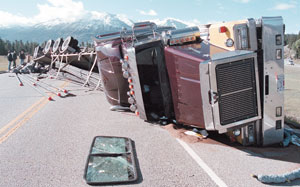
 key areas - not the least of which is size and weight. Most commercial vehicles are also "articulated vehicles". This means that they have at least one "pivot" point, such as a "fifth wheel" trailer connection or similar attachment. These articulation points mean that the vehicle behaves differently than a straight frame vehicle. For instance - I am sure at some time you have been in a town or city behind a large truck and seen the sign that says "This vehicle makes wide turns" - this is because at low speeds the trailer will always track "inside" the cab. This makes sense to most of us, as the trailer wheel base is longer than the cab, etc.... Would it suprise you to know that once that same vehicle reaches about 40 - 50 kph, that same trailer actually tracks "outside" the cab? Meaning that it actually makes a wider corner than the cab that is pulling it. This can have serious implications for a driver who does not take that into consideration. What if he is on an on-ramp to a highway, gaining speed & there is a curb that he feels he can easily clear - but his trailer clips it.... The results can range from the driver not even knowing he hit it, to losing control and a tragic rollover accident.