Western Shore Traffic Services
"H" Division
Lines and Rider


Vehicle Maintenance, Modification
and Rules of the Road

Maintaining a motor vehicle is an on-going responsibility that requires constant attention in order to ensure that your vehicle is in peak condition. In addition to this, there are a large number of accessories and after market products that are available to be added to vehicles. BEWARE: just because stores sell these products - they are not necessarily legal for all applications. Check the fine print on the package, and check Provincial and Federal Legislation. If you are still not certain, you should also consider checking with your local police - ensure you clearly explain what you are considering modifying.

narrowstripe

Advice By Category:

Annual Motor Vehicle Inspections
Auxialliary Lamps
Brakes - Automobile & Trailer
Bumpers
Emission Controls
Graduated Licensing System
Head Lamps and Lamp Covers
License Plates & Decorations
Lights and Reflectors
Lights Under Vehicles
Off Highway Vehicles
Tires and Mud Flaps
Radar Detectors
Seatbelts
Skateboards & Rollerblades
Tinted Glass

narrowstripe

Annual Motor Vehicle Inspection:

In Nova Scotia all motor vehicles must be inspected annually - this includes all private and commercial motor vehicles. These inspections are carried out at most local garages. Once the inspection is completed the mechanic will affix a sticker to the left side of the windshield - either a validation sticker for a period of one (1) year or a 'rejection' sticker. If a vehicle is rejected the owner has 10 days to make the necessary repairs to bring it into compliance with legislation.

The Motor Vehicle Inspection Regulation is a regulation which falls under Section 200(3) of the Motor Vehicle Act of Nova Scotia, and (in part) says the following:

Section 17 (1) Subject to this Section and to Section 20, where the Minister has ordered a vehicle or class or classes of vehicles to be inspected at official testing stations, it shall be an offence for any person to operate such a vehicle after the expiry date stated by the Minister in his Order unless the vehicle displays a valid inspection sticker.

(2) Notwithstanding subsection (1), the Registrar or a person designated by the Registrar may in writing extend the period for an inspection.

18 Every owner and operator of a vehicle shall have the necessary repairs made to such vehicle to bring it into conformity with the requirements of the Act and regulations.

19 (1) When a vehicle has been inspected at an official testing station and has been rejected, the necessary repairs must be made to the vehicle and the vehicle returned to an official testing station within ten days from the date on which the vehicle was rejected.

(2) Notwithstanding subsection (1), where a vehicle has been rejected the owner or operator may apply to the Registrar to have the date of the rejection sticker extended and the Registrar in his discretion may extend the date.

20 (1) (a) No person shall sell any vehicle unless that vehicle has been inspected and approved by an official testing station while in the registered owner's possession.


Top

narrowstripe

Tinted Glass:

Section 3(2) of The Standards of Vehicle Equipment Regulations (which is Nova Scotia Regulation 165/97) says the following:

"no person shall operate on a highway a motor vehicle, the windshield or window to the direct right or left of the driver's seat of which has been sprayed, coated or covered with any substance which reduces or is intended to reduce the amount of light that is capable of being transmitted through the windshield or window to the direct right or left of the driver's seat."

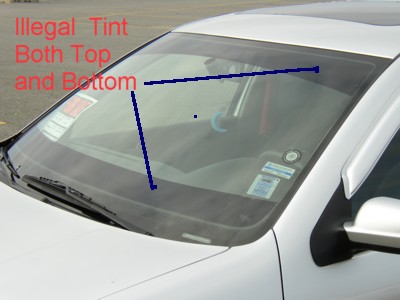
tint

It is the placing of this tinting material on the side windows which results in the majority of Motor Vehicle Act charges being by our officers, but there are an increasing number of motorists who are placing this tint on the windshield itself - this is also illegal. This tint is often a very sharp looking addition to many vehicles - however it is illegal and dangerous. The members of Western Shore Traffic Services take this offence very seriously and motorists considering placing this material on their vehicles should know that the fines start at $215.00 and it is the rare occasion that sees our officer issue a warning intead of a charge when this offence is encountered.

Placing this illegal tint on front side windows reduces the amount of light that is allowed into the motor vehicle. This has two effects:
1) the driver's ability to see out is reduced, especially in low light situations (dusk or evening), and
2) it is nearly impossible for a person looking into the vehicle from the outside, to actually see the face of the driver.
This is critical for pedestrians while at crosswalks, or for other motorists and cyclists at intersections or a variety of other situations where it is imperative that eye contact be made to ensure that a collision does not occur.

Top

narrowstripe

Brakes - Automobile & Trailer:

The Standards of Vehicle Equipment Regulations state in Section 23(3) that:

(3) The brakes of a motor vehicle shall be adequate to bring the vehicle, when travelling at a speed of twenty miles per hour, to a standstill in its line of travel

(a) within a distance of forty feet, if the brakes are two-wheel brakes;

(b) within a distance of thirty feet, if the brakes are four-wheel brakes.

and with respect to a trailer - the following applies:

Section 23A No trailer or semi-trailer with a gross weight of load and vehicle in excess of four thousand pounds shall be operated on any highway unless such trailer or semi-trailer is equipped with adequate brakes controlled by the operator of the towing vehicle.

Obviously brakes are the key piece of safety equipment which forms part of your vehicle. If you have any reason whatsoever to believe that there are problems with your vehicle's brakes - ensure they are checked by a professional immediately!.

Top

narrowstripe

Oversize, Worn Tires and Mud Flaps:

Oversize Tires -

Oversize Tires are required to be covered by mudguards which prevent wheel spray or splashing. In other words, the mudguard (fender, or fender extension) will extend from the vehicle further than the outer edge of the tire.

The Motor Vehicle Act of Nova Scotia says it this way:

199 (2) Every motor vehicle and every trailer shall be equipped with mudguards, fenders or flaps adequate to reduce effectively the wheel spray or splash of water from the roadway to the rear of the vehicle or trailer, unless the spray or splash is effectively reduced by the body of the vehicle or trailer or by a trailer drawn by the vehicle.

If you have equipped your vehicle with oversize tires - where they stick out beyond the fender of your vehicle - you are required to modify the fender as described above.

Worn Tires -

The Standards of Vehicle Equipment Regulations regulates this aspect of motor vehicle safety, and says;

Section 14(1) Subject to subsection (1A), no vehicle shall be equipped with tires

(a) which are damaged to an extent which would expose or affect the tire body cords;

(b) which have been re-cut or re-grooved below the original tread depth provided that this Section does not apply to tires manufactured for the purpose which are so identified by the manufacturer;

(c) where the tread is worn to the point where less than two thirty-seconds of an inch of tread groove depth remains at each point at which gauge readings are obtained; or

(d) where the tread is worn to the point where two consecutive tread wear indicators contact the road in any two adjacent grooves

Top

narrowstripe

Off Highway Vehicles:

The operation of Off Highway vehicles in Nova Scotia is regulated by the provisions of the Off Highway Vehicles Act. Off highway vehicles include; three and four wheel ATV�s, snow vehicles, minibikes, dune buggies, and other vehicles intended for off road use.

Children under the age of 10 may operate off highway vehicles only on the property of the child�s parent or guardian, or on private property where the parent or guardian obtained permission, and where the child is directly supervised by an adult.

Children between the ages of 10 and 14 may operate off highway vehicles on private property where the parent or guardian obtains permission for the child for the child to do so, or on property where operation is permitted and where a child is directly supervised b an adult.

Children 14 or over may operate off highway vehicles on property where operation is permitted.

No person may operate an off highway vehicle upon a highway, upon the shoulder adjoining the traveled portion of a highway or upon the median of the highway except as authorized by the Minister.

Section 12(3) of the Off Highway Vehicles Act explains that a person may drive an off-highway vehicle across a highway at right angles if
(a) that person stops the off-highway vehicle at the side of the road and yields to all traffic upon the highway approaching so close as to constitute a hazard;
(b) there is a clear and unobstructed view along the highway for a distance of five hundred feet in each direction; and
(c) there are no passengers on the off-highway vehicle.

BUT:

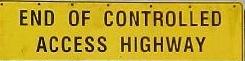
The Off Highway Vehicles Regulation makes it illegal to even cross a "Controlled Access Highway".

Controlled access highways
hwysign13 No person shall operate or drive an off-highway vehicle upon or across a highway designated as a controlled access highway pursuant to the Public Highways Act. Section 13 added: O.I.C. 88-952, N.S. Reg. 191/88.
In South West Nova Scotia most parts of the 101 and 103 Highway are designated as "Controlled Access Highways".

Top

narrowstripe

Lights & Reflectors:

Section 174 (Subsections 4 and 5) of The Motor Vehicle Act of Nova Scotia outlines the requirements for motor vehicles to be quipped with tail lights, clearance lights and reflectors.

When required these lights must be clearly visible for a distance of 150 meters ("under normal atmosphereic conditions"). The reflectors are required to be visible from 150 meters as well, when "opposed by a motor vehicle displaying lawfully undimmed headlamps at night, on an unlighted highway".

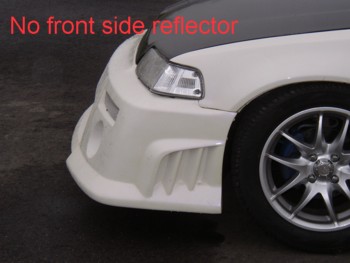
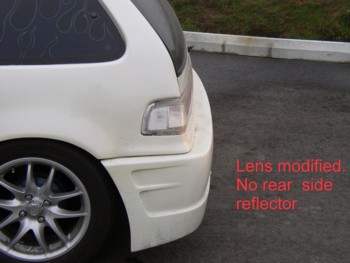
side   side

Recently we have seen a large increase in the number of vehicles begin modified by removing the rear lamp assembly and replacing the red lights with clear lens and red inserts. In most cases the lamps themseleves appear to meet the standards for brake or tail lamps. Where they FAIL is that in many cases the rear lamp assembly also doubles as the red retro-reflective side marker which is mandated by Federal Legislation. This renders the light assembly ILLEGAL until such time as a side marker is included, and mounted in a fashion which meets the standard.

The same problem exists for owners whose vehicle has a "wrap-around style headlamp" - one that incorporates the signal lamp & side-marker (amber) light into one assembly. When a tinted lamp cover is placed over the headlamp in almost all cases it covers the amber side-maker lamp, making this an illegal assembly. See "Head Lamps and Lamp Covers" on this page for further potential violations caused by the addition of these items to your vehicle.

The Government of Nova Scotia governs vehicle equipment through the Motor Vehicle Act and its various Regulations. Section 200 of the Motor Vehicle Act is the Provincial Authority for enforcing this aspect of vehicle equipment requirements and the Regulations which apply are the Equipment Approval Regulation. N.S. Reg. 49/73. This regulation adopts the standards outlined in CSA Standard D106.2-1973, which has recently been modified to refer to Canadian Motor Vehicle Safety Standard, Technical Standards Document 108. This is a standardized document which mirrors Federal Legislation in the United States, providing for common regulations across both our countries

References:
Nova Scotia Motor Vehicle Act
Nova Scotia Equipment Approval Regulations
Federal
MOTOR VEHICLE SAFETY ACT
Federal Technical Standards Document No. 108 Revision 3
Federal
MOTOR VEHICLE SAFETY ACT - Regulations Standard 108

Top

narrowstripe

Head Lamp / Tail Lamp Covers:

Section 174 of The Motor Vehicle Act of Nova Scotia outlines the requirements for motor vehicles to be quipped with two headlamps (exceptions are listed here as well). Section 178 of the same act goes on to explain that the light shall emit a colourless and non-glaring light.

It is the requirement of a "colourless" light which renders tinted headlamp covers illegal. These alter the shade of the emitted light - not to mention that they block a significant amount of light from passing at all. If your vehicle is equipped with Coloured Headlamp Covers (tinted or otherwise) the covers MUST BE REMOVED between one half hour after sunset and one half hour before sunrise. These are the times outlined in Section 174(1) during which motorists are required to have their headlamps on.

--** PLEASE NOTE **--

If your vehicle was manufactured with daytime running lights - it is a requirement that these lights be on an visible at all times - this renders tinted headlamp covers for these vehicles illegal at all times.

Top

narrowstripe

License Plate Decorations:

While there is no specific Provincial Motor Vehicle Act Section or Regulation that prohibits decorations on Licence Plates - they are not approved lights as designated by the Motor Vehicle Safety Act and it's Regulations, and this federal legislation is adopted by Section 200(3) of The Motor Vehicle Act of Nova Scotia.

The License Plates themselves are to be placed on the vehicle as prescribed by Nova Scotia Regulation 173/95. The basics of the regulation outline that a passenger vehicle or light truck are issued a single plate which is to be placed on the rear of the vehicle. Heavy Commercial Vehicles are also issued a single plate, however these are to be attached to the front of the Commercial Vehicle.

Top

narrowstripe

Auxilliary Lighting:

The Motor Vehicle Act of Nova Scotia outlines the limitations with regards to auxilliary lamps:

Auxiliary driving light
Section 177(2) Any motor vehicle may be equipped with not more than two auxiliary driving lamps or fog lamps mounted on the front at a height not less than 300 millimetres above the level surface on which the vehicle stands, and every such lamp or lamps shall meet the requirements and limitations set forth in subsection (3) of Section 178.

This section makes it illegal to have auxilliary lights mounted on the roll bar or any other part of the motor vehicle which is either:
a) not the front of the vehicle, or
b) less than 300 millimetres from the ground.

The MAXIMUM number of Auxilliary Lamps for any vehicle is TWO (2).

Top

narrowstripe

Seatbelt Modifications / Alterations:

In Nova Scotia - the wearing of seatbelts is MANDATORY. There are exemptions - but there are only a few.

If you are the owner of a motor vehicle and are considering altering the seatbelts in it - you should consider the following:

Section 175 of the Motor Vehicle Act of Nova Scotia says:

Maintenance of seat belts
(5) Every registered owner of a motor vehicle shall maintain all seat belts for the vehicle in good condition.

Modification of seat belt
(6) No person shall modify a seat belt in any way which reduces its effectiveness or remove a seat belt except for maintenance or if the seating position has been removed.

Any seatbelt that has been torn, cut, or otherwise damaged must be replaced immediately.

Top

narrowstripe

Bumper Height Restrictions:

If you are altering the height of your vehicle - either by "jacking it up" or modifying it to a "low rider", you should be aware that the Standards of Vehicle Equipment Regulations outlines the following with respect to bumper heights:

Section 22(b) All passenger cars and station wagons shall be equipped with a front and rear horizontal bumper of the same type and design as originally equipped, or equivalent, with the top of the bumper not less than fourteen (14) inches and the bottom of the bumper not more than twenty- two (22) inches, when measured, above the level ground surface.

Top

narrowstripe

Radar Detectors:

Radar Detectors are illegal in Nova Scotia. Police are authorized to seize any radar detector which is located in a motor vehicle.

The Motor Vehicle Act of Nova Scotia explains it this way:

182A (1) In this Section, "radar-warning device" means any device or equipment designed or intended for use in a motor vehicle to warn the driver of the presence of radar speed-measuring equipment in the vicinity and includes any device or equipment designed or intended for use in a motor vehicle to interfere with the effective operation of radar speed-measuring equipment.

Prohibition
(2) No person shall drive on a highway a motor vehicle that is equipped with or that carries or contains a radar-warning device.

Search and seizure
(3) A police officer may at any time, without a warrant, stop, enter and search a motor vehicle that the police officer has reasonable grounds to believe is equipped with or carries or contains a radar-warning device contrary to subsection (2) and may seize and take away any radar-warning device found in or upon the motor vehicle.

Radar-warning device forfeited
(4) Where a person is convicted of an offence pursuant to this Section, any device seized pursuant to subsection (3) by means of which the offence was committed is forfeited to Her Majesty in right of the Province.

Top

narrowstripe

Emission Control:

Section 12(3) of theStandards of Vehicle Equipment Regulations, made under Section 200(3) of the Motor Vehicle Act of Nova Scotia, state that it is an offence to modify a vehicle manufactured after 1991, to alter the emission control system. See the following:

Section 12(3) Every motor vehicle, of model year 1991 or later, registered or required to be registered in the Province pursuant to the Motor Vehicle Act and which was manufactured with pollution control equipment designed to reduce the emission of hydrocarbons, carbon monoxide and oxides to the atmosphere shall remain so equipped, and the equipment shall be maintained in good working order. Subsection 12(3) added: O.I.C. 91-293, N.S. Reg. 43/91.

(4) No person shall remove or modify or allow to be removed or modified any equipment installed in a motor vehicle, of model year 1991 or later, to reduce or eliminate the emission of a contaminant into the environment or in the case of a motor vehicle equipped with a catalytic converter, modify or allow to be modified the opening of the fuel tank or pour leaded gasoline therein. Subsection 12(4) added: O.I.C. 91-293, N.S. Reg. 43/91.

Top

narrowstripe

Graduated Licensing System:

Since 1994 Nova Scotia has employed a Graduated Licensing System for new drivers.

Graduated licensing is a system which places driving conditions on the beginner driver. As these conditions are gradually and systematically removed, exposure to increasingly risky situations is gradually phased in. Rather than being exposed to the full range of driving hazards at once, the novice driver is eased into full unrestricted driving situations with more competance and more experience to handle unexpected events.

As mentioned above, there are a number of conditions which apply to Newly Licensed Drivers, and are removed over time. For complete details on the Graduated Licensing System in Nova Scotia, visit the Service Nova Scotia Website.

Top

narrowstripe

Skateboards & Rollerblades:

The use of skateboards and rollerblades on highways is PROHIBITED under Section 172(1) of The Motor Vehicle Act of Nova Scotia. In Subsection (2) the Act outlines that a City or Town Council may exempt certain roadways from this prohibition.

Prohibition on roller skates or skate board
172 (1) Subject to subsection (2), it shall be an offence for a person upon roller skates or a skate board to go on a roadway except while crossing on a crosswalk or unless on a roadway authorized by the Minister.

Exemption by city or town
(2) The council of a city or an incorporated town may exempt from subsection (1) any roadway within that city or town that is not a highway to which the Public Highways Act applies. R.S., c. 293, s. 172.

Top

narrowstripe

Lights Under Vehicles:

Our Office has recently begun to receive calls from motorists wishing to modify their vehicle by adding neon type lights to the under carriage of the vehicle. This has become more popular as a result of some recent movies, such as "The Fast and The Furious" where sports cars were modified in this fashion.

The question we are being asked is - "Are these lights legal in Canada?" The short answer is....No. Any lights installed on your vehicle must be approved under the Motor Vehicle Safety Act of Canada (and it's regulations), and this will include any lights installed underneath. Neon lights under the vehicle are not approved for use in Canada. These lights create a potentially dangerous situation as they can create glare, and at the very least can be a distraction to other motorists.

References:
Nova Scotia
Motor Vehicle Act
Nova Scotia Equipment Approval Regulations
Federal
MOTOR VEHICLE SAFETY ACT
Federal Technical Standards Document No. 108 Revision 3
Federal
MOTOR VEHICLE SAFETY ACT - Regulations Standard 108

Top

narrowstripe
Returns
Return to Table of Contents

Hosted by www.Geocities.ws

1