|
BEST VIEWED WITH INTERNET EXPLORER AT 600 X 800 RESOLUTION

Club Awards 2005
Date
Venue
| | | |
June 30, 2005 (Thursday)
Marikina Rotary Youth Center
|
 | | | | | | | | | | | |
|  |
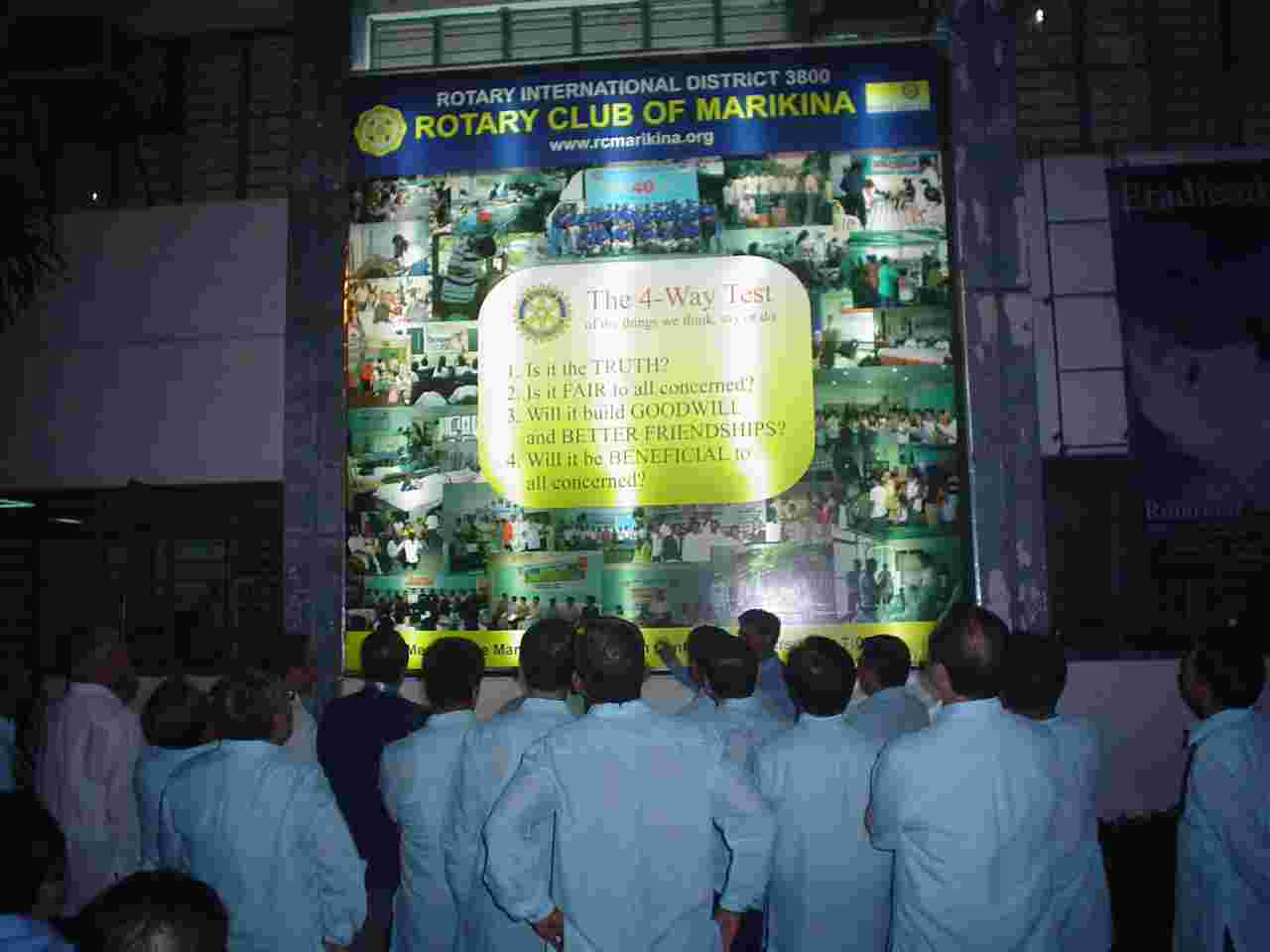
| Lighted Billboard
| | | | | | | | | | | |
|
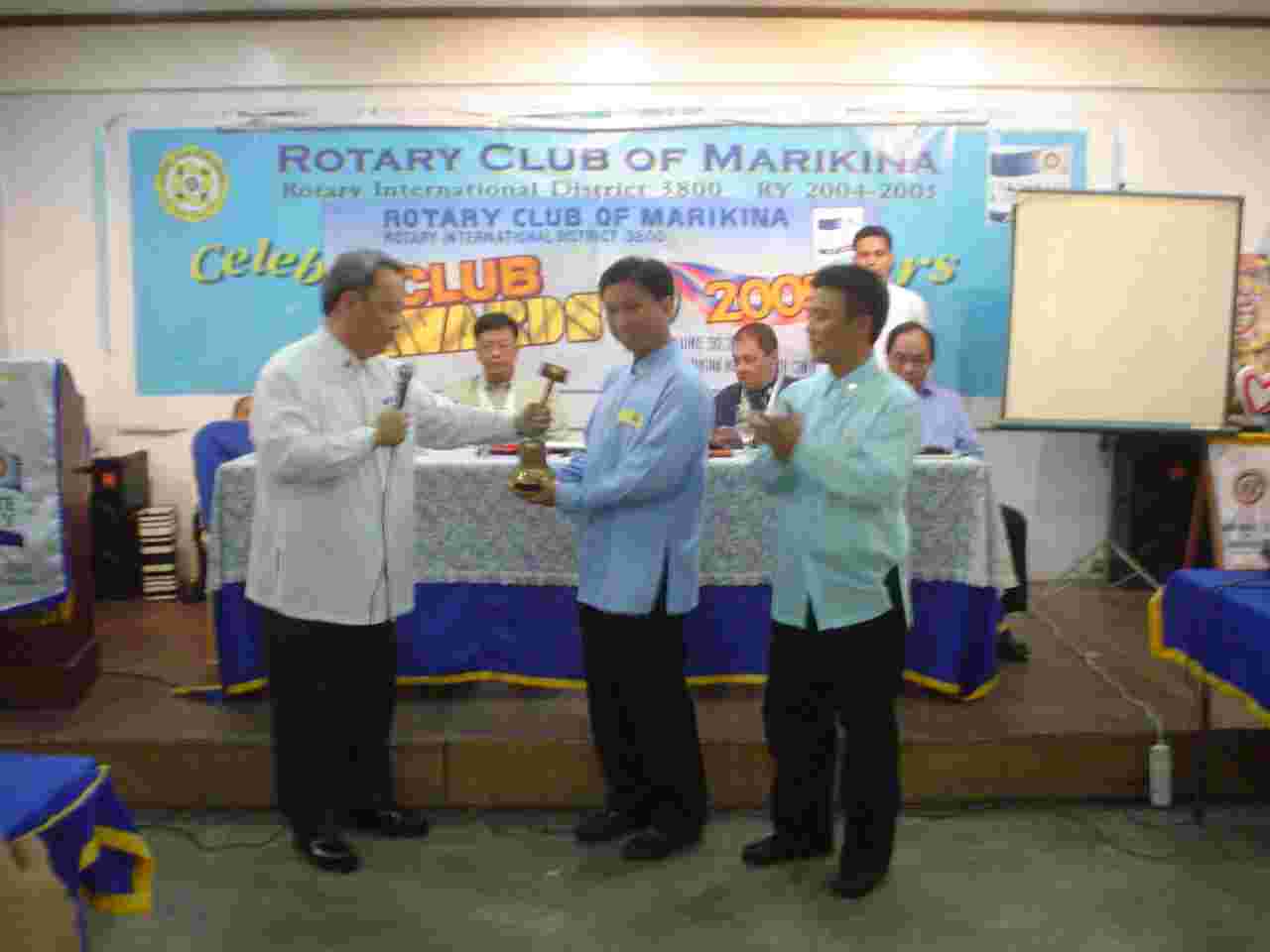
Handover Ceremonies
|
Valley Wheel Vol. 40 No. 50
CLUB AWARDS 2005
President's Current Account
by Pres. Kiko Pe Benito
It is with overwhelming gratitude that one feels for having been bestowed the Club Presidency at a rare occasion of celebrating not one, but two special events --- the Centennial Year of Rotary International and the Club�s 40th Year Charter Anniversary.
With the excitement though came the anxiety of living up to expectations, upholding excellence and creating a balance between family, work and committed Rotary service. But, as the proverbial Rotary wheel turns, everything came into place as each Rotarian join hand in service. The initial fear of surmounting such a big feat, was comforted by fellow Rotarians & their spouses constantly willing to assist.
In this light, I wish to take this opportunity to thank the Centennial Board, all the Past Presidents, Members and Spouses of RC Marikina for their full support. Our heartfelt gratitude to Assistant Governors Jun Abellar and Tony Fidelino for their guidance; and of course, to our Centennial Governor Fabio J. Enriquez and DGL Myrna Enriquez for their all out support to our club. And lastly, thank you to my wife and family for their understanding on the demands of my presidency. Needless to say without all these support coupled by Divine guidance & blessings from above, all our endeavors would be in vain.
Leading the Club for a year has given me the opportunity to widen my horizons on revitalizing members participation and understanding Rotary�s motto of �Service Above Self�. I do hope this humble service as Centennial President has contributed to our purpose and mission as Rotarians.
As we pass on the mantle of leadership, let us continue to �Celebrate Rotary� through �Service Above Self� as President Fabi Cadiz leads the Rotary Club of Marikina to the second century of Rotary movement.
To the new board Congratulations & More Power!!! And, that in all things we do, may God be glorified!!!
Francisco �Kiko� I. Pe Benito
Centennial President
RC Marikina
Touching Lives
by Sec. Doy Smith
DISTRICT AWARDS
Rotary Year 2005-2006
C. OUTSTANDING ROTARY CLUBS
Most Outstanding Clubs
The Most Outstanding Rotary Club will be selected from among the Outstanding Rotary Clubs. The clubs shall be given merit points for the following accomplishments:
- Outstanding Rotaract Club (5 pts.)
- Outstanding Interact Club (5 pts.)
- Outstanding Rotary Community Corps (5 pts.)
- For Organizing
- New Rotary Club (15 pts.)
- New Rotaract Club (5 pts.)
- New Interact (5 pts.)
- New Rotary Community Corps (5 pts.)
Likewise, the Top Five Clubs in Different Projects/Activities will be given merit points as follows:
- First Place - 5 pts.
- Second Place - 4 pts.
- Third Place - 3 pts.
- Fourth Place - 2 pts.
- Fifth Place - 1 pt.
- Best Club Bulletin
- Best in Attendance
- Top five club contributors to The Rotary Foundation in three categories:
- total contributions
- per capita contribution
- 100% club members contributing to TRF
- Outstanding Literacy and Education Projects
- Outstanding Water Management Projects
- Outstanding Health and Hunger Projects
- Outstanding Public Image Projects
- Most Number of Attendees in the Rotary Academy (%)
- Most Number of New Women members inducted
- Highest Net Membership Growth (%)
- Highest Number of New Rotarians Inducted
- Most Impressive Four-Way Test Billboard/Display Project
- Most Number of Attendees to the DISCON (%)
- Highest number of significant activities participated in as recommended by the 2005-06 Public Image Task Force as indicated in the RI Web site
- Most meet coverage of Rotary club events
- Most number of public service announcements in the newspaper, on the radio and/or television
- Most number of Four Avenues of Service Citations for Individual Rotarians
- Most number of new projects in support of Vocational Service
- Greatest impact in publicizing the Rotary�s role in the Global Polio Eradication
V. AWARDING CEREMONIES - The �Gabi ng Parangal at Pasasalamat� will be on June 10, 2006
Rotary Information
by PP Eric Ignacio
"CHAPTER 15 - ROTARY�S COMMITMENT TO YOUTH"
Rotarians have felt drawn to serve the needs of children and young people
from the earliest days of the International Association of Rotary Clubs.
In December 1913, the Rotary Club of Syracuse, New York, USA, appointed a
crippled children�s committee. Their interest was sparked by the plight of a disabled
girl whose parents couldn�t afford the surgery and rehabilitation that was
needed to restore her mobility. The Syracuse Herald endorsed the club�s project
and in two weeks collected $2,728.74 from its readers.
The club then conducted a citywide survey of similarly needy children
and found 200 of them. This opportunity motivated the new Rotarians to
make �crippled children�s work� their primary community service, and they
mobilized social workers, medical caregivers, and rehabilitation specialists to
their cause. Club members provided food baskets to the poorest families and
clothes, toys, and books to physically disabled children. In 1914, the club added
40 blind children to the program, and every surgeon and hospital donated
their services.
Inspiring stories such as these appeared in The Rotarian magazine just
at the time when both the association and its clubs were trying to shed Rotary�s
image as a self-serving business-boosting organization. Other clubs picked up
the idea and looked for similar needs in their own communities.
In 1915, a Toledo, Ohio, USA,
Rotarian learned of a 16-year-old
quadriplegic boy named Alva Bunker
who was unable to read or write. The
club discovered a unique school in
Michigan that specialized in educating
such children, so it raised enough
money to pay for the boy to be fitted
with artificial limbs and to complete
his education. The Toledo Rotarians
wanted to continue their work
with other handicapped children, so
they formed the Toledo Society for
Crippled Children. When automobile
magnate Henry Ford donated a
large sum of money to help disabled
children, the press credited the Rotary
Club of Toledo�s work for drawing
Ford�s interest.
Not far from Toledo was Elyria,
Ohio, home of Edgar F. �Daddy� Allen. Allen owned a successful lumber company
that supplied railroad ties and telephone poles throughout the East and
Midwest, but his wealth and business accomplishments meant nothing when
his beloved son Homer, 18, and other people were killed in a streetcar accident
in Elyria. The loss seemed even worse when officials told Allen that had
there been a hospital in the town, Homer probably would have survived. Allen
dedicated the rest of his life to helping children, especially those with physical
disabilities. When an eight-year-old orphan boy insisted on calling him �Daddy�
for all the help he gave him, the name stuck.
Daddy Allen sold his business and within two weeks had raised $100,000
to start work on the Elyria Memorial Hospital, so named in honor of the victims
of the streetcar accident. After it was completed, the doctors approached
him to build an extension especially equipped for crippled children. Allen
not only raised the money to finish that building; he became so aware of
the need for such treatment centers that, dividing Ohio into eight districts,
he persuaded hospitals in each area to erect their own crippled children�s
wings.
To nobody�s surprise, Daddy Allen, a member of the Rotary Club of
Elyria, convinced his club�and other Rotary clubs across the country�to
make crippled children�s work a major focus of their own community service
outreach.
Rotary clubs outside the United States initiated similar projects. When
the English industrialist Lord Nuffield visited New Zealand, he was so impressed
with the work undertaken by local Rotarians that he donated �50,000
to their cause. Aucklanders Mr. and Mrs. W. R. Wilson donated a house to
Rotary and 13 acres of land to be used for a crippled children�s home, at
which point Lord Nuffield added another �10,000 to his original gift.
Many Rotary clubs formed city and then state societies for crippled
children. This led to the formation of the National Society and then the
International Society for Crippled Children in 1921, of which Paul Harris was
chairman and Daddy Allen was president. This worthy organization added
�and Adults� to its name in 1944, and in 1979 dropped the term �crippled� to
become the Easter Seals Society.
Boys Work
While Rotary was actively
supporting projects for disabled
children, it also invested in something
called �Boys Work.� Boys
comprised the vast majority of juvenile
delinquents, truants, and
youth prison inmates at that time.
Rotarians saw the opportunity to
act as mentors who could be positive
role models with the resources
and desire to steer the boys in the
right direction.
So many clubs launched Boys Work projects that the 1916 Cincinnati
convention authorized a standing committee to promote and coordinate
such programs throughout the Rotary world. Each convention for many years
thereafter voted to continue this committee, and in 1920 delegates to the Atlantic
City convention even voted to amend the Rotary bylaws to include Boys
Work. In January 1924, RI established the National Boys Work Committee and
U.S. President Calvin Coolidge became its honorary chairman.
It is easy to see why Boys Work appealed to Rotarians. The objectives�
�to develop boys into good citizens and honorable businessmen, to afford
every boy the opportunity to attain his full potential, [and] to encourage
vocational training��were congruent with their own beliefs. Every issue of
The Rotarian contained stories of clubs actively involved in Boys Work.
Clubs frequently organized Boys Weeks, during which parades, conferences,
and newspaper articles were dedicated to the project. Many clubs sponsored
Boy Scout troops, citizenship training and character-building and vocational training
classes. Others created summer camps, orphans homes, and boys
clubs. Many Rotarians volunteered their time in juvenile courts, reform
schools, and prisons as counselors for boys already in trouble.
When fathers left home to serve their countries in two world wars, Rotarians
stepped in to be the positive male role models. When wars and the
Great Depression caused rampant unemployment and family despair, Rotarians
provided jobs, playgrounds, and a sense of hope to boys everywhere. The
Rotary Club of Atlanta, Georgia, USA, formed an educational foundation in
1920 and in its very first year provided enough funds to put six boys through
college. By 1940, the number had grown to 900 students, 700 of whom had
graduated. Two California districts emulated the Atlanta model and provided
college scholarships for 200 students from 40 countries.
Rotary�s work with youth cuts across all Avenues of Service. When a club
organizes a Boy Scout troop or takes disabled children on an outing, that is
Community Service. When it mentors teenagers with job skills or teaches a
physically challenged youth how to work with his hands, that is Vocational
Service. When Rotarians in one country provide assistance to children in another
or host a Youth Exchange student, they are performing International
Service.
[Home]
[Members]
[Activities]
[Valley Wheel]
[Links]
[Previous Years]
[Current Rotary Year]
[Rotary International]
This page is hosted by  Get your own Free Home Page Get your own Free Home Page
|