|
BEST VIEWED WITH INTERNET EXPLORER AT 600 X 800 RESOLUTION

Regular Weekly Meeting
Date
Venue
| | | |
June 23, 2005 (Thursday)
Marikina Rotary Youth Center
|
Valley Wheel Vol. 40 No. 49
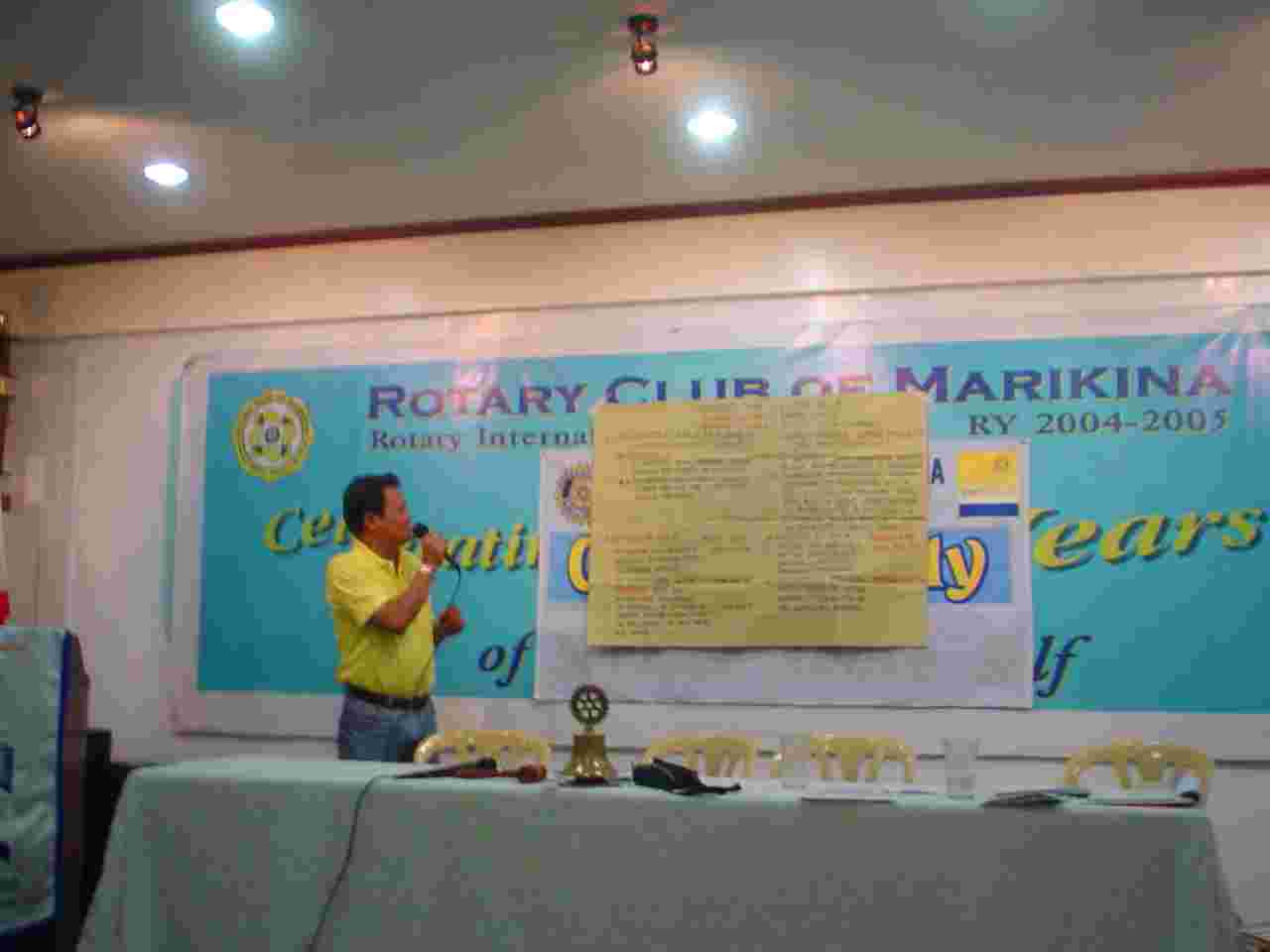
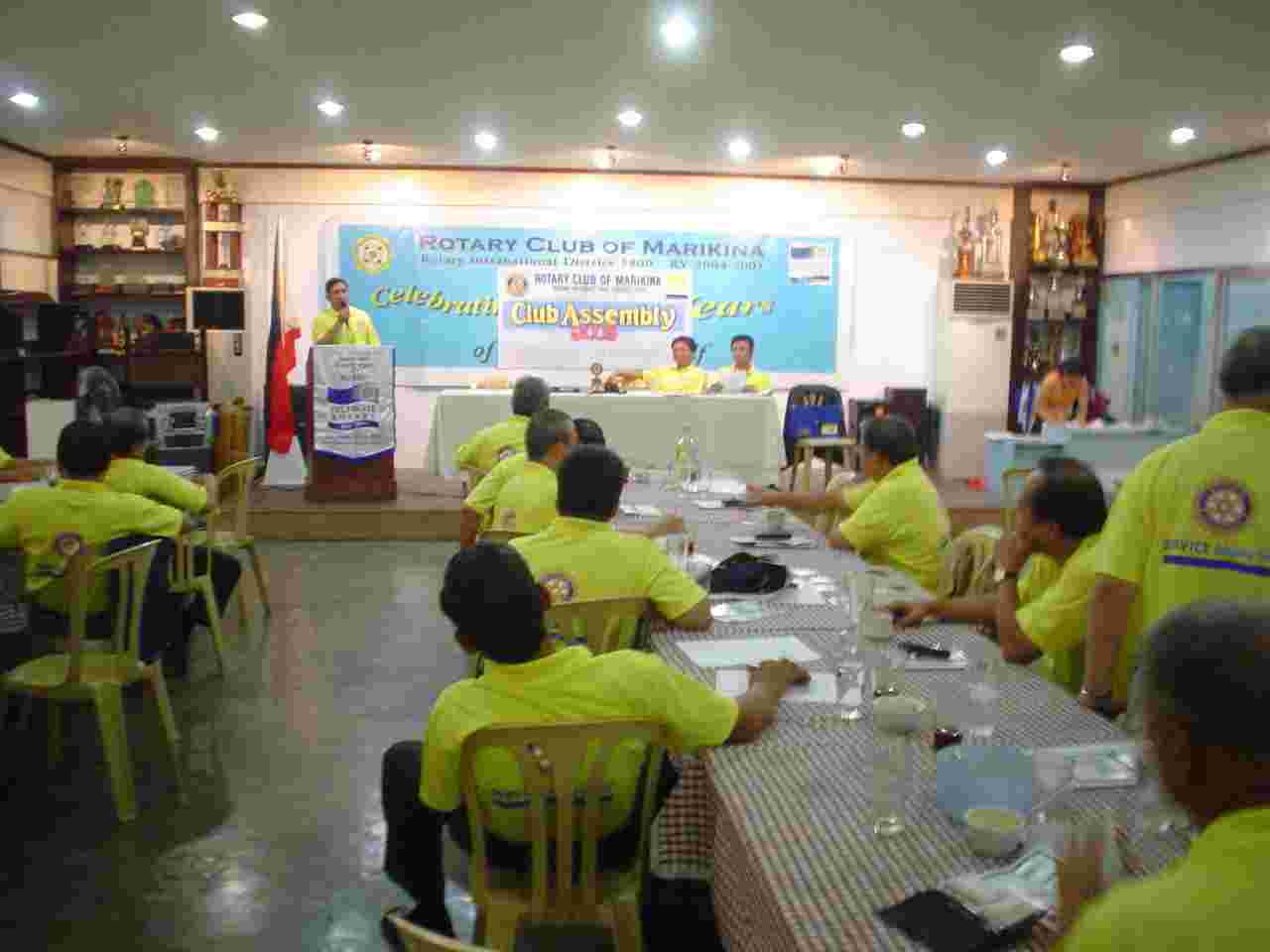
CLUB ASSEMBLY PART II
President's Current Account
by Pres. Kiko Pe Benito
Last Thursday, Incoming President Fabi Cadiz, successfully presented his plans and objectives during the Part I of our Club Assembly. With the help of a powerpoint presentation, he discussed in details the plans and objectives of the incoming board for the incoming Rotary Year �Service Above Self�. Different committees, chairmanship and several new projects were also presented. Tonight will be Club Assembly Part II, and key project chairmen will be reporting their activities for their respective assignments. Congratulations Incoming President Fabi Cadiz!
Next week, June 30, 2005 will be our last meeting and the last day of the Centennial Year. It will also be our Club Awards Night, Chairman of the Club Awards and Recognition/ Club Awards Night PP Dindo Santos has prepared a different presentation, something special for the awardees and other Rotarians. Dist. Governor Fabie Enriquez and Sps. Myrna, Incoming Dist. Governor Mickey Ortigas and Sps. Marinette, other district officers and centennial presidents will be joining us on that special night. Congratulations to all the awardees.
Tonight will be my second to the last weekly meeting as the Club President of Rotary Club of Marikina and I would like to start thanking all those who supported my term, to the Board, Past Presidents and Chairmen of the different committees, MARAMING SALAMAT SA INYONG LAHAT!
Let us CELEBRATE ROTARY!!!
Touching Lives
by Sec. Doy Smith
DISTRICT AWARDS
Rotary Year 2005-2006
B. OUTSTANDING PARTNER IN SERVICE
The following awards will be given to the extended Rotary family for outstanding achievements as determined/announced by the concerned District Committees:
- Outstanding Rotaract Club
- Outstanding Interact Club
- Outstanding Rotary Community Corps
C. OUTSTANDING ROTARY CLUBS
Outstanding Clubs
Rotary Clubs that pass the Basic Qualifications Requirements and satisfy the Four Elements of Effective Clubs stated below automatically become Outstanding Clubs for Rotary Year 2005-2006:
- Sustained Membership Growth:
A minimum of five (5) percent net membership growth by April 1, 2006
- Implementation of Meaningful and Successful Service Projects on each of the following:
- Literacy and education,
- Water management,
- Health and hunger, and,br>
There should be at least 25% of total club members as project participants and at least fifty (50) people in the community as direct beneficiaries.
- Develop and initiate two public relations activities that will enhance the public image of Rotary.
- Support The Rotary Foundation/International Service � submit a WCS project, or implement a Matching Grant project and contribute at least US$1,500.00 before April 30, 2006 to The Rotary Foundation.
- Development of Leaders Beyond the Club Level � be able to send the right mix (including new and old club members) of at least ten (10) Rotarians or 25% of total club members whichever is higher, to the District Rotary Academy training seminars.
Rotary Information
by PP Eric Ignacio
"CHAPTER 14 - SERVING THE WORLD COMMUNITY"
Through International
Service programs such as WCS,
Rotarians became citizens of the
world. This concept was considered
progressive when the RI
Board of Directors first adopted
it in 1949 with the statement
�Attributes of a World-Minded
Rotarian.� World War II was
over, and Rotary had played an
important role in the formation
of the United Nations and
UNESCO. Rotary International
realized that its worldwide
membership�then in excess
of 300,000 Rotarians in 80
countries�could be a powerful force for peace. The Board urged all Rotarians
to influence their own governments to adopt policies that would lead to
�international understanding and goodwill toward all peoples.�
Successive RI presidents and officers helped show Rotarians that poverty,
hunger, polluted drinking water, illiteracy, injustice, and disease were not just
problems of a faraway land. The world is small, and here were opportunities
to improve the lives of people everywhere. As Rotary volunteers returned
from Africa, Asia, and South America to their local clubs and districts, they
told spellbound audiences: �I thought I was going to give and that the local
people would be the recipients. But I have received so much more from this
powerful experience than I ever gave.�
The 13 years from 1956 to 1969 marked the coming of age for international
service. During that time, The Rotary Foundation (which is profiled in
chapter 10) underwent tremendous growth and took in the funds to launch
many humanitarian projects. Within a few years, the vast majority of Rotary�s
international service projects were made possible by funding from The Rotary
Foundation.
Rotary International President Carl Miller introduced the Matched Districts
and Matched Clubs program in 1963-64, urging Rotarians to participate
in WCS and to communicate across international borders. Correspondence
often led to exchange visits; and with the strengthening world economy and
the advent of low-cost air travel, Rotarians criss-crossed the globe in search of
cross-cultural exchanges and service opportunities.
Since 1921, Rotary International has held several international meetings
each year �to stimulate, inform, and inspire officers and members, so that
they will be motivated to make Rotary thrive at the international, district, and
club levels.� The annual convention is the largest such event and meets in a
different city around the world each year, attracting between 17,000 and
40,000 Rotarians and guests.
The RI president often convenes
regional conferences,
presidential summits, peace
conferences, conferences of
goodwill and development,
and other gatherings. These
meetings are a microcosm
of the Rotary world, serious
in purpose but bubbling
with international fellowship.
They usually include training
sessions for incoming officers, inspiring addresses from
speakers describing Rotary
programs, and an evening of
home hospitality as guests of Rotarians in the host community. A project exchange
forum is often held, during which clubs and districts needing help with
their local service projects will meet fellow Rotarians from other countries
wishing to adopt a new WCS project or work out a Matching Grant with The
Rotary Foundation.
Walking through the House of Friendship at any RI meeting, one sees
and meets men and women of every ethnic background greeting one another,
engaged in the common language of service to mankind.
In 1980, three RI presidents�W. Jack Davis (1977-78), Clem Renouf
(1978-79), and James L. Bomar Jr. (1979-80)�appointed a committee to decide
an appropriate way to celebrate Rotary�s 75th anniversary. The result was
the Health, Hunger and Humanity program, which RI officially launched in
1978 and which became known informally as �3-H.� It began as a seven-year
program, during which funds would be collected and projects launched. It
was different from WCS in that it was a �corporate� program, centrally managed
from the RI Secretariat, which urged every club in the world to participate.
For the first time since the Boys Work and �crippled children�s work� of
the early 1920s, Rotary encouraged every club to get involved in a coordinated
program. This was controversial with some clubs�and even some RI past
presidents�yet 3-H caught the imagination of Rotarians the world over. (For
more on 3-H, see chapter 10.)
WCS had long been involved in projects that addressed health, hunger,
and humanity, but 3-H brought a sharp new focus. The 3-H Committee
named three co-chairmen�Dr. Ben N. Saltzman, Webster Pendergrass,
and Clifford L. Dochterman (later RI president)�who were responsible for
health, hunger, and humanity projects, respectively. The program was a resounding
success. It also raised the consciousness of Rotarians to opportunities
for international service. It raised millions of dollars, which made possible
numerous new projects. And as the organization�s gift to the world on its 75th
anniversary, it was Rotary�s raison d��tre. Best of all, 3-H became the spark
that ignited the brightest candle in Rotary�s history: PolioPlus.
It is impossible to tell in one chapter, or even in one book, the whole
story of Rotary�s international service. It is not a story best told from the headquarters
level but rather from a personal perspective. A member of the Rotary
Club of Marlton, New Jersey, USA, took relief supplies to Beirut, Lebanon,
during that country�s civil war. �I hated Americans because I always considered
them to be responsible for supplying our enemy with the bombs he drops on
us every night,� admitted a Beirut Rotarian as he and the American brought
medicine to an orphanage. �But now I realize that I can disagree with a government�s
policy, but that I should not hate its people. Thank you for helping
our children.�
Group Study Exchange (GSE) began as an exchange between districts
in California, USA, and Japan in 1965. Rotary International adopted GSE as a
major program of The Rotary Foundation and has since had more than 40,000
business and professional men and women participate. The Australian FAIM
(Fourth Avenue in Motion) program, which was founded by Keith Hopper of
the Rotary Club of Inverell in 1963, is a model for launching international
service projects. Following the civil war in East Timor (now Timor-Leste), Rotarians
from Australia and New Zealand helped rebuild schools, provided employment
opportunities, and even built a factory that produced corrugated
tin roofs.
In 1995, Rotarians down under built Kokoda Memorial Hospital in
Papua New Guinea, and hundreds of Rotarians and their volunteer friends
have since visited the hospital on work missions. In its first five years, doctors
of Kokoda treated more than 100,000 patients and delivered more than 500
babies. Over the next 40 years, FAIM�with its all-volunteer staff�organized
almost 1,000 work teams like the one that served in Timor-Leste, bringing relief
and hope to needy communities around the world.
Past General Secretary Herbert Pigman went to Korea in 1961 as a staff
member of The Rotarian to report on the state of Rotary in the war-ravaged
country. He recalls being escorted by Rotarians to the outskirts of Pusan�city
of a million refugees�along 19 miles (30 km) of muddy roads to a farmer
who was able to support his nine children thanks to a cow that the Rotary
Club of Pusan had given him. The animal pulled his plow and provided milk
for his family; the only condition the club made was that the farmer donate
back to the club his cow�s first calf so that it could be passed on to another
needy family. But less than two decades later, Korean Rotarians were among
the greatest contributors in the world to WCS projects. They sent US$10,000
worth of computers and medical equipment to China, $15,000 worth of powdered
milk to children in North Korea, rushed $20,000 in disaster relief to
victims of earthquakes in Turkey and Taiwan, and donated $6,000 worth of
medical equipment to orphanages
in Ukraine.
International Service is
not just about giving money�
although tens of millions of
dollars are given each year in
the name of Rotary�s fourth
Avenue. The act of giving money
alone can be satisfying but
can also feel impersonal; there
is rarely a sense of connection
between the donor and the
recipient. To Rotarians, the
greatest reward of international
service is the personal satisfaction
of being bridge-builders
to another culture�the joy of
compassion in using one�s time
and talents to help the downtrodden
and disadvantaged
residents of the global village.
More than 80 years after
Rotary adopted International
Service as its fourth Avenue of
Service, it is a thriving, bustling avenue indeed. It brings together students,
young adults, and Rotarians from disparate cultures and is the glue that cements
countless projects in almost every country on earth. To some it may
seem a contradiction: it delivers tens of millions of dollars in aid�yet it is not
about money. It encourages citizens of hostile nations to talk with one another
�yet Rotary International remains nonpolitical and refuses to act as a
corporate entity in resolving such conflicts. It espouses the attributes of every
major world religion�yet Rotary has no religious message or affiliation.
Just as with the other important tenets of life�truth, integrity, loyalty�
international service comes down to the individual Rotarian. Others may despair
at the daily media reports of famine, disease, and bloody disputes in distant
countries with the dismissive �What difference can one person make?�
But Rotarians of every race, color, and creed in 166 countries and geographic
regions sing a well-known song: �Let there be peace on earth, and let it begin
with me.�
[Home]
[Members]
[Activities]
[Valley Wheel]
[Links]
[Previous Years]
[Current Rotary Year]
[Rotary International]
This page is hosted by  Get your own Free Home Page Get your own Free Home Page
|