|
BEST VIEWED WITH INTERNET EXPLORER AT 600 X 800 RESOLUTION

Regular Weekly Meeting
Date
Venue
| | | |
June 16, 2005 (Thursday)
Marikina Rotary Youth Center
|
Valley Wheel Vol. 40 No. 48
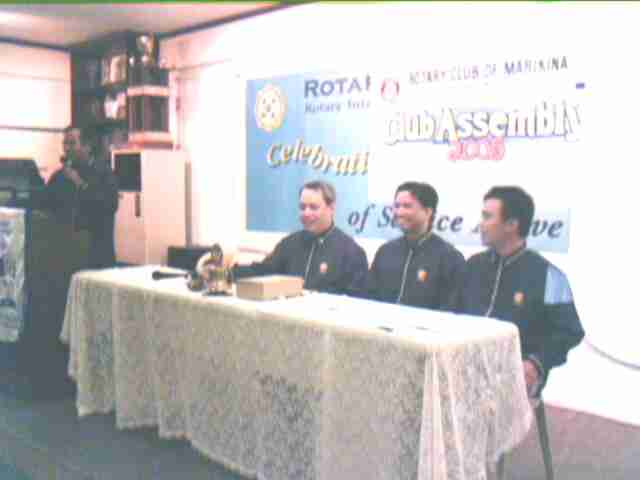
CLUB ASSEMBLY PART I
President's Current Account
by Pres. Kiko Pe Benito
Tonight�s meeting and next week will be dedicated to the Club Assembly of our Serving President Fabi Cadiz. These assemblies will prepare us for the next Rotary Year 2005-2006 � �Service Above Self�.
Like last year, our plans and programs had been laid out a month before the Rotary Year starts and we know where we are heading. It is now up to us for its implementations. But sometimes along the way, we change course to what is more appropriate and feasible that at the end we would still achieve our goal.
This coming Saturday, June 18, 2005, Sec. Doy Smith, Treas. Ronie Masangkay, Dir. George Ty and Rtn. Manolo Favis will be flying to Chicago, USA and represent the Club in the Centennial R.I. Convention from June 18-22, 2005. They will be joined by PDG Ting Tanco, PP Al Ancheta, PP Boy Ong and Dir. Vincent Santos who left last week for the States. Good luck to all of you and Thank You.
Again to Incoming President Fabi Cadiz, Congratulations and Good Luck!
Let us CELEBRATE ROTARY!!!
Touching Lives
by Sec. Doy Smith
DISTRICT AWARDS
Rotary Year 2005-2006
I. BASIC QUALIFICATION REQUIREMENTS
A club must meet the following requirements to qualify for the District 3800 Awards:
- Club must be in good standing with no past RI/District obligations
- Club must have qualified for the RY 2005-2006 Presidential Citation of RI President Carl-Wilhelm Stenhammar. To qualify for the presidential citation, the RI President ask each
club to complete the membership goal and one activity from four of the five categories
(letter of President Stenhammar to all Club Presidents).
II. DOCUMENTARY REQUIREMENTS
- Duly accomplished Club President�s Monthly Report with supporting documents, write-up and photos to be submitted not later than every 10th day the following month.
- Proof of payment (RI and District OR) of all Rotary monetary obligations.
- All required documents must be with the District Awards Committee by May 10, 2006. The above documents must be submitted to the District Governor�s office located at E-203B East Tower Philippine Stock Exchange Center, Pasig City.
III. COVERAGE PERIOD
July 1, 2005 to April 1, 2006
IV. CATEGORIES OF AWARDS
A. AWARD OF RECOGNITION FOR OUTSTANDING CLUB PROJECTS/ACTIVITIES
- Award of Recognition for organizing a new Rotary Club, new Rotaract Club, new Interact Club and new RCC
- Best Club Bulletin � top five clubs
- Best in Attendance � top five clubs
- Award of Recognition for top five club contributors to the Rotary Foundation in three categories � total contributions, per capita contribution, and 100% club members contributing to TRF
- Outstanding Literacy and Education Projects � top five clubs
- Outstanding Water Management Projects � top five clubs
- Outstanding Health and Hunger Projects � top five clubs
- Outstanding Public Image Projects � top five clubs
- Most Number of Attendees in the Rotary Academy � top five clubs
- Most Number of New Women members Inducted � top five clubs
- Highest Net Membership Growth (%) � top five clubs
- Highest Number of New Rotarians Inducted � top five clubs
- Most Impressive Public Image Project � top five clubs
- Most Number of Attendees to the DISCON � top five clubs
Rotary Information
by PP Eric Ignacio
"CHAPTER 14 - SERVING THE WORLD COMMUNITY"
On the drought-stricken plains of East Africa, Swedish pediatrician
Hakan Simonson sends a dust trail high into the sky as the pickup
truck speeds him toward waiting patients in remote Masai villages. In other
communities, Ulmka Lid�n restores sight to a blind mother who now sees her
child for the first time. Dentist Ingvar Persson examines 3,500 children during
the three weeks he spends at a Kenyan orphanage, and Gunnar Isabsson
teaches Zambian health-care workers how to treat and care for AIDS
patients. These volunteers for the Rotarian-supported Doctor Bank, founded
in Sweden, represent scores of Scandinavian health-care professionals who
devote countless hours each year to fighting disease in developing nations.
On the other side of the world, a group of Australians are laying down
their tools after a day of backbreaking work building a school in Indonesia.
At the same time, a larger group of their countrymen are constructing and
equipping a health clinic in a mountain village of Papua New Guinea. Meanwhile,
in San Francisco, California, USA, plastic surgeons are boarding their
flight for Santiago, Chile, where for the next 10 days they will perform surgery
on children with facial deformities.
On the surface, these people have nothing in common. Yet they are Rotarians,
joined together by the bonds of international service, giving a week
or more of their time for a vacation with a purpose. Many Rotarians hear the
call to service in their home communities; others feel drawn to programs for
which they have a special interest, such as The Rotary Foundation�s Ambassadorial
Scholarships. Others seek projects beyond their own national borders.
�Never has greater need existed for cooperation and goodwill. If selfishness,
distrust, and fear prevail, disaster is the inevitable result. The welfare
of the world demands that the facilities for better conditions of living and
health � be shared by all peoples in a spirit of mutual helpfulness.� Those are
stirring words as Rotary celebrates its centennial, yet General Secretary Ches
Perry first wrote them more than 70 years ago, shortly after International
Service became a part of Rotary�s Object.
Early Rotary activities focused on club and community service. Then,
in 1914, eight Rotary clubs in Britain and Ireland helped house refugees who
had fled from the impending war in their native Belgium. In 1919, a hurricane
and tidal wave struck Texas, USA, causing widespread death and destruction.
Rotary clubs in other countries responded with donations to the
Rotary International Relief Fund. When an earthquake in Japan destroyed
vast sections of Tokyo and Yokohama in 1923, Rotarians from other countries
quickly collected US$40,000 to help. It was a gesture that the Rotary Club of
Tokyo willingly reciprocated when two years later it sent $25,000 to help U.S.
tornado survivors.
When World War I ended and Rotary began its global expansion, this
informal international fellowship exchange spread further; and some clubs
even arranged exchange visits. When the conflict ended, it was only natural
that RI President Estes Snedecor and delegates at the 1921 convention in
Edinburgh, Scotland, wanted to further emphasize this trend. They adopted
International Service as the sixth Object of Rotary�although it was later
changed to the fourth Avenue of Service in
the Object of Rotary. International Service
thus became the last plank to be added to the
platform of the programs of Rotary International.
Danish Rotarian and educator Dr. Sven
Knudsen launched a youth exchange project
in 1927 between Danish and American teenagers.
The idea spread quickly across the borders
of many other nations to become one of
Rotary International�s most cherished and
enduring programs: Youth Exchange. Clubs
in Nice, France, inaugurated Youth Exchange the same year. Today, more
than 7,000 young people annually exchange visits for up to a year, studying in
another country while living with Rotarian families. The program is a powerful
lesson in cross-cultural understanding�part of Rotary�s objective of bringing
about world peace.
In 1927, two Rotarians each from Denmark, Finland, Iceland, Norway,
and Sweden formed the first Rotary intercountry committee to promote fellowship
on an international scale. Rotarians in France and Germany�enemy
countries during the Great War�formed petits comit�s to exchange club visits,
home stays, and promote better understanding between their citizens.
These exchanges spread beyond Rotary, and the idea blossomed around
the world. In Rotary�s first century, hundreds of thousands of Rotarians, students,
and community leaders have participated in exchanges. Some of these
are formal programs of The Rotary Foundation; others happened due to
chance meetings at an RI Convention or when traveling Rotarians made up
at club meetings.
The two elements that drew Rotarians into international service were
warm fellowship and compassion for the needy. Rotarians tend to be gregarious,
inquisitive, and interested in things beyond their own daily routine.
Small wonder that they responded enthusiastically to the opportunity to learn
about and socialize with Rotarians from other nations. To some, these were
little more than opportunities for fun, to share sports or hobbies such as golf
or sailing with Rotarians from another country. The Rotary Fellowships were
formed to bring together Rotarians from around the world who share such
diverse interests as golf, skiing, and stamp collecting, and many get together
throughout the year in regional and international gatherings.
Over the years, some have questioned Rotary�s emphasis on international
service, especially between citizens of hostile nations. Rotary has answered by
pointing out that the goal of all Rotarians is to advance world peace and understanding
between all people, and the work of individual Rotarians in international
service is the fuel that powers that engine.
There have been many occasions during wars or border skirmishes
when Rotarians of both sides of the conflict have worked for resolution of
the dispute. Rotarians from Argentina and Chile helped broker an end to
the longstanding border dispute between their countries in 1936. The Rotary
Club of Buenos Aires took the cannons that had been facing one another
and melted them down, ordering that the iron be recast into a statue of Jesus.
When they erected the enormous image on the border, high in the Andes,
their friends from the Chilean Rotary clubs placed a plaque on it that reads,
�May these mountains crumble into dust before Argentineans and Chileans
shall break this peace.�
�The Fourth Object of Rotary neither states nor implies any direct connection
of Rotary with the relations between the governments of two or more
countries,� Ches Perry wrote in 1938. �It has rather to do with friendly relations
between individual persons or small groups of persons.� Frequently,
while governments of nations such as Britain and Argentina, India and Pakistan,
and Bolivia and Paraguay were lobbing shells at each other, Rotarians
from those countries met to celebrate what they had in common, using that
as the starting point in their quest for peace.
As the 20th century progressed, Rotarians were at the forefront of those
who suggested that environmental, business, and public health actions should
have a global outlook. �A world-minded Rotarian looks beyond national patriotism
and considers himself as sharing responsibility for the advancement
of international understanding, goodwill, and peace,� advised one Rotary International
leader in the 1950s. This led, in 1957, to a new approach to international
service. Rotary convened a series of Into Their Shoes conferences at
which speakers from other countries would discuss topics of international interest
at community gatherings, often introducing a perspective that the local
citizens had not previously considered. The RI Board even designated each
February as World Understanding Month and 23 February�Rotary�s anniversary
�as World Understanding and Peace Day. During this time RI encourages
clubs to arrange activities that can bring about better understanding among
people of differing political, religious, or
cultural viewpoints.
The 1961 Rotary Institute for present
and past RI officers recommended to
the incumbent RI Board a �world community
service� program. The original
proposal was for teams of Rotarians with
expertise in education, public health,
agriculture, and industry to travel to developing
countries to share knowledge.
The Board adopted the proposal at its
January 1962 meeting. The World Community
Service (WCS) program began
that year and probably did more to bring
international service to local clubs than
anything in the 57 years that preceded
it. Suddenly, here was a vehicle through
which single clubs�even individual
Rotarians within a club�could become
actively involved in serving mankind in a
distant community. WCS helped clubs in
developing countries launch service projects in their local communities and
paired them with other clubs in the developed world that had the desire and
the resources to help.
To facilitate exchanges between clubs, Rotary International established
a project library. Those clubs and districts with a WCS project would file a
report with RI, describing the idea and outlining their needs. Meanwhile,
Rotarians or clubs in other countries would offer their talents, financial gifts,
or supplies. Most projects were planned well in advance, but World Community
Service also helped clubs respond to natural disasters, such as the devastating
1970-71 fl oods in Bangladesh, the 1973 Nicaraguan earthquake, the
1975 cyclone in Darwin, Northern Territory, Australia, and the aftermath
of Hurricane Mitch in Central
America in 1999.
[Home]
[Members]
[Activities]
[Valley Wheel]
[Links]
[Previous Years]
[Current Rotary Year]
[Rotary International]
This page is hosted by  Get your own Free Home Page Get your own Free Home Page
|