(from Stars and Stripes June 13, 2000)
click here to see photo and caption
BY RICK CHERNITZER
Stars and Stripes
The Navy’s elimination of points awarded for earning warfare pins is taking away sailors’ competitive edge toward promotion, some enlisted members say.
But the Navy recently says the new directive will help build a sense of teamwork among sailors and lay an equal foundation of knowledge among of sailors, according to recent Navy message traffic.
Warfare pins are awarded to sailors who have demonstrated proficiency in specific areas of naval warfare, such as surface, aviation, submarine, or construction battalion combat warfare.
Previously, sailors who earned warfare pins gained points used toward promotion. But earning the pin will now be a requirement for advancement for all enlisted sailors going for petty officer second class to master chief. The directive currently only applies at commands that have established programs.
“The goal is to go from a system where enlisted warfare qualification sets a sailor apart from their peers to a system where warfare qualification makes them part of something bigger,” Chief of Naval Personnel Vice Adm. Norbert Ryan wrote in the message.
For sailors trying to advance to petty officer first class, the requirement will affect the next advancement exam cycle in September. Sailors in the process of completing warfare qualifications will not be prevented from competing for promotion as long as their commanding officer certifies that they are working toward the qualification.
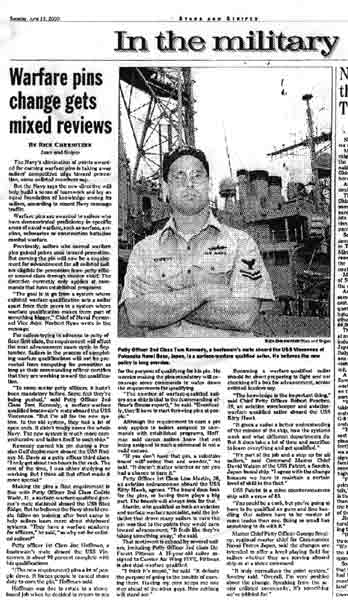
“To some senior petty officers, it hadn’t been mandatory before. Some feel they’re being pushed,” said Petty Officer 2nd Class Tom Kennedy, a surface-warfare qualified boatswain's mate aboard the USS Vincennes. “But I’m all for the new system. In the old system, they had a lot of open ends. It didn’t totally cover the whole Navy. The new system is much more comprehensive and tailors itself to each ship.”
Kennedy earned his pin during a Persian Gulf deployment aboard the USS Rodney M. Davis as a petty officer third class. “I only got about two hours in the rack. The rest of the time, I was either studying or working. But I think all that effort made it more special.”
Making the pins a fleet requirement is fine with Petty Officer 2nd Class Cedric Wade, 31, a surface-warfare qualified gunner’s mate stationed aboard the USS Blue Ridge. But he believes the Navy should create follow-on training after boot camp to help sailors learn more about shipboard systems. “They have a warfare academy for officers,” he said, “so why not for enlisted sailors?”
Doing their job at sea is part of the obstacle which kept some sailors from going for the pin, according to Petty Officer 1st Class Michael Wilson. Wilson, assigned to Commander Seventh Fleet, sees the requirement as counter-productive.
Petty officer 1st Class Joe Hoffman, a boatswain’s mate aboard the USS Vincennes, is about 90 percent complete with his qualifications.
“(The new requirement) pins a lot of people down.
It forces people to cancel shore duty to earn the pin,” Hoffman said.
Hoffman himself was due to rotate to a shore-based job when he had to make the decision to return to sea for the purpose of qualifying for his pin. He worries that making the pins mandatory will encourage some commands to water down the requirements for qualifying.
Although the requirement to earn a pin only applies to sailors assigned to commands with established programs, Hoffman said career sailors know that not being assigned to such a command is not a valid excuse.
“If you don’t have that pin, a selection board
will notice that and wonder,” he said. “It
doesn’t matter whether or not you had a chance to earn it.”
Petty Officer 1st Class Lisa Martin, 38, an aviation ordnanceman aboard the USS Kitty Hawk, agrees. "The board does look for the pins, so having them plays a big part. The boards will always look for that.”
Martin, who qualified as both an aviation and surface warfare specialist, said the initiative that drove many sailors to earn the pin was tied to the points they would earn toward advancement. “It feels like they’re taking something away,” she said.
That sentiment is echoed by several sailors, including Petty Officer 3rd Class DeForest Pittman. A 25-year-old sailor assigned to Carrier Air Wing FIVE, Pittman is also dual-warfare qualified.
“I think it’s stupid,” he said. “It defeats the purpose of going to the trouble of earning them. Having my pins keeps me one step ahead of the other guys. Now nothing will stand out.”
Becoming a warfare-qualified sailor should be about preparing to fight and not checking off a box for advancement, senior enlisted leaders say.
“The knowledge is the important thing,” said Chief Petty Officer Robert Pesebre, 39, an aviation storekeeper and aviation-warfare qualified sailor aboard the USS Kitty Hawk.
“It’s part of the job and a step up for all sailors,” said Command Master Chief David Watson of the USS Patriot, a Sasebo, Japan-based ship. “I agree with the change because we have to maintain a certain level of skill in the fleet."
USS Patriot is a mine countermeasures ship, and with a crew of 83.
“You could be a cook, but you’re going to have to be qualified on guns and line handling. Our sailors have to be master of more trades than one. Being so small has something to do with it.”
Master
Chief Petty Officer George Smutny, regional master chief for Commander Naval
Forces Japan, said the changes are intended to offer a level playing field for sailors whether they are
serving aboard ship or at a shore command.
“It truly normalizes the point system,” Smutny said. “Overall, I’m very positive about the change. Speaking from the senior enlisted community, it’s something we’ve lobbied for.”