INSTRUCTOR: Rebecca Carter
LESSON TITLE: Apply Dining
Etiquette
CLASS: AGSC 312/4th
period
DATE BEST TAUGHT Fall
TEACHING PROCEDURES---Preparation, Presentation, Application, Evaluation
Preparation (Interest Approach/Motivator)
Anticipated # of Minutes
|
Key Points |
Methods
10 |
|
Link:
Space out three questions on the board; What do you know about
Etiquette? What do you think you know about etiquette? What don’t you
know yet about etiquette? Have students discuss what they already know,
where they learned it, and how it has helped them so far.
Motivation:
Show clip from the movie Pretty
Woman. Question: How
many of you have ever been in a nice restaurant and didn’t quite feel
comfortable with what you thought you were supposed to do?
In the movie, how many of you felt that you could relate to Julia
Roberts’ character?
Overview:
Today we will…
Identify all appropriate silverware for a business dinner
Place silverware in the correct spot
Locate the correct silverware/dish for each course
Show the specific ways to excuse oneself from the table
Identify appropriate conversation topics and techniques |
Teacher led discussion
Descartes Moment
Teacher led discussion with use of Video
Review Objectives |
|
Key Points |
Methods
20 |
|
Etiquette
Presented by Rebecca Carter
Definition
Definition: Etiquette is the conduct or procedure required
by good breeding or prescribed by authority to be observed in social or
official life.
Where is etiquette used? Etiquette is used all around us.
1. When meeting people
2. When dining
3. Whenever we are around others
Common etiquette practices
1. Showing respect to others
2. Removal of hats by males in public buildings
3. Refraining from the use of cell phones in public
4. Excusing oneself when leaving an individual or a group
5. Dressing appropriately for the occasion
Dining etiquette
Fast food
1. Treat the employees with respect.
2. Remove your trash from the table when you are finished.
Full-service restaurant
1. Order food you are comfortable eating among others.
2. Wait until everyone is served his or her meal before beginning
to eat yours.
3. Leave your waiter or waitress a tip or gratuity of at least 10
to 15 percent of the bill.
Family dining
1. Pass items to the right around the table.
2. Wait until everyone is served before beginning to eat your
meal.
3. Place your napkin in your lap while eating and next to your
plate when done.
Setting the table for a meal
Casual dining
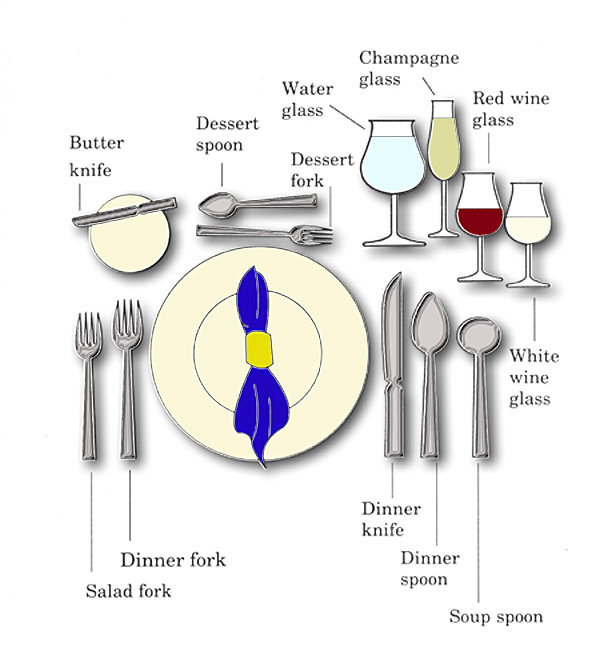
1. One plate, fork, spoon, knife, and glass
2. A napkin placed to the left; fork, plate, knife, then spoon;
glass above the knife
Formal dining
1. Nicely folded cloth napkin, salad fork to the left of plate
with tines facing up, dinner fork, plate, knife, and spoon
2. Bread plate above the forks, dessert spoon and knife above the
plate, and the glass above the fork
Basic dining etiquette
Vocabulary list
1. Dinner fork: innermost fork, used for main course
2. Salad fork: outer fork, used for salad
3. Dinner knife: knife used for meat and sometimes
for spreading butter on bread
4. Soup spoon: spoon used for either soup or
something in main course
5. Water goblet: water or iced tea glass, to the
right of the plate
6. Dinner plate: largest plate, placed directly in
front of person
7. Bread and butter plate: small plate placed to
the left of the dinner plate
8. Napkin: cloth or absorbent paper used to protect
the clothes or to wipe the lips and fingers while eating
Basic travel etiquette
A. Hotel employees
1. Doorman: person who takes luggage and turns it
over to the bellman. Also obtains taxis for guests. Tip $1 to $2 for
each piece of luggage and $1 to $3 for hailing a taxicab.
2. Bellman: person who carries or delivers luggage
to your room. Tip $1 per bag.
3. Maid: person who cleans the room. Tip $2 per
night.
4. Valet: person who sends out your clothes for
pressing or cleaning. No tip necessary if they leave your clothes while
you are not in your room. If you are present when they deliver your
laundry, tip $1 for every one or two items.
5. Room service waiter: person who brings your room
service order. Tip 15% of the bill.
6. Dining room staff: people who serve you in hotel
restaurants. Tip should be 15–18% of the bill. In a more elegant
restaurant, tip 18–20% of bill.
|
PowerPoint presentation
Ask students when they think that etiquette is most important. Do we use
etiquette in daily life?
Take a student poll on how often weekly they eat where: fast food, in a
restaurant, at home with the family.
Have students fill out dining chart with appropriate labels for each
item
|
|
Key Points |
Methods
15 |
|
Have students break up into groups of four and arrange their desks into
squares. Have the students designate one person to come to the front of
the room and collect plates, cups, and silverware for the group. Have
the students designate a different person to go to the back of the room
and get four rolls and a butter dish.
Ask the students to set up their desks in the correct silverware
arrangement that would be used in casual dining.
Have each group demonstrate to the class one example of an appropriate
way to leave the table.
Have each table demonstrate to each other how to correctly butter a
roll.
Ask each group to identify one appropriate and one inappropriate
conversation topic
|
Demonstration
Teacher led discussion
Demonstration
Teacher led discussion |
|
Key Points |
Methods
10 |
|
Pass out quizzes to each group and have them work on them individually
for two minutes. At the end of the two minutes ask the students to
discuss in their group the answers that they didn’t know.
Go over any questions from the beginning of class that was not answered.
Have the students throw away all of their trash and put their desks back
in the original order
References |
Quiz, Show What You Know Moment
Teacher led discussion. |
REFERENCES:
bremercomminications.com/images/place_setting.jpg
Reardon, Mark; Derner, Seth. Strategies for Great Teaching