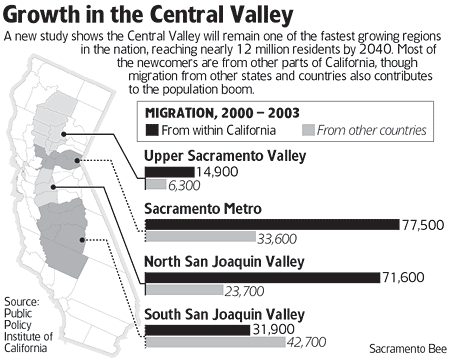
The vast Central Valley, from Bakersfield to Redding, is fast evolving into
four separate worlds. That is the finding of the Public Policy Institute
of California. In its exhaustive analysis of census data and migration
patterns, institute demographer Hans Johnson found four different
emerging Valley population trends in four distinct regions of the Valley.
The Sacramento region has emerging similarities to the Bay Area, attracting
highly educated immigrants as well as residents from the coast, both groups
finding jobs close to home. For the Sacramento region, this is good news.
The trends are mixed, on the other hand, for the northern Sacramento Valley
(defined by these demographers as Sutter through Shasta counties). An influx
of retirees, and working but poor immigrants, is creating pockets of relative
prosperity and poverty.
The same holds true for the northern San Joaquin Valley (Merced, Modesto and
Stockton). The educated residents this region is attracting are generally
earning good incomes. But for roughly half of these new residents, their jobs
are still back in the Bay Area. That's not the case for the new immigrants,
who are far less educated than those who are tending to come to the Sacramento
region and are struggling to find good jobs.
The southern San Joaquin Valley (Bakersfield through Fresno), on the other
hand, is experiencing a deathly brain drain. Despite its stunning growth
since 1990, this region has fewer college-educated residents now than then.
In a recent conversation, Johnson explained what these trends mean for
these four regions, and for the Valley as a whole.
Q:
Are the migration patterns healthy or unhealthy for the Sacramento region?
A:
I think they reflect the strong economy that Sacramento has had over the
years. In particular, the Sacramento metro region has experienced a lot
of job growth. Sacramento tends to receive both low-skilled and high-skilled
migrants, whereas other parts of the Valley receive primarily only
low-skilled migrants. Sac metro in many ways is beginning to look more like
the Bay Area than the rest of the Central Valley.
We have a very different picture emerging, with former Bay Area residents
moving to two parts of the Valley. In Sacramento, they are finding both
relatively affordable housing and jobs in the region. In the north San
Joaquin Valley, they find housing but often do not find jobs there, instead
commuting to jobs in the Bay Area. And that creates a very different dynamic
for that area. In the north San Joaquin Valley, people talk about the lack
of civic life and participation as commuters spend so much time away from
home on the road and have jobs that are in a different region than where
their housing is. There is a mixed geographic identity that exists there
that won't exist here in Sacramento.
Q:
What can any given region of the Central Valley do to change its migration
and population patterns?
A:
Key to that is job growth, and the nature of job growth. And here in the
Sac metro region, you have two very large, strong public institutions -
Sacramento State University and UC Davis. Both of those places, as we've
seen in the study, attract not just high school graduates from the region,
but also attract high school graduates from other places in California.
When they graduate, are their opportunities here or do they go elsewhere?
They do both. And that is what's different about Sac Metro than other parts
of the Valley. There is that choice. At Chico State University in the upper
Sacramento Valley, very few graduates stay in the upper Sacramento Valley.
We have a very large flow of college graduates out of the Sacramento Valley
and back to the rest of California.
Q:
Your thoughts on the new UC campus in Merced: How much can the campus
change overall population and migration patterns?
A:
It is an open question the effect that UC Merced is going to have on the
San Joaquin Valley. Obviously, it is going to transform Merced and already
has begun to do so to some extent. I think it is an open question about
whether it has an effect beyond Merced. It is hard to imagine that it will
have a big impact in terms of changing some of the economic patterns that
we see in Fresno and Bakersfield.
Q:
In Fresno, Bakersfield and the entire south San Joaquin Valley, why are
college-educated people leaving, and where are they going?
A:
Most people, when they cite reasons for moving to or from the valley, often
cite jobs, housing and family. When we look at the characteristics of people
who are leaving the southern San Joaquin Valley, it is clear that jobs are
very important.
There are not, and have not been, a large number of high-skilled jobs for
them. One of the reasons I did the study was my own experience. I grew up
in Redding, primarily, and graduated from high school in Redding. It was
my experience that if I wanted to go to college, first of all, from Redding,
I had to leave the area. And I didn't go back. Of my peers who went on to
college, very few of them have returned to Redding.
Q:
What do you make of what is happening in the northern Sacramento Valley
as someone who came from Redding?
A:
It is an interesting place. It is actually lightly populated. 600,000
to 700,000 people in a very large area. It looks in racial and ethnic
composition like California did about 30 or 40 years ago, with an
overwhelmingly non-Hispanic white majority. And yet it shares some of
the same kinds of poor economic outcomes as the rest of the valley
outside of Sacramento. It has very high unemployment rates, very high
poverty rates, like those of the south San Joaquin Valley. It has a lot
of poor economic outcomes. For that region, the challenge is to provide
economic opportunities for other residents of the upper Sacramento
Valley, people like me who grew up there but couldn't return even if
we wanted to. There simply aren't the types of jobs we'd be looking for.
Q:
Is agriculture, and its low-wage jobs, the main reason behind the trends
of these communities to attract low-skilled workers and lose high-skilled
ones?
A:
Most people are working in jobs that are in no way related to agriculture.
In fact Fresno, Bakersfield, Modesto, Stockton, all those places in the
Valley are large urban centers. The Stockton, Bakersfield and Fresno
metropolitan areas will be surpassing a million people in their populations
in the next 20 years or so. Agriculture was certainly part of their history,
and to some extent will remain a part of their future. But already those
areas are places where the vast majority of people work not in agricultural
jobs, but urban jobs. The challenge is to shape the urban economies in those
regions.
Q:
How dependent upon one another are these four emerging regions of the Central
Valley? Are we in the same boat, or four, at this point?
A:
Four boats in the same pond is the way to put it. What happens in one boat
will affect the other. It is right that these regions would consider each
other to be, in some cases, in competition for the same set of employers.
In others cases, there needs to be thoughtful regional cooperation. Clearly,
one of the best examples of that would be air pollution. It doesn't follow
county boundaries and lines. You share the same air basin. You clearly have
issues and concerns in common with other regions. To the extent that Modesto
and that part of the valley grow tremendously, it will affect Sacramento,
whether it's people who commute from that region to Sacramento or air
pollution.