Spider
�Russians surpassed everyone� � that was the European press reaction to the participation of the Cayman firm at the annual International 4x4 auto show in France.
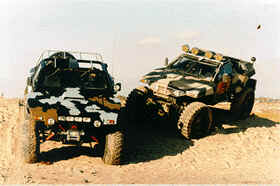
�Tarantula�, or if you wish, �Cayman-7�, was the latest masterpiece of the Saint Petersburg company in the seventh year of its existence. This sport utility vehicle (SUV), or in Russian -- BTC, does not have any analogs, at least in Russia.
The anatomy of the Tarantula is extraordinary. Its welded frame is built at the northern shipyard out of steel girders, and is able to bend if needed. All of the basic parts are built on that frame.
The second important part of this SUV is its body, which is made at Admiral Wharves from AMG-3 alloy, is almost impervious to corrosion, and can hold its shape well.
The body is connected to the frame with rubber mountings.
The construction is rugged enough for the ever-changing load. It is made as a single piece, but it is not inflexible � it can take bumps without getting damaged.
6The weight of the �naked� body is around 250 kg. The frame is even lighter.
The main load arrising from the work of the suspension and steering mechanism is transferred to the central part of the frame (a rectangle of 90x70 cm), which has been strengthened accordingly. This is precisely where the torsion bars and power steering mechanism are connected.
This version uses twin cylinder construction for the power steering. Incredibly stiff, it provides precise control when the vehicle moves over motionless vertical obstacles, and removes the constant vibrations and the beating of the steering mechanism at high speeds on rough terrain. It also decreases the wobbling of the wheels when the car carries heavy loads.
The creators of Tarantula use domestic parts. Most of the constructed elements, except for the original pieces, are of Russian make, which can easily be bought at any automotive store. That is why there are no problems fixing and finding any parts, even if the SUV will work �somewhere in a jungle�.
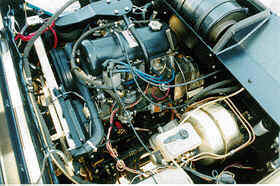
1.8-litre engine was taken from the 4-door VAZ-Niva 2131 because of its reliability, economy, and good weight/power ratio.
The five-speed manual gearbox was taken from Vaz-2107 for the rear wheel drive models, having proved itself in past reliability and easy maintenance records. The transmission is also from Niva. The choice is logical: the parts are easier to assemble. The design of Tarantula is made so �Tarantula� would not inherit problems in Niva.
The cardan shaft on this SUV is the original one with mass produced hinges.
The suspension is independent. The reduction gear that is connected to the frame is protected by special housings that also protect other vital parts.
The reduction gear is from Luaz. People, who have found this out, skeptically said: �From that puny thing? From that cattle carrier? This is not serious!� I would like to remind you that this gear reducer was built at the time when the whole country was standing on �military rails�, or simply put, they were built for war. That is why they are very reliable and can withstand almost anything.
For example, I can tell you this fact. On previous versions of the Cayman, which were heavier, had more powerful engines from UAZ with a total capacity of 2.89 litre, and greater rpm among domestic carburettor engines, there were no problems with the gear reducer, even when the Volga transmission broke down.
Power from the gear reducers that are connected to the frame, with wheel gear reducers (steel, from MAZ trucks and with 3,4-compression ratio) are of foreign make, although domestic ones can also work from AZLK 2141. The driving shaft goes through the suspension levers and is protected with �walls of metal�. This driving shaft cannot only be bent, but it is impossible to break.
Wheel discs are welded, from Niva with a deflector fin. Wheel covers are original, tires are self-inflatable and resistant to oil and gasoline. The unavoidable vertical shaking of the body is compensated by hydraulic suspension made by the St. Petersburg firm �Plaza�.
The car�s clearance can be customized from 420 to 510 mm (Yral trucks have a clearance of 500mm) The gem is in the suspension but we will talk about this once the inventors get a patent.
Dynamic performance might look disappointing: minimum speed is 3 km/p, maximum speed is 80. Gas consumption is 15-17 litres for every 100 kilometres on 92 octane unleaded gasoline when travelling off-road. But don�t forget, �Tarantula� was not built for rally racing on loose surfaces but for occasional crawling in swamps, rocks, canyons, and anywhere else where no tractor, tank or BTR can go through.
�Tarantula� was custom-built for the Baltic Financial Group, and that is why it does not have all possible capabilities that it should have. For example, this one cannot swim.
�Tarantula� differs from its predecessors with a soft-top. It is made from a synthetic material. The mechanism that connects the tent to the rest of the car is clever in design and is simple. Water cannot penetrate anywhere, and you can stand up like you would in a bus.
The car has the same interior volume of AZLK-2141, so the powerful heater (taken from 2141) fills the interior with warm air. In the front, 2 people can sit comfortably. In the back two more can sit on extra removable seats. The ascetic front panel was constructed with safety and practicality in mind. Controls were from VAZ, the levers mostly from Niva. The audio system was put to the driver�s top-right; there you can also install a communications system. The carpet on the floor is easy to wash, just like the whole interior. The water that gets in gets out trough specially made holes.
Travelling on the highway is disappointing because of the limited speed. But aside from that, it feels as if you are driving an average SUV. Good acceleration, very good visibility, and soft thick doors make even the longest rides tireless.
But don�t forget the impression the car leaves after a ride over rough terrain. The deeper the pothole, the better is the ride. Grass, sky, then again grass, rocks, sky. It feels as if the car is going to turn upside down any second, but no. �Tarantula� confidently stands on all of its four wheels. When testing, not once did it fail us, even though we were going over huge rocks and harsh swamps.
To sit behind the wheel of a Cayman (like the other models), you do not need any special driving skills. You just need to remember which control affects which wheel. The main difference from Cayman predecessors is that the car is heavier, the suspension is firmer, and the tires have deeper tread, which, by the way, contributes a lot to the fact that Cayman is virtually unstoppable.
Almost no one has ever heard of the existence of a whole class of unique rare Russian automobiles. Apparently it is for this simple reason that many institutions whose employees work under extreme conditions are not yet showing much interest in Cayman�s product. Foreigners are another matter. Another thing, sneaky, know-it-all businessmen. They are trying to get their fingers inside the design bureau in order to buy off ideas and hardware. They sense the possibilities.
In Russia, people do not realize the real price for such extreme machines. The base price for �Tarantula� is $25,000. Although the car looks rough and spartan, in reality it is quite unique and complex. But all over the world even mass-produced SUV�s cost no less. Take, for example, the Hummer: it is mass-produced, but you cannot buy it new for less than $60,000. And if you wish to customize it -- well, that is another story.
And what about other extra work? Many parts are ordered through special manufacturers. Some assembled parts are good quality and arrive by the deadline, while others are not. In that case the craftsmen at Cayman have to rebuild and/or finish the job in their own shops. I wonder how long it takes for the designers to lose their patience working like this. The foreigners are promising heaps of gold and inviting Russians to come over.
I will tell you a secret: all of the work starting with Cayman-2 was built for the Russian Army. That is where this Spartan look comes from, as does the paint finish of a bomber.
The other important role of Cayman is completely different in character. Subdivisions of MChS spend a lot of their time in places where no man has gone before. But such is the natural setting of Cayman -- swamps, desserts, woods, and cliffs. The plastic of the hubcaps is resistant to the aggressive environment, and doesn�t even fear spilled crude. In many places such a fast (some with a top speed of 120 km/h or 75mph), light (1500-kg) and maneuverable off-roader can save the day.
32If this car ever gets mass-produced, the price will not be so frightening (at least in Russia).
33The real disappointment would be if �Cayman� or �Tarantula� were sold in Russia with a label saying �made in�� -- in other words, if it is produced by a company other than Russian. The funny thing is, they would sell like hot cakes
Igor Lagytin Photos by Vitaly Ysov
Translated by Artur Kasimov
History/Timeline
1993 The Association of securities- �Defend� opens the Cayman firm.
1994 Cayman-1 is the first Cayman car to be produced, and known as- means of off-road transportation (MOT). Special construction: Unit bodies, engine from OKA-30 hp. Turning rear wheels, low pressure tires.
1995 Cayman-2 is produced. Special construction: welded body from AMG-3, all independent suspension, engine from VAZ 21011-65hp, special mechanics to swim. The company also made special low-pressure tires. Cayman is used in the �Department of Environmental Defense� in the Lenin district.
1996 Cayman has participated at the �Automobile world� auto show to initiate 100 anniversary of Russian transportation. Cayman-2 is in the film by C. Rogozhkin �Happy New Year�.
1998 Cayman-6 is produced. Special construction: space frame, new independent suspension, and automatic wheel blockage, carburetor engine from YMZ410.10 with a capacity of 2.89 litre-90 hp.
1998 Participation at the International 4x4 Auto show in Val d� Lsere, France.
1999 Tarantula is produced.
Special Thanks to Igor Grigoriev for letting me borrow the "Spider" aricle from the english version of "Koleso" Visit Koleso web site at the links section.