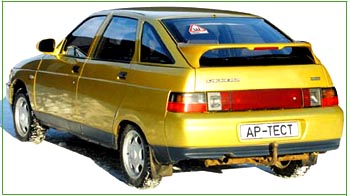
Test drive - LADA 112
To better understand the car that VAZ has recently put into production we went to the randomly picked six auto VAZ dealers. For ethic reasons we will not tell you the names for the dealers. Not in one of them car dealers could tell us anything about the car or what�s under the hood, besides its specifications. Strange, we thought and using the advantage we asked the managers about the vehicle. Most of the answers sounded like this �folks, we saw this car in pictures, the factory is not selling in large amounts yet, and this car is like Lada �108� except it is from the 2110 family.
�VAZ-2112 with a 16-valve engine was already brought to Moscow �buyers somehow got the cars from the experimental party and sell them for $7500 (Autoreview #18, 1999)
But before we start talking about the car, lets first understand what are sedans, hatchbacks, and station wagons.
Sedan is the most popular body in the world since the 70�s. It doesn�t have any serious bad sides since; it is pretty much a �classic� even if a car is front or rear wheel drive. Sedans have a load of positive effects: good balanced, comfortable interior, because everything is located between the wheel-base, and a soundproof trunk- in other words there is little vibrations or sound coming from the trunk, if something needs to be taken from the trunk it won�t bother the passengers sitting inside. This in my opinion is why most taxis in the world are still sedans even though some projects are being crated to replace them. For long distances, minivans, and buses are used, but taxis still are sedans and not only in Russia but all over Europe although they are quite large. From Paris taxis are mostly Peugeot 450, Reno Megane, Mercedes Benz-200, Opel Omega to name a few.
Station wagons are the same basic size as sedans because they are built on the same platform. If we are to talk about cars from the VAZ (in Europe known as LADA) factory they are 2102, 2104, and 2111. These vehicles have a roomy interior that allows them to carry long and heavy loads. From the consumer�s point of view, one minus is that the trunk is connected with the rest of the car. Interior is not protected from odours, noise, and in wintertime arrives the rear door gets dirty rather quickly, and when the rear door is opened it lets the precious heat out very rapidly. From the constructions point of view the stiffness is weaker, because the rear wheel arches are not directly connected to the body itself the way it is on sedans. But this is the price to pay if you want put a refrigerator and then be on your way. And this helps a lot to the many Russians who own �datchas� (summer homes-cottages for summer). And the prestige� Today luxury, sports station wagons started to pop out all over the world. Some examples are BMW-323i sport wagon, BMW-540i sport wagon, Audi A4 T Avant, Audi A4 2.8 Avant, Saab 9-5 wagon. The automobile itself-station wagon follows toady�s fashion and/or aerodynamic laws then the sedan and looks better, more complete. By our standards VAZ-2111 with a 16-valve engine is a luxury.
Hatchback is the basic type of body used with manufacturers that produce vehicles in the C-class range. In Russia, hatchbacks started with IZH-Combi at the end of the 60�s. Minuses are dirty rear door, odours, and dirt in the interior when the rear door is being opened. Pluses
Are compact, less weight, bigger interior.
Eighth family started its production in this fashion: 2108-2-door hatchback, after two years-2109 4-door hatchback, and after almost two years 21099-4 door sedan. No station wagons were built on the eighth platform. The mistake was made in the wrong order of production, since LADA 21099 had more demand.
From past experiences, the base model of the modern 2110 series was started with the sedan. The strategy was this: first 2110 with a carburettor engine, then 2111 (station wagon) with injection, then a more comfortable version of LADA 2110-21102 with an engine of almost 100 horsepower-16 valve. This way the decision was made to top the whole family with a sportier hatchback thus LADA 2112.
Because of economic reasons, first of all the tenth was not put into production for a long time. Second, its stability to the consumer was also stretched. And then the basic mechanical parts were also redesigned, a new injection engine was put, and 2111 was different then the others, the 2110 got more powerful. In the market, a new 16-valve engine started to pop out on the streets that everyone loves so much.
At this moment, tactics were changed a bit. It was first decided to put the �hot� version of 110-112 with a powerful engine and 14-inch tyres. But later, the company put both cars at once on the conveyer belt the 21122 and 2110.
This car was actually the one that we test drove. So we can better understand what did the designers and consumers want, we invited the designers and consumers to test the car with us.
So we decided to do the following things during the test:
First: we won�t try to do what the drivers are incapable of doing.
Second: it�s possible to drive on anything, so we will drive on anything we can.
Third: we will try to understand the car and not criticize it for the smallest details.
Theme: Pick nick by the roadside. Participants: two couples and two �almost single� young men.
The colour of the automobiles played a big part-golden Niva. We don�t know how does this paintjob work in the practicality department, but it was quite effective in the design and looks. In the fall, with the yellow leaves and the blue sky, the car looks very attractive. There is something in the exterior that connects to the soul. During the whole test drive not once did we comment on the great interest of the spoiled public to our car, especially children and women of all ages who paid special attention to our vehicle rather then all other ordinary 110, 09, and etc.
When we thought about what we will do at the test drive we didn�t know what to expect. It was very interesting to watch and listen to the participant�s comments and discussions about the new vehicle
Let�s start with the sitting position. Only one expert said that in the 112 you feel crowded, others, however, said it was comfortable and nice.
One of the experts said that after driving the car over 140 km/h the steering wheel tends to �rumble�. After that it was understood that there can�t be any �rumble�, and in the discussion process of the terminology of an �empty steering wheel� that on the 112 nobody commented on. All experts did comment on the difference of the steering wheel feel between the 112 and 110, and said that on the new hatchback-112 it was a lot better. Maybe this all has to do with the lack of a sedan type trunk�
All noticed that the 112 had plenty of power, and one of the experts said: � the automobile simply makes you want to press the pedal to the floor� Of course, when the conversation went about the reaction of the vehicle when accelerating the result was predictable. �2110� that was used at other test drives had a carburettor engine. But our decision was motivated by the fact that the 2110 were first sold to the public and today more drivers use these cars and thus there are more of them on the road.
One of the special things of the new hatchbacks is that 112 have better breaks. Also, the handling was better on emergency as well as normal driving conditions, probably because of the use of R14 wheels.
Resume:
The picnic never happened. This automobile was such an interesting car that we remembered about lunch at dinner.
112 made a big impact on its impression; it transformed us. We felt younger, the women more beautiful.
All drivers drove the car with great enthusiasm -- owners of OKA, foreign cars, 2110, and 2109.
Feelings:
� Comfortable, reliable, fast
� Lighter than 2110, impressive
� Engine 2111 easily, speedy, and smoothly takes us forward. The only difference between the engines -2112 can be found if a skilful mechanic looks over the whole mechanism. The automobile is more nimble than 2110, so it feels more stable, tight.
� Comfortable sitting position. No obvious problems. The interior has more volume.
� Interesting fact: the rear window does NOT get dirty at all the way it usually does with other hatchbacks!
� Even though the car is built on the same basic platform as 2110, the car performs differently, like it has it�s own character.
� We think that 112, even in its most standard form looks like a lucrative object.
� Firms that specialize in the tuning department should start to think about new suspension and mouldings for the 2112.
Price:
In my opinion, the price should be more than for 103 and less than for 102. It�s hard to predict the correct prices in our market, so I do not have the courage to predict its price.
Minuses:
� Heavy, especially for women, rear door.
� Tiresome interior noise (from individual interior lights)
� Exterior heater knobs didn�t even get us want to play with them to check the ventilation system.
� Hard suspension. (You can feel the road through your seats)
By Dmitry Baransov
Translated by Artur Kasimov
Article was borrowed from Price-Auto. I would like to thank the person who wrote this article and INTER�Omega for letting me translate it. If you would like to find information or purchasing information on LADA�s of almost any models (including trucks like VIS) please visit www.omega-inter.ru
Specifications. Engine perfromance: Lada 2110/2112
Size and dimension (mm)
Length: 4170 (4265)
Width: 1680
Height: 1430
Wheelbase: 2490 (2490)
Engines 2111 2112
Horsepower/rpm 75/5400 94/5600
Torque: 116/3000 128/3700
Top speed, km/h 167/185
Acceleration 0-100 K?/h, sec. 14/12
Fuel Consumption, for every 100 km.
At 90 k?/h 5,2/5,2
At 120 k?/h 6,6/6,5
City Cycle 8,9/8,8
Tires 175/70 R13 175/65 R14
Noise in the interior of the car, db (A) 72
Emissions R-83