
Spirited Away
Review By: A.D. Nicholas Bundt

 Series: Theatrical Movie Series: Theatrical MovieDirected By: Hayao Miyazaki Written By: Hayao Miyazaki Original Concept : Studio Ghibli Released: July, 2001 |
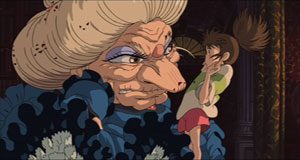
"It's fun to move to a new place. It's an adventure,” says Chihiro's mom as they drive to their new home. Chihiro has apparently been reluctant on moving. Soon after her mother assures her that moving is an adventure, her mother, father, and herself end up lost and looking down a fake tunnel, with a bellowing train screaming in the distance, and an ominous wind beckoning the family in. The adventure heeds its call. So begins Spirited Away, director Hayao Miyazaki's second greatest film. Spirited Away is not about high-tension thrills and non-stop destruction, nor is it along the lines of Miyazaki’s other current works with its giant lumbering beast-gods. Spirited Away is about the story that thrives on the little things and the huge growth of its main protagonist, Chihiro. Chihiro does not defy danger at every turn, but instead pouts by jumping up and down in an attempt to defy her parents, complains about moving to a new town, is melancholy about leaving a friend at her own home, is worried about her bouquet of flowers; only to have a fantastic adventure to make her into a strong-willed, brave little girl. Character development makes Spirited Away such a touching story, all weaved masterfully by a grand storyteller. In 2002, the Academy Awards gave Miyazaki’s Spirited Away the ‘Best Animated Feature’ award because, from what I believe, Chihiro's subtle, yet very apparent character development. Spirited Away's plot is a simple one. On their way to Chihiro's new home, she and her parents end up lost and wandering into an abandoned amusement park. Things do not appear as they seem in the park, and soon Chihiro’s parents are turned into disgusting pigs and spirits start inhabiting the area. Chihiro had warned her parents that they would get into trouble, and, obviously, they find trouble. Chihiro is then cast into a world of spirits in one of the movies most awe-inspiring sequences. Chihiro befriends a spirit named Haku, and with his help lands a job working in a spirit bathhouse. The bathhouse is owned by a witch named Yubaba, and she is a person/spirit not to be crossed. Inside the bathhouse is where Chihiro finds the driving conflict that allows for such fantastic character development. Though, perhaps I'm being too mechanical. Spirited Away is a love’s labor, and Miyazaki’s storytelling allows him to place an entire audience in Chihiro’s shoes. That is how Spirited Away works as great anime. Coming into the movie, the audience can feel as though they themselves are falling into a mysterious spirit world. Miyazaki’s narrative perspective is pitch perfect throughout the movie as the audience discovers exactly what Chihiro discovers. Miyazaki’s animation, best described, is appropriate. The imaginative world Miyazaki creates is crammed with fantastic creatures, sights, and sounds that are so lovingly animated that the animation speaks for itself and creates a sense of realism in a fantasy world. The way Chihiro moves, the way the bath operates, and the smallest movement details of creatures are, in and of themselves, joys to behold. One of my favorite touches, though small and obscure, is the boiler opening into which Chihiro must throw a piece of coal. The opening has three protrusions that mildly look like teeth, yet at the same time, those protrusions look like nothing at all, except protrusions. Small details like these are all throughout Spirited Away, and are a testimony to the thought and care Miyazaki places into his movies. Each creature in the background, every creature in the foreground, and even the backgrounds themselves have these lovely details. Clocking in at two hours, the movie never seems long or dull, due to better pacing than Miyazaki's last film. Spirited Away skips along with a nice zest as the audience descends deeper and deeper into the spirit world. The movie flows so well into the spirit world, and the conflict generated is not overtly dominate, allowing the viewer to feel at ease with the spirit world as the viewer sees its fantastic sights. We are never afraid of the fate of Chihiro's parents, because we feel Chihiro can take her time solving her dilemma. She has a lot of growing up to do before she can save her parents, and the movie takes the time and care to grow her up before the final resolution. Or, is it because we do not want Chihiro to leave this wonderful world? Pacing aside, Spirited Away is full of imagery beyond beauty and has exquisitely complex scenes. Garbage flowing out of a Stink Spirit is painstakingly animated. Papers flying around Yubaba’s desk are chaotic and hypnotizing. Fast moving shots across backgrounds and characters serve to steal the audience’s breath away. These images serve to enchant us into the world of Spirited Away. There is also the underlying themes to Spirited Away that are subtlety and tastefully presented to the audience. Themes such as greed being bad, trusting friends, and cleaning up the environment are all familiar to Miyazaki movies, and in Spirited Away these themes disappear into the event that explores them. Spirited Away does not seem like a movie that explores these themes, but the entire movie is basically built off of them. Spirited Away is a great anime. A movie that touches hearts, takes its time to make lasting images in our mind, and tells a great story of growth and imagination. Hayao Miyazaki has been making movies for a long while, and his art has been fine-tuned into parables of unimaginable grace and beauty. Spirited Away takes its female lead role, makes her grow into a fuller human being, and places her into a story with beautiful images and great depth. Spirited Away is the undisputed gem of Miyazaki's newer works. |
<Top>
Report a broken link / image to the webmaster.Last Updated: September 6, 2006 |