
Diebuster
Review By: A.D. Nicholas Bundt

 Series: 6 OVA episodes Series: 6 OVA episodesDirected By: Kazuya Tsurumaki Written By: Yoji Enokido Original Concept: Studio Gainax Released: November, 2004 |
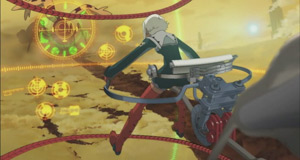
The problem with many anime franchise sequels is that they assume you enjoyed the original show enough to push along weak material involving the same characters you already know and enjoy. The problem with other sequels is that they generate a new storyline involving the initial concept, but spun in a radically different approach that pulls all the life out of the original. In 1988, an OVA called Gunbuster/Aim for the Top was created by the then still young Gainax studios. The show was a fantastic display of creative animation, imaginative, yet bold storytelling, and, above all, a proud display of campy action. In 2004, Gainax created a sequel to the show, entitling it Diebuster/Aim for the Top 2. I’m sure that more than a fair number of people were worried about the possible outcome of this gamble. So, imagine my surprise when I came upon Diebuster and found it to be not just an equal to its predecessor, but found the six episode OVA, in many ways, expanding upon the original that spawned it. Directed by Kazuya Tsurumaki—the same genius behind the first half of End of Evangelion, the last eight episodes of His and Her Circumstances, and the director of the hilariously great FLCL—Diebuster was the first of Gainax’s 20th year anniversary projects and is a showcase of how camp should be handled in present day anime. First off, Diebuster is the story of Nono, a girl wanting desperately to become a space pilot. She must have been entranced by pilots earlier in her life, because she will stop at nothing to become one, spouting off on unsuspecting people that she must “become a Nonorigi!” Whatever that may be. In the very first scenes of Diebuster, we see her stowing away on a train—a standard Gainax motif—and starting her journey to become a pilot, only to be trapped in dept and working herself towards the fleet academy. To say that she comes closer and closer to her goal would be obligatory. If she did not progress towards her goals, the show would not be an interesting one. Soon enough, one thing leads to another and Nono is soon caught way too close to a ground battle between the space monsters and a Gunbuster, specifically Dix-neuf, the second female lead’s Gunbuster. Lark, the pilot of Dix-neuf and Nono’s Onee-sama—a nod to the original series—soon adopts Nono in Fraternity, the Gunbuster pilots’ base of operation. These pilots are called by the name of Topless. Being Topless is to possess the ability to control the Gunbusters, and the name is a nod to the practically useless Top division in Gunbuster. Nono soon trails along with Lark and ends up in the middle of every conflict with the space monsters. Nono affects and is affected by all the battles within the series, and the space monsters are in tandem with the space monsters of the first series. Just like the first series, Diebuster is also a dense interweaving of plotlines and fantastic visuals involving the ever present enemy of the space monsters. In fact, Diebuster is structured very similarly to Gunbuster. However, there is one nagging question when watching the show. Where is this show in the timeline of the Gunbuster universe? It is a retelling? Is it many years in the future, where time dilation is no longer an issue? If it is in the future, why are there still space monsters? Where they not dealt with in the first series? Tsurumaki deals with this problem without addressing it. In many shows, these facts would be placed in an exposition segment of the series, thus cheapening or removing a chance for some mystery and intrigue. Diebuster knows the audience is asking these questions, and thus delivers the answers in a way a show should answer them; through actions and images. Besides, there is hardly any time for exposition. Diebuster is all about Nono, who is fantastic mesh of character design, comedic relief, and dramatic conflicts. Nono is one of the Gainax’s most memorable female characters, and with her pink hair and smiley hairpin, Nono is both compelling as a character and alluring as a female character. She is funny, serious, goofy, simple, and complex all at once, and by episode four we know that Nono holds a secret that not even she knows herself. She stands as one of the additions of pink-haired characters that are so intriguing to watch, and will be remembered for years to come. Speaking of Nono, one of Nono’s special talents is splitting objects in half, such as plates and apples. She discovers this when she is working in a bar, and soon is racking up a debt from destroyed objects. She soon graduates to larger objects. “Normal people don’t break refrigerators,” her boss says to her. If only she knew what Nono will end up splitting by the end of the series. Nono’s ability is a humorous concept and is utilized in such a grandiose way that Nono will split things and the audience will not even realize it. I thought it was a funny character trait, but Tsurumaki is setting up Nono’s role for the entire series. After a second viewing, I discovered that Nono’s ability is obviously in plain sight, and that I had missed it. It is just that the creators did not force the point down the audience’s throat. Nor does any of the subplots, or even the main plot, receives the treatment of audience bludgeoning. For example, one subplot involves some of the minor characters, who are Topless members. At every age, there comes a time when the Topless lose their Topless ability. It is a crippling event and there are many ranging reactions in dealing with it. This subplot resurfaces time and time again, but never has a full episode dealing with it. It is around the edges of the main story, so by the time its drama effects the characters we care about in episode six, the effect is of shock and surprise from the audience and very powerful drama in the series. Gainax also knows that dramatic events sometimes work best when it is not just the audience witnessing the events, but also minor characters who can do nothing but witness what is unfolding. Pushing such plot lines to the side allows for some mystery to develop behind them, and the best use of this produces the ending of Diebuster, which is one of the great endings in anime. It is a complex, heart-filled, ah-ha moment that is shown through the most simplest of images. Diebuster’s ending made me smile, and smile, and smile for days afterwards. It is that good. Though, all this talk about fantastic endings and dramatic effects is making Diebuster sound like some sort of dramatic masterpiece. It is not, by any stretch, a realistic, serious space series. It is a giant fighting robots show, and I do mean giant. However, what makes Diebuster work is the dead-pan presentation of outrageous concepts. Tsurumaki’s directorial style has always been touching the extremes. Animation allows us to create things, actions, and locations beyond life-action, and Tsurumaki almost abuses this concept. Though, the dead-pan deliver follows the traditions set by the first series. Every outrageous moment, from a planet being cut in half to a tennis racquet wielding Gunbuster that comes in a plastic wrapped action figure case, miraculously avoids being stupid and over-contrived, and becomes funny and awesome. Everything is at extremes, and that is why Diebuster melds so perfectly to Tsurumaki’s style. If anything, Diebuster must be seen for the visuals. Tsurumaki knows how to set up a frame and knows how to use color, shadows, and animation to bring characters and events into beautiful visuals. Diebuster is not a good looking anime, but a gorgeous one. The newly built Gunbuster awakening behind Nono; Lark yelling at the presumably dead Nono; Nono running towards the door to see the sky larks; the tea-ceremory room that is also a briefing room; every single shot in this series borders on perfection. Tsurumaki’s use of camera angles, pauses, and color washes adds tremendously to the series, and never detracts. Everything within the series is stylized in a way that is fun to watch, but never so deformed that it becomes unrealistic. Maybe Gainax was putting both series on the line when they decided to green-light the project. Too many sequels have sucked the life out of the original, and too many sequels have been disappointing mush, making them unable to stand alone. Diebuster does not follow that line of unfortunate tradition. When a series splits a planet in half, only to have the planet slid along its cut, so—you know—the audience knows it is cut in half, deserves some credit. Diebuster plays the point so seriously, which makes it funny. Diebuster is a showcase for camp action, which not only amplifies its predecessor, but allows the series to stand on its own. Diebuster is great anime, and is by far the best of the 20th anniversary works Gainax, which have been otherwise been disappointing. I was unsure about this gamble at the beginning. Too much was at risk, for both this project and the original Gunbuster. Maybe that is why one of Diebuster’s themes is what humanity will gamble on in order to win; how much humanity is willing to put at stake. Gainax has gambled, and has produced a series worthy of its history. Coming out soon is a Gunbuster vs. Diebuster movie. What it is about, I am unsure. However, it is deemed great, the three reviews will be merged into one. |
<Top>
Report a broken link / image to the webmaster.Last Updated: September 6, 2006 |