
Akira
Review By: A.D. Nicholas Bundt

 Series: Theatrical Movie Series: Theatrical MovieDirected By: Katsuhiro Otomo Screenplay By: Izo Hashimoto Original Concept: Katsuhiro Otomo Released: July, 1988 |
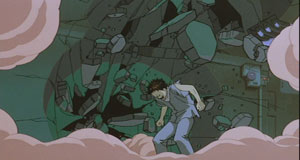
For America , classic anime has literally no other perfect designator than Akira. Akira is a film that helped translate Japan ’s “funny cartoons” to American audiences. For that, Akira has a solid and loyal fan base. No matter how loyal fans are, however, many anime movies and series are simply replaced by the next big series, and once loyal fans move onto bigger and supposedly better things. There must be a reason why Akira’s fan base still exists, why Akira has so many releases and re-releases, and why people never seem to grow out or old of the movie. (I mean, how many people love to admit that they are avid Sailor Moon fans to this very day? Right now, I am definitely saying I am an Akira fan.) Two reasons come to mind as to why Akira’s fan community has never left it out to dry. First, Akira is one thing above all: it is a show case to what animation can and should do. I make the case that Akira is one of the best looking movies in anime history with the simple argument that Akira used literally zero help from computers in the animation production. It is the same reason why Ghibli movies have such a force of awe behind it, and it is the same reason why some people prefer the older-looking animation to the slick, almost soulless, animation of the present day—some series excluding, of course. Akira’s animation is the easy to explain reason, which really is only done justice by an actual viewing of the movie. The second reason Akira is a seminal movie, beyond its fantastic animation, is that Akira, at its very heart, follows all the conventions of a blockbuster movie, which allows audiences to have simple escapism with the movie, even though Akira’s story is cheapened. Akira’s story is a very compact, and honestly, cobbled together series of events that pales compared to the lengthy and beautiful manga. Katsuhiro Otomo’s manga is brilliant, and his directorial role is far from stale or worthless, but the medium he was working in with the story he had made allows too little. The story is not what keeps Akira afloat, but Otomo’s direction knew a thing or two. Akira’s following of standard conventions is what makes the movie work and work well. My friend and I recently watched Akira because we had not seen it in a while, and we wanted to watch something that was entertaining, but would not make us fall asleep. After the credits were rolling, my friend threw up his hands as he often does and said he had come to a conclusion. The creators had made some fantastic quality bullshit. I asked him to explain, and soon enough we collaborated on a metaphor that helped us visual how Akira works. We knew we enjoyed the movie immensely, and what surprised us was that we where not angered by the inability to piece everything together, whether it be directly told to us, or by coming up with reasonable, supportable explanations from the content provided. This confused us. The metaphor works as such. Every anime series and movie falls into two categories. The first category is anime productions that might try to do things different, but basically end up telling their story as like any other story, and the quality of the series can be determined by how effective the story was. Basically, the throw-away entertainment category. Creators that work this field should be good at presenting a story that intrigues us because we want to know what happens next, but by the end we feel as how we should and little needs to be dwelled upon, because nothing of interest was presented. The second category would be the “art” category, the category Akira falls in. This category is a very fine line to walk, and this is where the metaphor comes in. Creating art is like building a well. The diameter of the well would be how much or how little the creator—consciously or unconsciously—to wants portray on the screen. This involves what the story is about, what visuals are used, and how the story is presented. Now, a well needs a bottom to hold all the contents. Some bottoms are shallow, but certainly not throw-away entertainment. These are shows that have some meaning behind them that the audience can take away from it. A sort of allegory for personal, public, or completely unknown affairs that works as a sort of principle set of rules for that specific topic. It takes a truly gifted talent can make a well with a bottom so deep that a majority of the audience knows the bottom is deep, but will not be able to truly find it. Making the well deep can be purposeful, by chance, or by complete ignorance; it does not matter, but as a working system within the well, the bottom is somewhere deep within the meanings, metaphors, and symbolisms on screen. Some talents can do it, others cannot. Akira’s well has no bottom, as my friend concluded. That is why it is quality bullshit and this is why the story fails for making the movie work on its own. Otomo had no ground rules for what reasons, with what specific factors, and for what systematic logics, were perpetuating what exactly Akira’s power is. Or, if he had the rules, he certainly did not have the time or the story arc to explain—or even hint at—said rules. From seeing the movie many times, I understand the process and end result of Akira’s transformation. That is deducible from what is presented. What baffles me is where this power is coming from. The female protagonist Kei offers nothing but ramblings about the origins of Akira’s power. If I take Kei’s shaky understanding of where the power comes from completely as truth, I see very little correlation between that power and psychic abilities manifesting itself into people. Having the primal energies of millennia gone past should not allow you to read and control the mind of another. For this, Akira is a bottomless well, and thus not worthy of attempting the journey to find the bottom. To take that journey, read the manga. It provides much more explanation about the powers, with my personal favorite analogy being Tetsuo’s river of energy. Processing more energy is irrelevant, says Tetsuo. It is about directing the eternal energy’s flow. This is where normal movie conventions come into play. Akira is a movie about psychic human beings and the anti-government groups that tries to lay their hands on these psychics, with the most powerful of the psychics being a person named Akira. This is the bare, basic premise, and from this premise comes classic movie conventions. Kaneda, one of the lead characters, is one convention at work. He is a standard comic-relief character that follows two important rules. One, he is actually funny, and two, even during intense situations and extreme danger, no physical harm will actually come to him until the climax of the movie. He survives an almost direct orbital laser impact with no injury because he is the funny character. There is no convention more standard than that, but what makes the convention work in Akira is that there is absolutely no mention of it whatsoever, either as some cynical, post-modernist comment or otherwise. In addition, the two-hour long Akira fits very well into a three-act movie structure, another standard movie convention. These conventions merge with the story presented to create a movie that has no bottom to the well, but the audience is intrigued by what they see, feel, and hear, instead of being annoyed and frustrated. The audience may not know what is going on, but they certainly know what they are seeing on screen is breathtaking. Akira’s detail in every frame reaches the ludicrous. There are many shots where every window in the background buildings is filled with different pieces of furniture and different layouts of workspace. Combine that with fluid animation unseen and unparalleled, hand drawn to fill in two hours worth of material, every lighting effect merges together and every spoken word matches exactly to the mouth movements of characters, and the beautiful “cinematography”, capturing scenes of Tetsuo, resident antagonist and Kaneda’s childhood friend, rising dramatically up from burning helicopter wreckage, and you have a visually stunning movie that has influenced generations of filmmakers all over the globe. I could delve deeper into the animation’s breathtaking qualities, but it is only best to be seen first hand. What impresses me most, though, is that all these feats of animation where completed with a very minimal use of computers. Thus said, the only computer graphics used in the movie is the read-out of Tetsuo’s mental abilities, which dance in a circle pattern that is never explained in the movie. I assumed more visuals equal more power. Yes, the animation is amazing, and I recommend Akira only for its visual prowess. It is the only anime that I will probably ever recommend under such category. Akira is great anime, and the visual showcase. However, as I hopefully have made it clear enough to address, Akira would normally not work as a movie and would certainly not be great anime. Its story does not come through, and that lack would be infuriating. But Akira never angers, but pleases and entertains. It is a well that has no bottom, but Otomo was talented enough to masks its fallacies with normal throw-away conventions. Akira is the animation showcase through either a freak occurrence of good fortune, or of Otomo’s direction allowing for Akira to merge a story too compressed to be successful with the entertainment value of a blockbuster and the visual sensuality exploiting the eccentric nature of the events. Either reason would suffice, as long as Akira retained its animation. |
<Top>
Report a broken link / image to the webmaster.Last Updated: September 6, 2006 |