Whistle Filter
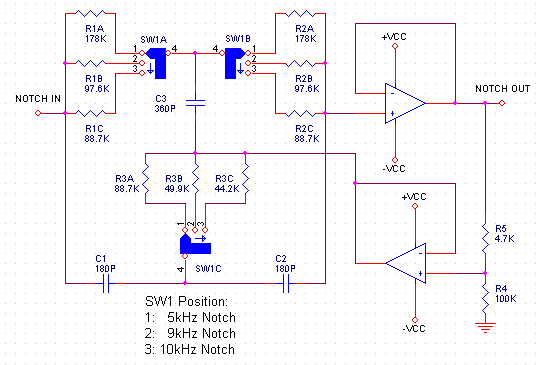
The schematic above is the notch filter section of the AM signal processor. It is extremely difficult to form a high Q notch filter at high audio frequencies. The Twin T notch configuration was chosen because it is unity gain, and relatively easy to tune. All passive components should be 1% except for R11 through R14, which can be 5%. The depth of the notch depends to a large extent on the matching of the components. C3 should be formed from placing two 120 pF in parallel. Care should be taken that these capacitors should be taken from the same batch. Similarly, R1 and R4 should be from the same batch, as should R2 and R5, and R3 and R6.
There are areas of the world where both 10kHz and 9kHz stations are receivable. In these areas, virtually any frequency from 1 kHz to 20 kHz is possible. It would be difficult to design a filter to reject all of these frequencies. In the unlikely event that a particular frequency is objectionable, this design can be modified to reject it: the center frequency of the notch is 1/2pR1C1. R2 = R1, C2 = C1. C3 is twice C1, R3 is one half R1. If there are more than one tone in the audio, two or more notch stages can be cascaded to eliminate them. Sections of the filter can be eliminated. A North American listener can eliminate the 9 kHz notch. The 5 kHz notch can be eliminated for listeners that do not care about shortwave.
Low Pass Filter
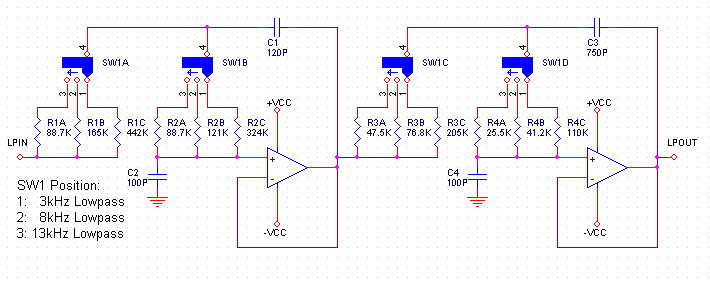
Each op-amp is configured as a Sallen-Key low pass filter. Stage 1 has a Bessel characteristic, and stage 2 has a Chebyshev characteristic. The combination of the two form a Butterworth filter with a roll-off of 0.5 dB at the indicated frequencies. The three frequencies selected - 13 kHz, 8 kHz, and 3 kHz are selected to match the settings on a Hammarlund SP-600JX receiver - which the author uses for Medium wave and shortwave listening.
Rumble (High Pass) Filter
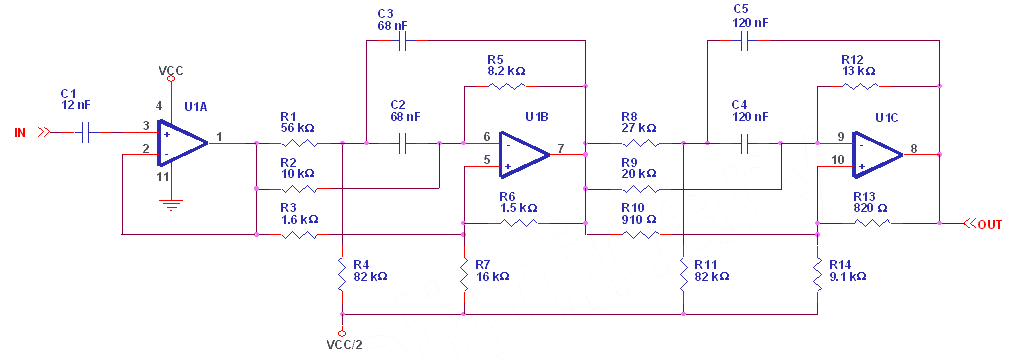
The rumble filter above has been designed to reject audio below 50 Hz. It is a 5 pole elliptical filter with no more than a couple of dB ripple. Since the ripple occurs in the low bass end of the response, it should be inaudible.
Response
This audio processor has several switches to enable and disable functions as needed. The response below has the rumble filter enabled, with the 13 kHz, 8 kHz, and 3 kHz low pass filter progressively each separately enabled. The "flat" postion is not shown. The notch filter is disabled in the first response curve, and enabled in the second. 9 kHz and 5 kHz notch response is not shown, but will produce similar results.
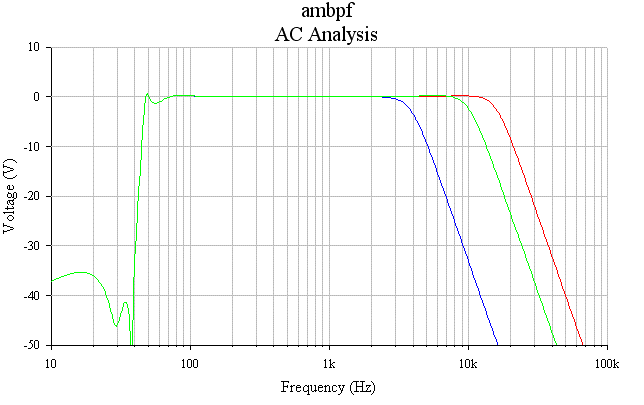
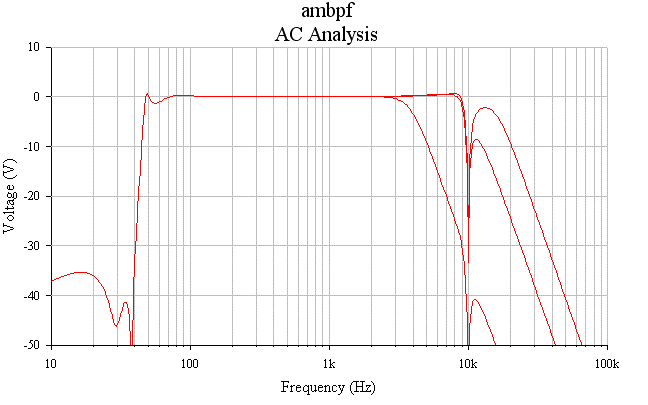
The action of the notch makes the 13 and 8 kHz settings of the low pass filter almost identical, except for a small band of high frequencies above 10 kHz. The 10 kHz notch is not needed for the 3 kHz low pass filter. Even without it, 10 kHz is attenuated more than 30 dB.
A Simpler Alternative
There is an alternative to the audio processor above. All of the undesirable audio components can be eliminated in a single filter, if high frequency audio (above 10 kHz) can be sacrificed. The audio processor shown below is a 5 pole 50 Hz high pass elliptical filter with 0.5 dB ripple, followed by a 5 pole 8 kHz elliptical low pass filter with 1 dB of ripple. It has over 40 dB of rejection below 40 Hz and above 10 kHz.
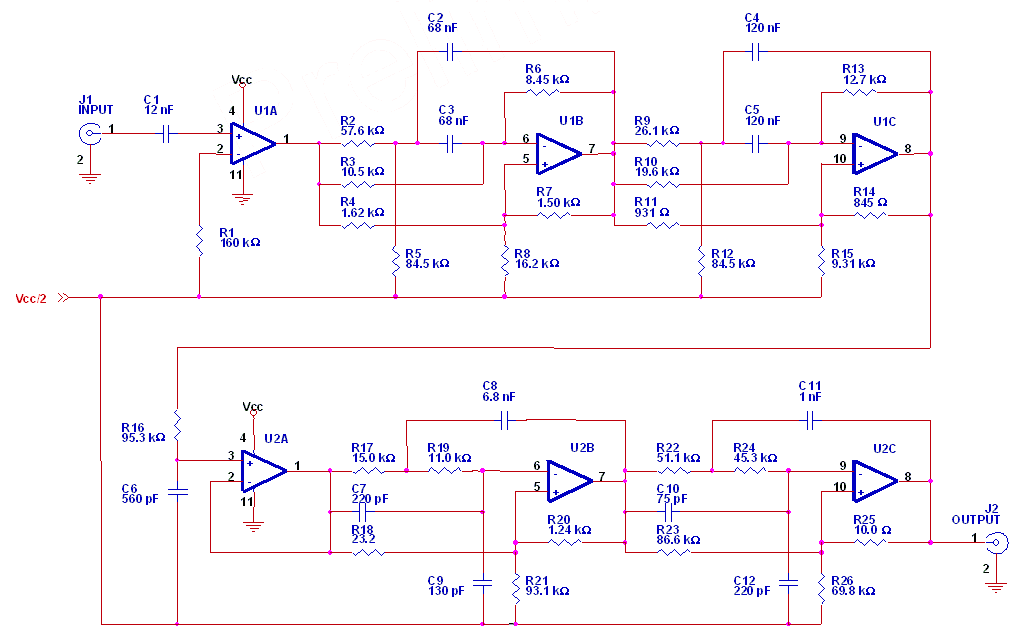
Two of these filters should be constructed for AM stereo. If monaural reception is all that is desired, only one filter is required. Component values are critical. There is no way to convert to 5% resistor values, 1% are absolutely required. If 5% are used, filter characteristics will degrade badly. The response of the filter is:
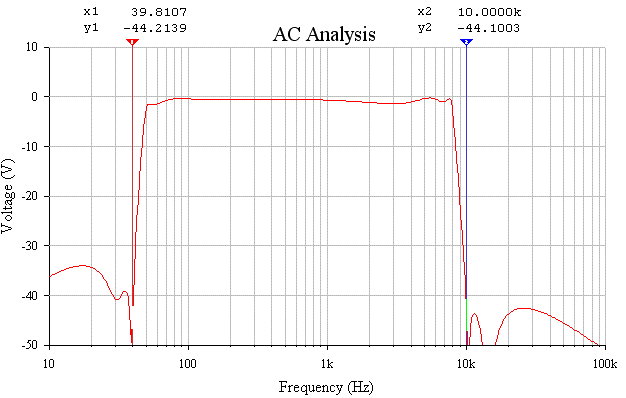
The high pass filter will remove the pilot difference frequencies as well as the stereo pilot, while allowing bass frequencies of 50 Hz and above to pass unaltered. Because FM radio also rolls off below 50 Hz, the listener should not notice any difference between AM and FM in bass response. High frequency noise and the 10 kHz pilot tones are removed by the low pass filter. This filter also limits the high frequency response of the AM audio to 8 kHz, so the listener may notice a difference compared to FM. Because high frequency noise only occurs on distant stations in the daytime - the listener should be able to listen to local AM stations with the filter section switched out the circuit.
The circuit above is the rest of the circuit, showing the power supply, the creation of Vcc/2 (U1D), and the bypass switch. If monaural reception is all that is desired, only one set of input / output connectors are needed, and SW2 can be a SPDT.