
Arahau [ara'xaŭ] is an a priori constructed language created by Russian writer Ivan Karasev in 2006.
The Arahau language is polysynthetic and typologically active. This is unlike most artificial languages. Each vowel designates a noun, and consonants designate grammatical formants. This system often lets Arahau produce compact speech. Arahau has been found to have similarities with Basque and Nakh-Dagestanian languages.
Arahau is a minimal language. It has 26 phonemes (not including diphthongs and triphthongs) and about 100 main root words. Grammar is minimally inflected. The valency of a verb and word order determine case, because it is an active-stative language. Auxiliary formants mark constructions such as questions, negative polarity, and grammatical aspects. Arahau has a system of noun classes. They are marked by vowels (a – the humans, u – the animals, i – the plants, o – the names etc.).
Arahau is inspired by natural philosophy and dualism. There are only two grammatical genders, tenses (real and irreal), grammatical numbers, personal pronouns (near and far), grammatical cases (translative case and possessive), parts of speech (the verb and the noun) etc.
Arahau uses only the Subject Verb Object (SVO) word order.
|
|
a |
ä |
e |
i |
o |
ö |
u |
ü |
ou |
ao |
|
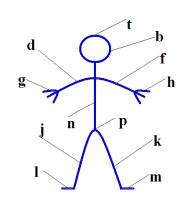
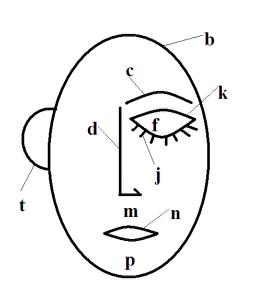
BR rb |
head face |
|
vault
|
top
|
– |
mountain, north
|
muzzle
|
source
|
brain hart |
sugar
|
|
CR rc |
eyebrow knee |
|
rainbow
|
|
– |
hill |
horn |
|
|
|
|
DR rd |
back of the head left hand |
wing |
night
|
wind |
– |
east |
right low |
|
|
hot |
|
FR rf |
eye left hand |
|
sun
|
hollow
|
– |
pit, crater west |
|
typhoon
|
|
|
|
GR rg |
temple finger of the right hand |
|
thunder, lightning |
foliage |
– |
|
claw of the right low |
tail stream, spring |
|
|
|
HR rh |
pupil finger of the left hand |
|
moon
|
|
– |
|
claw of the left low |
|
|
|
|
ZR rz |
eyelash body |
|
|
needle trunk |
– |
|
|
|
|
|
|
KR rk |
neck left leg |
|
|
|
– |
south |
|
estuary |
|
|
|
rl |
phalos |
|
|
|
– |
|
|
|
|
|
|
MR rm |
mustache left foot |
antenna
|
|
волокно root |
– |
|
|
|
|
acid |
|
NR rn |
mouth back |
панцирь |
|
flower
|
– |
|
jaws, mouth of animal
|
whirl
|
liver
|
bitterness
|
|
PR rp |
beard omphalos (stomach) |
bristle
|
rain
|
|
– |
grass centre |
wool belly, paunch |
wind
|
lung
|
salt
|
|
TR rt |
ear breast |
|
|
|
– |
plain |
|
noise
|
kidney
|
cold
|
The alphabet and reading
Arahau's alphabet
is Latin. It has 27 letters:
A, Ä, B, C, D, E, Ë,
F, G, H, I, J, K, L, M, N, O, Ö, P, R, S, T, U, Ü, V, Y, Z
which correspond to 27
sounds. There are ten vowels and seventeen consonants.
Each letter corresponds to one phoneme (one precise sound). Pronunciation does not depend on a letter's position in a word. In particular, consonants at the end of a word are never silenced, and vowels do not change. The accent in words varies and falls, as a rule, on a root verb.
The pronunciation of
practically all letters can be assumed without special preparation (M, N, K,
etc.) The pronunciation of others is significant:
Ä [ʲa],
Ö [ʲo],
Ü [ʲu]
as in German.
Y
[ɨ].
Ë
[ʲe].
Е [e].
H [x] the fricative sound [kh].
J as in the word 'yard'.
С – an affricate [ts].
Arahau uses double consonants (geminates), even at the beginning of a word. The structure of words is not uniform: There can be congestions of consonants, both in the beginning, and in the end. The usual construction of a word that consists of a maximal cluster is сссVссс.
|
A |
-as-
to think; |
G |
g-
that...; |
N |
n-
to be mobile; |
U |
-us-
to be (to exist); |
|
Ä |
-äs-
to drink; |
H |
h-
dual number (h+Noun); |
O |
|
Ü |
-üs-
to flow; |
|
B |
b-, -b-, -b together (with); |
I |
-is-
to have; |
Ö |
-ös-
to rest; |
V |
v-
that does...; |
|
C |
-c- and |
J |
j-
intention of action |
P |
p-
one whom; |
Y |
-ys-
to irritate; |
|
D |
d-
near; |
K |
k-
one who |
R |
детерминация; |
Z |
z-
very; only; |
|
E |
-es-
to do; |
L |
l-
no, not; |
S |
s-
you (he); |
Ë |
-ёs-
to gladden; |
|
F |
f-
there, where; |
M |
m-
to be live; |
T |
t-
I; |
|
|
Examples
Lord's Prayer
Our Father in heaven,
hallowed be your name,
your kingdom come,
your will be done,
on earth as in heaven.
Give us today our daily bread.
Forgive us our sins
as we forgive those who sin against us.
Save us from the time of trial
and deliver us from evil.
For the kingdom, the power,
and the glory are yours
now and for ever. Amen.
Ëttange msuohusoer
Msfarfésarkv músgausaskecö
Soisiragsaguastaa coezetlo cosareasguoastaa
Ctaarë’skuoastaa. Coslavadorfaat
Nsaulsyrtaakl marcozusfarfsopl.
Design principles
 Each vocalic sound designates
a noun, and consonants designate grammatic formants. The construction of
language allows it to reduce a stream of speech sometimes. The Arahau
language is generated by a polysynthetic principle, and the language is
typologically active, unlike the majority of artificial languages.
Each vocalic sound designates
a noun, and consonants designate grammatic formants. The construction of
language allows it to reduce a stream of speech sometimes. The Arahau
language is generated by a polysynthetic principle, and the language is
typologically active, unlike the majority of artificial languages.
Language belongs to not numerous groups of linguistic models of active typology. Each letter of language Arahau bears semantic loading, and behind vowels the dominating role admits, and consonants are grammatical formants. Therefore all words in Arahau are etymologically transparent. Categories of a case and tense in classical understanding are absent. The specific design of a new language allows reducing essentially length of words (Speed think). One word of language Arahau due to incorporation can transfer the whole sentence: t-fra-s — I see you (the reference to the person), ro-s-fru-k? — Do you see yourself? (The reference to an animal), Ma-c-af-us-hod-g-argei - the Life and Death are two halves of the whole.
In the alphabet Arahau only 27 letters (ё – soft “e” and y – “dark i” are facultative as transfer categories of politeness and roughness). Drё – aroma, dry - fetidity. The system consonantism is very simple and characteristic absence hissing sounds. The vocalic system includes vowels back of some as in Finnish, and also ё (more softly then e), y (postlingualis sound), and also 10 simple diphthongs, 10 long diphthongs (triphthongs).
The most specific formants language Arahau - pronouns (the third person is absent) to which the important role drops out - to mark the beginning (an active pronoun) and the end (an inactive pronoun) words. Pronouns are capable to mark quantity of participants of action and gender characteristics: ta – I, taaj – we (women), tacaaj – we (the man and two women). In this case complex pronouns can be transcribed by specific consonants: ɕ, ʂ, ʐ, ʑ, ʥ, ʨ, ʧ, zz... For example: taj-anr-ajs [ʨanɾasj] – I (woman) speak you (woman).
In Arahau there is the unique
opportunity which is not meeting in other linguistic systems. It is a
question of the specific "irreal" pronouns suitable in basic for the
folklore texts. For example, it is possible to tell not only sa – you
(man), si – you (tree), but also saof – you (extinct fire).
Besides can be used exclusive and inclusive pronouns: taba – I with
you, tabla – I
 without you.
Language
Creation of
language Arahau is attempt in some times to reduce a speech stream without
essential damage for understanding. Such rare mechanisms of linguistic
designing as active typology are involved in it, polysynthetism and noun
classes. Being some kind of gymnastics for mind, Arahau is possible to
consider as one of the hypotheses explaining an origin of words in language.
The specific structure of the new language which has absorbed many of
archaic and unique linguistic characteristics, possesses the certain
gnosiological value. It essentially facilitates understanding of structure
of many languages which are appeared on periphery of a modern civilization
and not entering in Nostratic macrofamily of languages.
Diphthongs
The phonologic
system besides 10 vowels includes 10 diphthongs which also as well as vowels
designate nouns:
au, ao, ae, ai, ou, oe, oi, oa, ei, ea
10 long diphthongs (triphthongs)
serving for formation of plural:
uau, uao, uae, uai, uou, uoe, uoi, uoa, uei, uea
And four labial diphthongs
which are facultative and serve for specification of sense:
ua, uo, ue, ui.
Diacritic
Diacritic (á, é,
í, ó, ú, ý) serves for a designation of the intense (guttural) vowels at
formation of categories of tense in verbs. Letters (ă, ŏ) designate
the unessential vowels inserted for correction of harmony. And letters (â,
ê, î, ô, û) are usually used in dictionaries for marks of roots and also
are facultative.
Dictionary structure
In Arahau there is
a more potential of designing of specialized lexicon. Well enough also the
base lexicon is thought logically over, but there are some lacunas in a kind
of the small period of existence of this language.
Grammar
Arahau it is
possible to state grammar in the form of the dozen simple rules shown in the
tables. Language has logical structure: each vowel letter (or their
combinations) transfers a noun (a - the man, o - a name, u
- an animal, ai - a stone, etc.), and each consonant specifies sense,
acting in a role of propositions, verbal aspects, etc. Declensions, cases
and conjugations are absent. In Arahau only two parts of speech - a noun and
a verb, two categories of tense (real and presumable), two persons - the
first (personal) and the second (extraneous).
Plurative
Alongside with
plural which producing doubling of vowels or consonants (saa-h-is-opl>
ssisopl – they have all) or due to labialization diphthongs, exists
special formants, forming a singular from plural (woods> a tree, breads>
grain, an onions> a bulb) and multiplicate number (a – the man, aa
– people, aad – a member of a society, az – a giant).
Plural is formed by doubling of a vowel: аа – people, aaj –women. If it is a question of words where there are diphthongs in plural they will be transformed to triphthongs (it is added u-): ое – a bone, uое – bones. Adjectives as an independent part of speech in Arahau are not allocated. It is possible to speak, however, about «adjectives cases» –affixes: ad – the small man, az – the big man, af – the dead man, nunu – a sleepy animal...
There is binary (pair), and even the figurative number used infrequently. A marker of this category h-: haj – two women, haaj – three women. And also for pair things –‘horns’ hucr, ‘brothers’ hara. Plural of higher order is less often used: haca - ‘four’, haaca - ‘five’, hacaa - ‘six' it can be characterized and the combinatory number uniting different gender categories: taaj – they women, tacaj – they the man and the woman. And can be united not only people: tacij – they (the man and a grass).
Interrogative
The interrogative
forms are constructed by an interrogative words (do, vo, go, etc.),
or special formants ro- (“whether”). Rotáfrs? – “We
shall meet?” Gotafr? – “What do you see?” Ofsus? – “Where do
you live?” or Fofas? – “Where is your house?” Odors? – “What
is your name?”
|
how, which |
do-|od- |
means |
dor |
by no means |
lod |
somehow |
dlo- |
|
than |
vo-|ov- |
material |
vor |
by nothing |
lov |
by something |
vlo- |
|
and |
co-|oc- |
union, league |
cor |
- |
- |
- |
- |
|
but |
no-|on- |
opponent |
nor |
- |
- |
- |
- |
|
let, if |
mo-|om- |
admission (condition) |
mor |
- |
- |
- |
- |
|
where |
fo-|of- |
search |
for |
nowhere |
lof |
somewhere |
flo- |
|
whereas, while |
zo-|oz- |
consequence |
zor |
- |
- |
- |
- |
|
when |
bo-|ob- |
time |
bor |
never |
lob |
at one time |
blo- |
|
whether |
ro-|or- |
question |
ror |
- |
- |
- |
- |
|
what |
go-|og- |
object, place |
gor |
nothing |
log |
something |
glo- |
|
who |
ko-|ok- |
subject |
kor |
nobody |
lok |
somebody |
klo- |
|
it, this |
ho-|oh-, arg |
index, guide |
hor |
- |
- |
- |
- |
|
even |
to-|ot- |
hyperbola |
tor |
- |
- |
every, each |
tlo- |
|
may be |
po-|op- |
possibility |
por |
always |
lop |
all |
plo- |
Negation
 Negation
besides has the double nature; and in general behind the letter l the
special role admits word-formation. Compare wide application of this sound
in case formants k/kl – above/under, p/pl – in/from, v/vl
– to/from, b/bl – with/without, d/dl – near/far.
Negation
besides has the double nature; and in general behind the letter l the
special role admits word-formation. Compare wide application of this sound
in case formants k/kl – above/under, p/pl – in/from, v/vl
– to/from, b/bl – with/without, d/dl – near/far.
There are two kinds of negation– direct (l it is written before formant of negation: Lous! –“It is not necessary”; ltanras cags “It is not I have told him about you”; tlanras cags “I have not told him about you”; tanrals cags “I not to it have told about you”; tanras clags “I have told him not about you”) and logic (l it is written to postpositions: al – inanimate object> a thing; alza – the nature).
As well as in English, in Arahau there is an interdiction of double negation lokfrás (literally “Anybody will see you”).
Negation together with “game by vowels” – rather productive way of word-formation: lard – legless, lürd – stagnation, lord – leglessness, lurd – padless.
|
Yes! < "I want" |
Taus! |
Welcome! < "foot+good" |
Arkë! |
|
No! |
Lo! |
Thank you < "I am doing good" |
Tës! Tesë! Toisë! |
|
Ah! |
Nara! Nar! |
Its a pleasure! |
Cotës, log! |
|
Free places are absent |
Logor! Lonalagoor! |
- |
- |
|
Ahoy! |
Ty! |
Pleas! < "I need" |
Tous! |
|
Hello! < "I hear" |
Tatr! |
Help! < "I'm asking a help", "Give a hand" |
Touls! Tăroessoul! Oisafr! |
|
By! < See you |
Táfr! |
Good day, mister! |
Frë, az! Oehenë, az! |
|
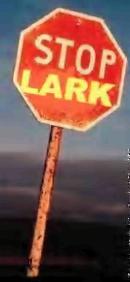
Stop! < "not+foot" |
Lark! Hana! |
Good night, madam! |
Hrë, ajz! |
|
Farewell! < I not see you" |
Tlafr! |
Come here! |
Evs! Hevs! |
|
Go out! < "evil+foot" |
Yrk! |
Hi! < "I glad to see you" |
Tëfr! Tafrës! |
Qualitative
Qualitative is a
specific feature of language Arahau, capable to mark concept as a category
of the Evil (Yrei) or Good (Ërei). As though in this lingual
matters from time immemorial exists postulate of Manichaeism: Ëreihuulsyr
– “Good always wins an Evil”. As it was already spoken, the letter at is
considered indecent and with its help shades of roughness, curses and
damnations are transferred. For example, Vlesë – please, leave,
Vlesy! – Get out!
Gradation of vital force
Gradation of vital
force is the most typical certificate active system of Arahau language.
Arahau consist a complex interlacing of animate/inanimateness,
activity/static character and the active/passive voices.
Connection formants changes «vital force» of a noun: af – the deadman, a mummy, a skeleton, am – the young man, ma – the alive man, an – elder, na – mobile, vigorous. Moreover, a method of reduplication is possible to achieve more thin adjustments: ana – costing (anar – a stop), nana – sleeping (nanar – a dream), anan – sitting (ananor – a throne), nan – to yawn, a pharynx, chaos. By inclusions of function of negation can be developed a theme further away: mal – involuntary (malor – the prison), nal – free, nala – new, anal – to lay.
Changing a vowel (vocal sound), it is possible to achieve generation of sense: if is ‘a hand-made article’, in ‘a dry trees’, mi ‘runaway’, ni ‘sprout’...
|
Gradient of deceleration |
Gradient of acceleration |
||
|
af to dead |
|||
|
an to grow old |
|
am grow young again |
|
|
na to move |
nal to be free |
ma to live |
mal to be forced |
|
nan to gape, to yawn |
nala to be new |
mam to sweep |
mala to drown |
|
ana to stay |
anal to lay |
ama to fly |
amal to fall |
|
anan to seat |
anam to hang |
amam to go, to drive |
aman to carry |
|
nana to sleep |
nanal to be awake |
mama to run |
mamal to creep |
|
|
Active |
Inactive |
|
|
person |
k- |
p- |
|
|
non-person |
the repositories of action |
g- |
|
|
production of action |
v- |
||
|
place |
f- |
||
Other formations: aimail – ‘a rockfall’, but compare amalgardei (amardeil) ‘a meteoric shower’, fanan –‘a boardroom’, amum ‘the man goes on an animal’> ‘the rider’, mumu ‘running herd’, umum ‘a horse’, nini ‘winter’, amu ‘the man flies in the plane’> ‘to fly by plane’, gama ‘the plane’, Hana! ‘stop!’ ünü ‘a bog’, mümü ‘a flood’, Mümüz ‘the Great flood ’ Hunub! ‘No admittans with animals’, mamakfor ‘running on the spot’.
|
I The maim verbs The old verbs Positive Negative
Plural |
as ras als, rals aas |
to think to sing to kill ? to thing for a long time |
II Temporal and aspect verbs ás, ans, nas, ajs, jas, ams, mas, jans, ajns, jams, ajms
|
|
III Moods Subjunctive avs (vas) if to think Imperative has! Do think!
|
|||
|
Somatic Facial
Singular Pseudoverbs Modal Complex pseudoverbs Pleonastic Pseudonegative
Gradual семейство глаголов |
arb(s) bra(s)
a
aussa
fasaad assa ala
na, an, nan, ana… |
to pull faces to move by a head
очеловечить
want to think
to learn brood somebody else's
to move, to grow old, to yawn, to stay… |
IV Qualitative Invective ys, yas, ays, aysy… to think the evil…
Courteous forms ёs, ёas, aёs, asё… to think the good, to create the good
|
Verb
The verb
characterizes formant -s. Compare: a (the man), as (to
think); u (an animal), us (to be, to exist).
The category of the man is made out by prefixes sas (you think/ he thinks), tas (I think). Instead of linear temporal concept of Indo-European languages (yesterday-today-tomorrow) in Arahau presented the radial model of Tense (now and possibly) which varies from two corners of sight, or aspects (duration-prescription and frequency-speed). The similar concept is in the African languages of family Akan. Irreal tense is marked by acute: tás (like would think and I shall think, may be). Aspects (specific characteristics) are designated by infixes -n-, -j-, -m-. There are centrifugal and centripetal versions of verbs.
|
a |
-as-
to think |
ö |
-ös-
to rest |
ae |
ae – metall
-aes-
to cut |
oa |
oa – wool, black
-oas-
ought |
|
ä |
-äs-
to drink |
u |
-us-
to be
|
ai |
ai – stone
-ais-
to bt
able |
ei |
ei – abstraction
-eis-
become |
|
e |
-es-
to do |
ü |
-üs-
to flow |
ou |
ou – body, yellow
-ous-
to need |
ea |
ea – air
-eas-
to sound |
|
i |
-is-
have |
au |
au – blood, red
-aus-
to want |
oe |
oe – bone, white
-oes-
to make |
y |
-ys-
to irritate |
|
o |
-os-
to feeling |
ao |
ao – fire
-aos-
to
burn |
oi |
oi – blue
-ois-
to give |
ë |
-ës-
to gladden |
tasse
I think to do
tosse
I am feeling, what to do
tösse
i quiet to do
tarüsse
I am speaking, what to do
tausse
I want to do
tolsse
I am be silencing
taisse
I can to do
tarausse
I am be afraid of to do
tousse
I (think that) necessary to do
toulsse
I am helping to do
toisse
I am giving to do
toilsse
I am undertake to do
toasse
I must to do
The aspects:
tes
I am doing
tees
I'm doing very long ago (and I'll be doing perhaps)
tjes
I shall be doing (I'll be intending to do)
tjés
I shall have intended to do
tejs
I'm doing often
téjs
I've done often
tnes
I'm doing quickly
tnés
I have to do quickly
tens
I'm doing for a long time (slowly)
téns
I've done for a long time (slowly)
tmes
I'm doing now
tmés
I've done already
tems
I'm doing again
téms
I've done again
Pronouns
|
1
|
I |
Non-I |
|
||||||
|
3 |
4 |
5 |
6 |
3 |
4 |
5 |
6 |
11 |
|
|
I (male) |
ta/t |
t- [t] |
-t [t] |
-t |
sa/s |
s- [s] |
-s [s] |
-s |
You (m) |
|
I (female) |
taj |
tj- [ʨ] |
-t’ [tj] |
-ajt |
saj |
sj- [ɕ] |
-s’ [sj] |
-ajs |
You (f) |
|
We (m) |
taa |
tt- [tt] |
-tt [tt] |
-aat |
saa |
ss- [ss] |
-ss [ss] |
-aas |
We (m) |
|
We (f) |
taaj |
ttj- [ʣʣ] |
-tt’ [ttj] |
-aajt |
saaj |
ssj- [ʐʐ] |
-ss’ [ssj] |
-aajs |
We (f) |
|
We (two) |
taca |
tc- [ʦʦ] |
-ct [ʦʦ] |
-acat |
saca |
sc- [zz] |
-cs [zz] |
-acas |
We (two) |
|
We (m+f) |
tacaj |
tcj- [ʤ] |
-ct’ [ʨ] |
-acajt |
sacaj |
scj- [ʤʤ] |
-cs’ [ɕ] |
-acajs |
We (m+f) |
|
We (three) |
taaca |
ttc- [ʣ] |
-ctt [ʣ] |
-aacat |
saaca |
ssc- [ʐ] |
-css [ʐ] |
-aacas |
We (three) |
|
Two male+female |
taacaj |
ttcj- [ʧʧ] |
-ctt’ [ʥ] |
-aacajt |
saacaj |
sscj- [ʂʂ] |
-css’ [ʑ] |
-aacajs |
Two male+female |
|
We (four) |
tacaa |
tcc- [ʧ] |
-cct [ʧ] |
-acaat |
sacaa |
scc- [ʂ] |
-ccs [ʂ] |
-acaas |
We (four) |
|
Male+two female |
tacaaj |
tccj- [ʨʨ] |
-cct’ [ʨʨ] |
-acaajt |
sacaaj |
sccj- [ɕɕ] |
-ccs’ [zj] |
-acaajs |
Male+two female |
1 –
means of pronouns;
2 –
detailed names of
pronouns of near person;
3 – pronouns in
ergative (detailed forms);
4 –
pronouns in ergative (brief
forms);
5 – pronouns in
absolutive (brief
forms);
6 – pronouns in absolutive (detailed
forms);
11 –detailed names
of pronouns of far person.
Numerals
Numerals are based
on somatic subclasses. Multiples of five carry the name arf “the left
hand” (ten), ard “the right hand” (five),
rka “the left leg” (twenty), rza “the right leg” (fifteen),
and also some other parts of a body, as in some Papuan and Tongan languages.
The system of counting up to 10 is five-base (quinary), and after 20 it's
vigesimal. The separate names have numeratives 21 (rpa) and 22 (rpaj),
meaning taboo parts of a body. 100 - ar (mankind, weights), 1000
urs - (genesis), 10000 - raj (uncertain etymology), az -
million (mister), azei - one million (giant). Zaharg -
billion, zahac - quadrillion, zard - pentillion.
|
0 |
plus |
million |
AZ |
milliard |
AZEI |
||||
| 1 | arg | 100 | AR | 1000 | URS | 10.000 | RAJ | ||
| 2 | ha | 1/2 | had | 200 | har | 2000 | hanurs | ||
| 3 | harg | 1/3 | hargod | 300 | hargar | 3000 | hargurs | ||
| 4 | haca | 1/4 | hacad... | 400 | hacar | 4000 | hacanurs | ||
| 5 | ard | 500 | ardar | 5000 | ardurs... | ||||
| 6 | ardarg | ||||||||
| 7 | hard | ||||||||
| 8 | hacana | ||||||||
| 9 | blarg | ||||||||
| 10 | arf | ||||||||
| 11 | arh | ||||||||
| 12 | harf | ||||||||
| 13 | hargarf | 30 | arfark | 31 | arfarkcarg | 32 | arfark(co)ha | ||
| 14 | hacarf | 40 | harka | 41 | harkacarg | 42 | harka(co)ha... | ||
| 15 | rza | 50 | harkaarf | ||||||
| 16 | arl | 60 | harkab | ||||||
| 17 | arlarg | 70 | rkablarf | ||||||
| 18 | harl | 80 | hacark | ||||||
| 19 | blarm | 90 | rfabl | ||||||
| 20 | rka | ||||||||
| 21 | rpa | ||||||||
| 22 | rpaj | ||||||||
| 23 | rka(co)harg... |
