|
Testament of Willby: Red Raven
Release Date: Febuary 25th, 2003 In short: Truly the beginning of something deep beyond imagination.
It never ceases to amaze me though, how many people will inevitably complain games such as Xenosaga focus "too much" on story and plot and "not enough" on gameplay aspects. It was widely reported that Xenosaga is but one episode of six ambitiously weaving a tale spanning 10,000+ years across space and time. Furthermore, Xenosaga's subtitle, "The Will to Power," bears the name of Friedrich Nietzsche's most well-known philosophical masterpiece, a book in which he decisively describes the primary motivation of all living things. The era in which the extent of an RPG's plot is measured in the number of evil empires toppled is over; if you feel as if a "mere" game such as Xenosaga tries too hard or is too highbrow for its own good then perhaps you are in the wrong genre. My suggestion would be to pursue a pleasant Adventure game like the new Zelda or Dark Cloud instead.
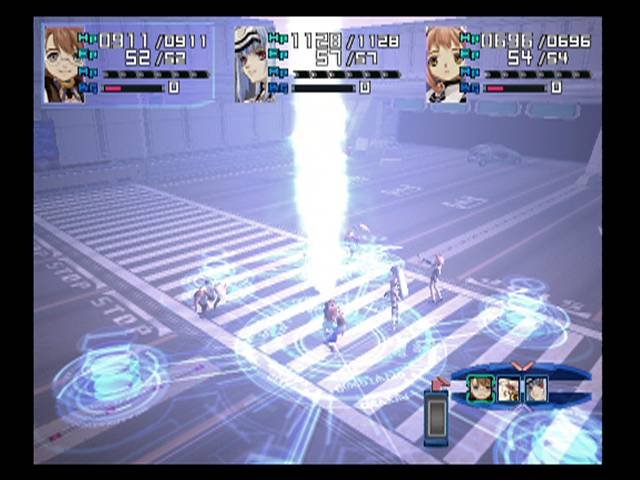
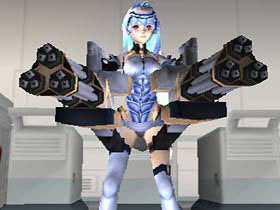
Despite exaggerations to the contrary, a majority of Xenosaga is actually spent battling, exploring dungeons, tweaking characters, and so on. The battle system itself can be best described as a hybrid of FFX and Xenogears. Each character begins battle with 4 Action Points (AP), which allows them to make two attacks (either physical, magical, or a combination), use items, call their A.G.W.S., use ether (magic), or defend. By only attacking once or defending, your character gains an additional 2 AP on their next turn allowing access to the "deathblow" special moves that populated Xenogears. The flow of battle is turn-based, with a small window in the corner dictating whose turn is coming up next, ala FFX. This window does not dictate everyone's turn however, and so it leaves an element of chance when it comes to choosing whether to attack or defend based on whether a member of your party's turn is next. The other features of battle that are noteworthy are the Event Slot, Boost Gauge, and A.G.W.S. After each character takes their turn, a small reel (the Event Slot) clicks forward and shows one of four pictures: blank (nothing), explosion (critical hit rate up), ring (boost gauge increase), ring with plus (bonus experience). These states are not trivial matters as a well-timed critical (or denial of an enemy critical) can spell the difference between victory or defeat in the hardest battles this side of, well, the SNES era. The Boost gauge appears beneath each character's portrait and this gauge increases whenever that character deals damage. After it fills up completely that character can "boost" and take an immediate extra turn after the current one. Enemies can take advantage of Boosting as well, so despite the turn-based structure of combat, battling still feels exciting and fast-paced. The Gears from Xenogears are back--more or less--in Xenosaga under the new moniker of A.G.W.S. Forget everything you heard about these machines being "unnecessary" or "useless": often they are the only thing that separates you from annihilation at the even more difficult boss battles. The fuel concerns from Xenogears have been eliminated so A.G.W.S. are functionally similar to the Guardian Forces from FF8 in terms of use and general strategy. They may not be as flashy as they were in Xenogears but they serve their purpose�keeping your characters alive�well enough...if you keep them upgraded on a fairly consistent basis.
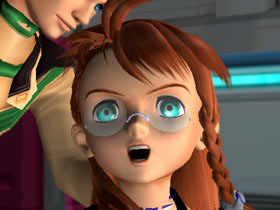
The in-game visuals for Xenosaga are not all that impressive until you make the realization that this game was designed before the release of FFX--the game that remains the benchmark for RPG graphics. This is not to say that the visuals are sub-par, it is just that the majority of the game takes place in space stations and ships which are about as visually interesting as sterile hospitals. Whenever the action moves to one of the many in-game cut scenes however, it then becomes apparent where a lot of time and graphical care was spent. Character facial expressions are hauntingly realistic, conveying far more information in a single smirk, raised eyebrow, or expression of pain than two paragraphs of text. Although much of the game does indeed take place in nondescript interior locations, Xenosaga makes fabulous use of color whenever it can. For example, battles are extremely flashy even when the characters are doing normally benign actions such as using a potion or completing a regular attack. While some might see this as annoying since one will be battling quite a bit throughout the game, it remains a nice visual change of pace.
While the subtle goal of every reviewer is to cast their favorite games in an appealing light, I will�in Xenosaga's case�instead issue a word of warning. That warning is to be very sure that you are willing to give Xenosaga the chance to weave its fantastic tale to the very end. The first ten hours of the game will undoubtedly turn away countless potential fans in its clumsy execution while countless others will never give the "interactive movie" a chance to begin with. If you feel your money is better spent elsewhere, then by all means do not waste it on a game that you can never enjoy. For the rest: have fun experiencing a game which transcends its ultimately shallow peers through the first chapter of what promises to be the greatest story our medium has ever told. Stand tall and shake the heavens, indeed.
|