|
To Shake the Heavensby: Red Raven
Release Date: October 12th, 1998 In short: The most ambitious and epic RPG ever created by anyone.
The largest point that divides each camp is concerning the plot, so I shall address this at the beginning. First, the plot is huge. There is no disagreement that Xenogears has quite possibly the most involved, confusing, and epic plot to ever grace a role-playing game. The disagreement comes in the presentation of the stated huge plot. For most of the game, the player is subject to the typical plot point-dungeon-plot point scheme familiar to most gamers. Xenogears�s plot points are quite a bit longer than average however, often leaving the player to read the less than average translation that scrolls at a snail�s pace. The problem is further compounded once the player reaches the infamous �2nd disc.� After switching CDs, the game�s focus completely changes; instead of plot being revealed through the actions of the main character, it is instead revealed through various characters� narrations. This sudden change of pace will confuse many gamers, as they quickly realize that what once was a fairly open game suddenly narrows in linearity, and they are left watching people sitting in wooden chairs suspended in a black void advance the plot instead of them experiencing it.
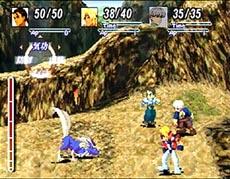
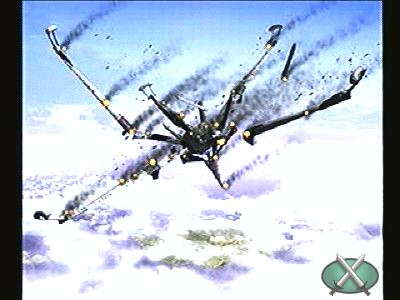
This is not to say that Xenogears does not feature an impressive battle system. Being a Squaresoft game, Xenogears shares a few battle elements with the Final Fantasy series. Most notably among them is the Active Time Battle gauge which must fill up before a character can input a command. Besides this common staple, there are not many other similarities. Each character has a number of Action Points that they receive at the beginning of each combat round. When attacking, one may select either a weak, medium, or fierce attack, (corresponding to the Triangle, Square, and X buttons) and each attack consumes 1, 2, or 3 AP respectably. After a number of battles, Deathblows can be learned. These combos are initiated by pressing the correct sequence of buttons, such as Triangle-X (Weak-Fierce) for the Deathblow, Raijin. Deathblows are typically flashy moves that deal a substantial amount of damage to either one or many enemies. Another facet of this battle system is the ability to store excess AP for use in a longer stream of Deathblows. In many cases, the long sequence of Deathblows is the only way to take down the more powerful bosses. A magic system is also included, but even the most powerful spell in the game (which destroys the Milky Way galaxy in its execution) deals far less damage than the average Deathblow. The battle system in general is entertaining the majority of the time. The characters jump around the screen when attacking, and watching the various critters you run across become vaporized by the skillful kung-fu moves of your party hardly ever gets old. If one well-executed battle system was not enough, Xenogears features another. In this second setup the characters pilot Gears, which are the 40-foot tall armored mecha common to a lot of Japanese anime. The same attack scheme is implemented, and most of the Deathblows earned on foot can be recreated in glorious giant robot fashion. A new concern is raised however, and that is the issue of fuel. While Gears still have AP limiting their number of attacks, each move also drains a number of fuel units. Running out of fuel in an important encounter is a serious concern, as the only way to restore lost fuel (besides purchasing more from a refilling robot) is to defend; not only do you lose the chance to attack while defending, the amount of fuel that is restored is typically very small. For the reckless or prudent, the Booster option can be used to nearly double the speed of the boosted Gear (resulting in more attack opportunities) at the cost of hemorrhaging large amounts of fuel every turn. Just as the long stream of Deathblows are typically required to beat the tougher bosses on foot, so too is a boosted Gear party a must for the even harder Gear Bosses.
In many ways, the musical score for Xenogears launched the career of Yasunori Mitsuda. While Mitsuda penned many of the popular scores in Chrono Trigger, Xenogears was really his first large solo project; a project that excelled in just about every area. While the majority of the album is made via a synthesizer, the range of emotion Mitsuda is able to capture is amazing. For example, June Mermaid is a brilliantly depressing piece that rivals Nobuo Uematsu�s Aerith�s Theme in simple beauty, while Flight is one of the most motivating and energy-driven songs I�ve heard in a videogame. There are two vocal tracks, Stars of Tears and Small Two of Pieces, and they stand out not only because of their quality, but also because the English versions are actually far superior to their Japanese counter-parts. Mitsuda eventually out-performs Xenogears when he made the score to Chrono Cross, but this soundtrack will stand out as one of the brighter spots in his career.
For many people, the ultimate question boils down to whether Xenogears is worth it. Is it worth the incredible 80+ hours needed to complete it once? That answer is an unhesitant and ardent yes. The two diametrically opposed camps aside, there is little debate that Xenogears is something much more than the average RPG; the two camps argue only about whether Xenogears was successful at living up to the undiluted praise constantly heaped upon it. Such a judgment call can really only be made by the individual gamer, and thus the final verdict for Xenogears lies in the hands of those that have yet to experience it. For this reviewer however, Xenogears has evolved into something more than a mere game and into a statement of will. That statement is, �Stand tall, and shake the heavens.� I feel Xenogears has done just that.
|