|
The Great Saga Continues...by: Red Raven
Release Date: May 10th, 2002 In short: Although falling completely flat when compared to any console RPG, this is easily the best RPG for the Gameboy Advance.
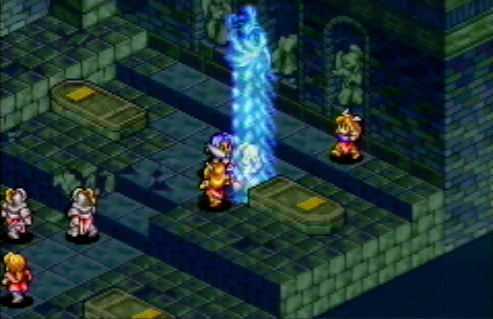
Was I so wrong. As is evident by playing just the first few minutes of the game, this is the real deal. Well...pretty darn close to the real deal. It is clear that Atlus made a few fundamental changes in the way the game plays versus the original, but these changes were by and large done for the better. Battles still take place on rather varied isometric grid maps, but instead of the usual ten soldiers, you may only select eight. This is still much larger selection than even Final Fantasy Tactics' paltry five, but the markdown in the number of soldiers results in battles that are that much quicker; not necessarily a desirable thing in strategy RPGs, but just right for games on the GBA. Two other major changes in the way combat works is the addition of a resurrection item and the turn structure. Probably at the request of all but the most hardcore gamer, Atlus finally has included an item that can revive dead characters; even better, this item is accessible right near the start of the game (the original Tactics Ogre had nothing but a hidden Revive spell featured at the end). While the addition of this resurrection item might not seem like it would make much of an impact on your strategy, it in fact does. The player is much more likely to do something risky with their best soldiers when they know that failure simply means resurrection later. There are strings attached though: the high price tag in a game where selling equipment is one of the best ways to make money, and the fact that you must use the item before the end of battle. And let's not forget: if the main character dies it is Game Over.
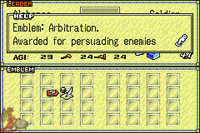
Through all that I still need to mention the new gameplay mechanic: the Emblem system. It is not just enough to have the correct statistics anymore to change a character's class to something else, one must usually have the Emblem as well. The Emblems are basically medals awarded to your (and your enemy's) characters for actions done in battle. The system is remarkably logical; if you want to be a Knight for example, you must do Knightly things such as attack from the front. Do that enough times and you will be awarded with the Knight's Certificate, and that class will be open to you (if you also meet the other statistical requirements as well). Other Emblems simply give you combat bonuses: Archers earn the Sniper Emblem and their accuracy goes up, Barbarians kill an enemy with one hit and earn the War God Emblem and their strength goes up (at expense of intelligence), ect. There are Emblems for practically everything, including some that are not so good. The Don Quixote Emblem is given to a character that misses and then suffers a major counterattack, while the Gibe of the Fallen Angel is awarded to a Cleric who kills. The system is fun and adds a shade of strategy to what some might call an entertaining yet watered-down battle system. Speaking of shades, no dark ones here as Knight of Lodis goes on to show that some GBA developers have enough common sense not to load a handheld game with too many dark hues. In fact, the graphics are pretty much identical to the Playstation release of TO, which in turn imitates the graphics of the SNES. The generally bright colors help you see the battlefield clearly and the surprisingly good character animation brings the battles themselves to life. Music, which would usually help bring a game to life seems to miss a step with some marginally good songs that are unfortunately repeated ad infinitum during the various battles. A little more variety in songs would have definitely helped the music score in this respect. Something that didn't really need any help was the great localization and the plot in general. While Knight of Lodis certainly doesn't shake up the genre when it comes to plotline, it probably will be adequate to hold the attention of a gamer through the more than 40 hours that he or she will spend playing this game. On the localization front, it wasn't that the localization itself was fantastic or dialogue particularly compelling but rather the complete absence of errors. I spotted one proper noun that should have been capitalized but that was pretty much it over the course of this game, and I was looking. An achievement of great grammar might not seem like much, but it is a welcome moment to come across a strategy RPG that looks like it was actually proofread before being produced. A sad state of affairs really, but I'll take what I can get.
In every review, the ultimate question comes down to as whether or not you should buy the game under review. To that end I say: if you have a GBA and liked Tactics Ogre, buy this game. Even if you didn't like Tactics Ogre (due to the high difficulty or otherwise), I would still give this game a try. In fact, if you like strategy games at all, buy this game. Tactics Ogre: Knight of Lodis has managed to capture the general essence of the original and refined it into a much more accessible package. Perfect for the beginner willing to test the strategy RPG waters, Knight of Lodis is also able to sate the appetite of veterans with new innovations to the core gameplay, an extremely hefty play time for a GBA game, and four different endings; sate them, at least, until the next major Atlus release. Enjoy.
|