|
New Game, New Buzzwordsby: Red Raven
Release Date: Feburary 15th, 2000 In short: One of the more innovative and refreshing games to be released in quite some time, Saga Frontier 2 manages to climb out of the hole the first game dug for the series.
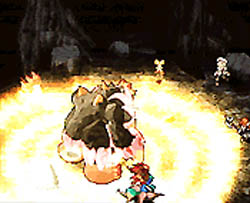
SF2 now sports a "duel" mode of battle, where one of the characters of your choice face off against one of the enemy's. These battles are handled a little differently than the normal battles. First, instead of a list of techs or magic you can choose from, you'll see a list of the individual motions of the various attacks, depending on your weapon. You input four actions per round, and then you watch what happens. For an example, let's say Gustave is using a sword. His options would include slash, backslash, feint, defend, charge, among others. These attacks by themselves are very weak, if you want a chance you'll try to form them into techs. For instance, slash-backslash are the motions for Cross Slash. Instead of learning them in battles, tech can also be learned by combining the appropriate moves, with a little luck. Besides inputting the four commands, you do nothing else during a duel. The characters will jump around and generally act silly while trying to kill each other. The last battle mode is Strategic, a combination of moving tokens around a grid board and a bunch of regular fights. In each fight, the characters have only 100 HP and 1LP, so attack wisely. That too is turn-based, battle and moving the tokens. Outside of battle is where you'll encounter the "Free Scenario System" for the first time. After glancing around the world map (and avoiding the Chronicle like the plague), you'll notice an underlined sentence. That's your gate to the world of SF2. Each one is a little event or town that you must complete. Completing them could be as easy as just watching some dialogue take place, or as hard as a strategic battle or good old fashioned dungeon crawl. As you complete some, more will open up and feel free to do them in any order that you choose. The order has no bearing on the actual plot of the game, hence "Non-Linear Gameplay". Speaking of plots, there are two going on: Gustave and Wil Knights. They meet up briefly but after that they'll never see each other again.
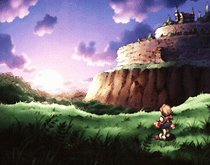
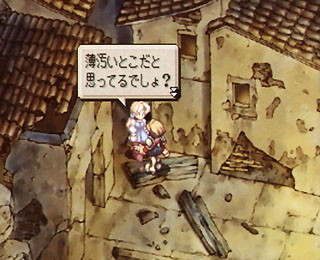
Music in the game was very light hearted, which went along with the whole storybook motif. With a piano in most of the songs it reminded me of the tunes you hear while watching Charlie Brown. While excellent overall, it features nothing that'd make me want the OST. Sound effects are good as well, explosive noises are there when you need them. Yes, a big storybook motif. The graphics are gorgeously drawn sprites with actual watercolor paintings as the backgrounds. After all the dark post-apocalyptic RPGs out there, this was a very nice change of pace. Battle effects feature some polygons, but other than that there are none. And I can tell you that I don't miss them one bit. I wouldn't be surprised if the artists that drew SF2 had their other works hanging in a museum. As stated before, plot in this game is very relaxed. While everyone will eventually get the same exact ending, it doesn't matter which order you did the story events in. Most of the events are bite-sized, just about 5-15 minutes in length. While they are more coherent when you do them in the right order, most are just as fine by themselves. As for the real story, it revolves around Gustave the main character. Gustave is a prince without anima. Anima is the magical essence that is supposed to exist in all things (even in grass and rocks), so naturally anyone who does not have anima is considered less than dirt. Gustave is exiled along with his Queen mother and his story goes on about what he did after that. Wil Knights holds the second plot line, he is just a Digger who wants some Quells (ancient tools). This is a generation game (it spans close to 100 years), so expect a lot of people to die and their children take their place. For the most part that is very bad, as all the people you bonded with when you first started will eventually be replaced by their whiny, clueless children later on.
Amount of text hasn't changed much since the first game, it's still small. A Xenogears this game isn't. Anyway, the localization was excellent seeing as that I didn't notice anything wrong with it. Replay value is very bad in this game. Despite having all those events you can go through in any order, it still doesn't matter because you'll get the same ending. Another shortfall in replay value is the fact that you're really just watching an interactive movie most of the time. I must say it was a delightful experience, but nothing compels me to see it again. For all your troubles of beating this game your only reward is the ability to play any of the events over again in any order. Yay. Why is this game impossible? At first it is not. The game tricks you into thinking that you are on a high enough level right up till the very end of the game. At that point you are hopelessly outclassed by the final bosses. I was forced to restart to try to be a little bit more prudent the next time. Gustave's last battle however, is impossible. Nearly. As I said most everything else was okay about the difficulty. Just the end is impossible. It doesn't help that there are no easy ways to level-up near the end. Good luck. So what's the final verdict? Will this game reek of failure as SG1 and just further the gap between Square and absolute gaming perfection? Or will this game redeem the playful Saga Frontier franchise and further the chances that later non-linear games will be just as fun as their linear counterparts? Only you can decide. As I see it, this game was a definite Good Move and people should get it just because it's so different than your average RPG. If nothing else it should keep you occupied for 30 some hours, and who knows, maybe you'll like it. A nice cure for that $20 that's been burning a hole in your pocket. Happy gaming.
|