|
Plagiarism At Its Bestby: Red Raven
Release Date: January 29th 1998 In short: Easily the most addicting and memorial tactics game of all time.
Also of note are fallen characters. After losing all HP, the characters collapse and a "death counter" appears over their body. After that amount of turns is up, and they aren't revived, their body disappears forever and they leave either a treasure chest or life crystal. Life crystals can be picked up to refill all a character's HP and MP, or you might be able to transfer an ability the dead character once had into the one who picked it up. A successful attack or spell will earn both experience points and job points. Experience points are obvious; the job points are added to you total in your current job. Job points are sort of like money, you "buy" skills with them. Skills can be individual spells, movement bonuses, counter-attacks, or other such bonuses. I hope you like micro-management; whether boon or bane FFT has it in spades. Outside of battle you have the daunting task of equipping your party AND changing their classes to suit your needs AND allocating numerous skills to each individual AND making sure your party's Zodiac signs complement each other. It is not uncommon to spend 15 minutes per character to get them up to speed. It certainly doesn't help to have 20 different character classes, with about 15-20 special abilities per class. You may pick one class and one secondary class for a character, and then you must pick a Reaction ability, a Support ability, and a Movement ability. The amount of different combinations are staggering. And welcome, provided you're into micro-management. Heaven help you if you are not. When you're not working with your characters you are probably moving about the world map. In FFT you do not actually explore towns, dungeons, or the countryside. You are simply moving between points on the world map.
Speaking of plots, Final Fantasy Tactics has an excellent and twisting one. It deals with Ramza, the youngest son of the noble Beoulve family, and his exploits as he learns just how harsh the world can be. FFT is outstanding in the fact that besides being set in medieval times, it strays from the standard medieval plot. The two great countries of the world have just ended a 50-year war between them, and are looking for peace. A vast conspiracy is started as an evil force is poised to not only take control but to destroy everyone, and Ramza is right in the middle of it. The story is amazingly detailed, a press of the 'select' button on a town (or pretty much anything) will reveal a little snippet of text, while not directly effecting much, at least gives you some further insight into the game. It is suggested that you do this often.
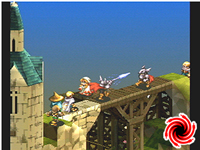
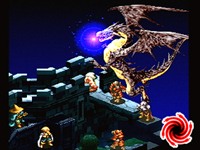
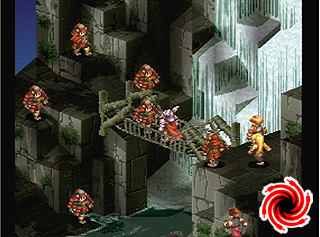
As far as originality goes, FFT has actually only a few new ideas. You may rotate the environment around and zoom in and out as you please. The AT gauge is invaluable during the heat of battle. The sheer amount of combinations of abilities and classes are all fairly new ideas. But as mentioned above, it borrowed a lot of ideas from Tactics Ogre, and a few other games as well (Vandal Hearts, FF5). Improving on existing designs is a good thing, but it's not innovative in of itself. The localization of this game can only be described as...original as well. Actually, the localization for this game was the worst that I have seen in a Square RPG before. Frequently seen spelling and grammar mistakes don't detract from the game completely, but in several instances it becomes very confusing during story sequences. That's very mild considering the game's butchered tutorial mode. In it, the now-famous Daravon proceeds to explain the battle system with such poor speech that I'm surprised anyone actually knew what he was talking about. Chances are you've already heard some of the terrible lines from this game, from "Off course!" to "I had a good feeling!" This game went above and beyond the realm of stupid mistakes. Luckily this game is simply fun enough to ignore the shortcomings of the dialogue. While it sports no alternative endings, FFT has quite a few optional quests that range from the Deep Dungeon to finding and recruiting Cloud from FF7. Besides those, there are probably a bunch of skills that you might have missed the first time around. You might find yourself trying to beat the game with a handicap just to see if you can, nothing but a group of wizards (which is very possible) for example. If you like strategy RPGs there is a good chance that you'll like to play this one over several times. I play it even today, which is more than I can say for my copies of FF7 and 8. As far as visuals go, they are pretty adequate. They are sprites imposed on 3D landscapes. The sprites contain a surprising amount of animation, they move fluidly during battle and story scenes. Most characters have portraits for when they talk, those look okay. They have no noses however. The landscapes themselves don't have anything particularly exciting about them. They're pretty drab. Spells, and summons for that matter, are short and to the point. No eye candy here. You should be focused on battle at hand anyway. Despite the difficulty, drab visuals, and weak localization, Final Fantasy Tactics is still an excellent addition to anyone's RPG collection. The engrossing plot, fun battle system, and simply gorgeous music are enough of a reason to finish this 40-60 hour game at least once. Probably twice. If you find this game somewhere be sure and pick it up, if not for the hours and hours of great gameplay, then at least to witness those legendary localization mistakes firsthand. Either way, you won't be disappointed.
|