|
Murder By Numbersby: Red Raven
Release Date: March 1st, 2000 In short: A solid psuedo-RPG that breaks new ground in the ability to creatively kill people.
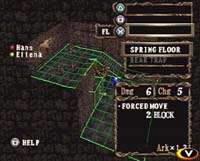
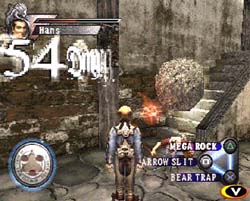
So what do you actually do? At the beginning of each new mission, you are given the opportunity to view the layout for the castle or mansion you are going to be fighting in, check out your enemies' statistics, and create new traps. Trap creation is a lot different from the previous game, Kagero: Deception 2, if you've played that one. After each mission you receive a certain number of Dreak, which is Dark Delusion's form of "money". To create a new trap you must first select which of the three areas of traps you want (Floor, Wall, Ceiling). Then you must choose a general type--a Base Circle--, such as bear trap, push wall, or boulder. Once you have narrowed that down, you may then select individual components that will make up your trap. The first is the trap's Emblem, which adds some effect like fire/ice/electricity among many others. The next thing you can add is a trap Ring, which is related to the trap's activation; different Rings allow the trap to recharge faster, become automatic, or even lure enemies into their area of effect. The final variable is a trap's Orbs, and the number of Orbs (1-4) determines a trap's power level. After you have chosen everything, the trap is created and an amount of Dreak is subtracted (the better the trap, the more Dreak is required). With all the different variables, there are well over 2,000 total combinations of traps that you can create. You must be patient however, as you only receive Emblems and Rings as the story progresses.
Room with a staircase; a bear trap at the bottom of the stairs; a push wall in the wall behind the bear trap; a giant boulder hanging above the top of the staircase. A knight enters the room and heads for the staircase. Bear trap snaps the knight's legs and he cannot move. Boulder falls, rolls, and smashes the knight against the wall. Push wall pushes the knight back on the bear trap location. Bear trap activates, and the combo continues... The longer the combo and the more damage done equals more Dreak earned to create even more deadly traps. You can earn even more Dreak by creating a chain that includes a room's inherit traps (which range from death fans to iron maidens to falling chandeliers of razor blades); this is typically harder to do since those traps cannot be moved, but the added Dreak is a big incentive to try. If you cannot tell already by how many times I mentioned it, Dreak is very important; the major reason is that there are no random encounters or anything to that effect so you have only one chance per mission to earn as much Dreak as possible. Not only do the deadlier traps require a lot of Dreak, but also as the game progresses you are going to start fighting enemies who are resistant to all but the most powerful (and consequently, the most expensive) traps. A combination of that fact, and the fact that it is genuinely hard to use yourself as human bait without taking a lot of damage is why I termed this game Very Hard. All right, enough about traps. How does this game look? Well, it is easily the best looking game in the Deception series, but unfortunately that's not saying much. The graphics are pretty similar to Kagero: Deception 2 except that Dark Delusion is slightly less pixilated at close range. The textures have not improved very much nor have the enemies, as far as looks are concerned. Overall the visuals are a disappointment considering that the designers had quite some time to improve them between the second Deception and this one. Music was completely forgettable as well; besides creating a vague sense of urgency it did little else.
Featuring multiple endings as did its predecessors, Dark Delusion does offer quite a bit of replay value to those who can ignore the abysmal plot. As stated, the gameplay is amazing and depending on how long you spend making traps, this game can take anywhere from 10-30 hours to complete. Additional play-throughs net you access to uber-traps that can certainly make getting the other endings a lot easier; that is provided you actually care about the different endings (see above). But in the end, Deception 3: Dark Delusion offers something that disappointingly few games offer these days: a completely refreshing and fun experience. Good luck and happy hunting.
|