|
Dante Would Be Proud...by: Red Raven
Release Date: 10/2/97 In short: The greatest Castlevania game ever created.
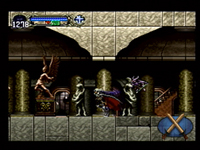
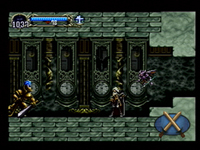
The third thing you'll notice, especially if your last Castlevania experience was on the Nintendo, are that the visuals are simply beautiful to behold. Alucard is fluidly animated and so are the other numerous demonic inhabitants. Backgrounds and the like also pay great homage to the improved graphical power of the system, and make this one of the best-looking 2D games I've played. The castle is huge and diverse, with each section having its own look and feel. Speaking of quality, one cannot simply describe the intense magnificence of musical score of this game. The Castlevania series had always had a fitting and interesting soundtrack, if somewhat constrained by the ancient architecture of the Nintendo. Released from its bonds, this is easily the best music I've ever heard for the series. The soundtrack even rivals such giants as Chrono Cross and Xenogears, the handicap being of course that C: SotN predates them by a number of years. Just trust me, it's very good.
As mentioned above, the story line focuses on Alucard, the son of Dracula. This is the same Alucard that helped Trevor Belmont with finding and defeating his inhuman father once again in Castlevania 3. Since that time, Alucard put himself in a deep vampiric sleep, never to waken again. Fast-forward to the timeline during game, and it seems something woke him up. More specifically, the Castlevanian castle, which appears once every century, has reappeared 96 years early. This is in addition to the fact that the Belmont that defeated Dracula 4 years ago, Richter, has disappeared. Now it is up to Alucard to defeat his father one last time, and finally rid the world of his cursed bloodline for good. The great plot is told through a remarkably little amount of text and spoken dialogue. Yes, you should worry about the spoken dialogue. Once again, a game company has proven that English voice actors are probably the worst actors ever hired, save for mimes. While Alucard's voice sounds cool and emotionless, as it should, Richter's voice is inexcusably out of character. On the bright side, I guess they are pretty funny, but laughing would pretty much kill the mood that the game would be trying to invoke at the time. The major factor in determining the difficulty was the fact that in this Castlevania, there are no instant deaths. That's right, the reflex-impaired can breathe easy because falling does no longer mean a game over. Other helpful things are the fact that whenever you save your game, your HPs and MPs are refilled to max. This ends up making the game pretty easy, until you check out the replay value as well. C: SotN features a second, inverted castle, one that you can only get to by finding some well-hidden items. This inverted castle gives you another whole game to explore and the enemies are now twice as hard. It was a nice touch to add, and along with the four possible endings, makes for a semi-long game. Castlevania: Symphony of the Night features no towns, one shop, three NPCs, and only two paragraphs of text, but it is still an RPG in every sense of the word. A fun experience all around, this is a great game for RPGamer looking for a fresh new RPG, and a definite must-have title to anyone who remotely likes the Castlevania series. This game has now been re-released as part of Sony's "Greatest Hits" program and it's an easy recommendation to pick this one up. Konami has produced an excellent genre-bending title that finally features only the best qualities from both types of games. Good luck, and happy hunting!
|