Cowboy Bebop
by: Red Raven
 Format: TV Series
Type: Fansub
Studio: Bandai
Length: 26 episodes
Rating: PG-13+
| Plot: | 5 |
| Characters: | 5 |
| Art: | 4 |
| Music: | 5 |
| Tilt: | 5 |
Overall: 5
Release Date: Spring 1998
In short: One of the most moving, gripping, stylish anime series of all time.
Most words fail to encapsulate all of what Cowboy Bebop is. Looked on with objective eyes, it is the fairly episodic adventures of a space bounty hunter who's down on his luck, running from a past that refuses to die. When subjective experiences are utilized however, this is when the whole of the English language fails to measure up. Cowboy Bebop can be called the "quintessential anime experience" - whereas Evangelion requires a little bit of footwork to enjoy, Bebop is accessible from the first few frames of the opening sequence right down to the last second of the best ending ever devised. Cowboy Bebop is "quality." Director Shinichi Watanabe prophesized that "The work which becomes a new genre itself, will be called... Cowboy Bebop." Some might call this arrogance, others confidence. Either way, the fact remains that Bebop is quite possible the most complete, explosive, and stylish anime series of all time.
Space Cowboy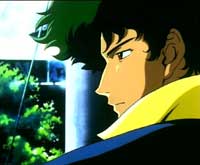 |
Where to begin? As mentioned, the anime essentially details the life of Spike Spiegel, an ever-confident and ever-broke space bounty hunter whose marks never seem to bring him any good luck. Spike is later joined by a few other souls in similar straits and their constant interaction maintains the facade of continuity from one self-contained adventure to the next. In truth, the majority of the main plot is moved along with a trio of two-part episodes which appear towards the middle and at the very end of the series. Each stand-alone episode though, does happen to further enrapture you with a bit of stylistic flair which leaves you begging for more. Indeed, the writing is brilliantly done by the Hajime Yatate group - a pen name for a team of writers at Studio Sunshine, which did Outlaw Star and Escaflowne - as even relatively minor roles are given almost bombastic flavor. Even decidedly "cartoonish" actions and events are immediately forgotten once Spike shares particularly delicious slices of life or there is an otherwise surprisingly poignant scene.
Julia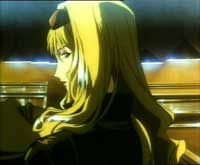 |
The soundtrack which accompanies this experience is similarly delicious. Composed by the musical goddess, Yoko Kanno, there is nary a track which plays that is not ambrosia for the senses. Songs such as Adieu, Call Me Call Me, and Rain are almost music masterpieces more worthy of enjoyment than 10,000 of the greatest tunes ever penned. These songs are capable of not only aurally cementing the listener into the context of the anime in which they were heard, but also empathetically channeling the pure and unfettered emotion carried on each fleeting note. A huge variety of other songs also manage to create context: ELM and Don't Bother None drive home the cowboy, while Road to the West and Space Lion perfectly conveys the vast emptiness of space. One song does stand above the rest - above all other songs, really - and that song is Blue. Beautifully crushing, Blue is by far the best song ever wrote for an anime (perhaps ever wrote for anything), and is likely to remain so for the foreseeable future. It encapsulates all of the emotions generated by all twenty-six episodes across all characters and spins them into intangible feelings which then can be consumed audibly. You only hear this song once in Bebop, but that one time is all that is necessary - purchase or download of the soundtrack inevitably follows.
Beyond the general aural beauty, the rest of the animation is capable of keeping up visually despite being five years old. Character design was handed by the competent Toshihiro Kawamoto, whom worked previously on Golden Boy. While lacking the insane detail featured in other anime such as Kite, Bebop nevertheless impresses with a heighten sense of style for the duration of the entire show. Characters look their personalities: Spike the suave cowboy, Jet the experienced tutor, Faye the sexy thief, Vicious the brooding antagonist. The space ships and various locales are similarly detailed enough to seem organic, and still manage to stop short of being distracting.
Duel of the fates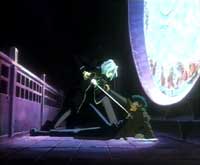 |
Special praise must also be given to the man whom had the biggest hand in elevating Bebop to the work of art it is: director Shinichi Watanabe. Fingerprints of Watanabe's genius are left all over the series, ranging from the more obvious color schemes and choice camera angles to the infinitely subtle, such as foreshadowing major plot twists in seemingly benign facial expressions or moments of silence. In this sense, Watanabe manages to weave the scripting, plot, and music into a rich tapestry greater than the sum of its individual parts. And while stylish, Watanabe never allows Bebop to become so simply for its own sake - every sarcastic remark and huge explosion is but another thread woven to complement the greater whole.
In the end, perhaps the greatest accomplishment Cowboy Bebop has attained is its ability to be enjoyed by just about everyone. Those anime viewers looking for a science-fiction Dragonball Z will find plenty of gunfights, explosions, and comedic elements. True anime connoisseurs looking for something capable of rivaling Evangelion in merit will discover a boundless depth of material, populated not just in certain episodes but throughout the entire show. Finally, those viewers whom simply wish to enjoy themselves a half-hour at a time will do so with the help of clever scripting and the episodic pace of the series. Put simply, if you are looking for a true anime classic that is still ahead of its time, look no further than Cowboy Bebop.
|
