|
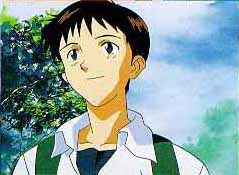
Evangelion: Take Care of YourselfVersion 1.2Last Updated: 8/19/03
Related Sites
The Evangelion Otaku Page
Preface
"Evangelion is like a puzzle, you know. Any person can see it and give his/her own answer. In other words, we're offering viewers to think by themselves, so that each person can imagine his/her own world. We will never offer the answers, even in the theatrical version. As for many Evangelion viewers, they may expect us to provide the 'all-about Eva' manuals, but there is no such thing. Don't expect to get answers by someone. Don't expect to be catered to all the time. We all have to find our own answers." This document does not claim nor strive to offer definitive answers to the powerful questions the Evangelion series left in its wake. Anno himself clearly stated not to expect anyone to release the "official" reason why a situation played out the way it did or what certain characters' motivations were. We will indeed "all have to find our own answers." The purpose of this FAQ of sorts, then, is to simply facilitate one's inner dialogue and to spur one's desire to find their own answers. These are my answers. What are yours? Major spoilers obviously follow.
In all seriousness, End of Evangelion was just about the most perfect end to the series that was possible. It certainly did not seem so at first, to myself and millions of other viewers, but hopefully by the end of this document you will begin to see why this is indeed the case. 2) Alright, fine. Why did Asuka say "What a disgusting feeling" during the finale of End of Evangelion? It first needs to be pointed out that Asuka uttered "kimochi warui," a phrase that is impossible to directly translate into English. It means a variety of related, but subtly different things. Examples: What a disgusting feeling; I feel sick; how disgusting; I don't like this feeling; this feeling sucks; and so on. I have seen End of Eva subtitled two different ways, one with the first translation and the other with the third. The two most widely accepted translations have been "What a disgusting feeling" and "How disgusting," with more emphasis on the latter.
"Kimochi warui. Thus, MDWig's theory is that Asuka was commenting on her prior experience in the LCL when she had her soul laid bare to all of humanity. In effect, she was "breathing the same air," "using the same toilet," and so on with not just Misato and Shinji, but with everyone. This is a paraphrased version of MDWig's theory, and I suggest you visit his page for a more detailed version. With that said, I personally do not agree. Asuka said "kimochi warui" only after caressing Shinji's face and after he stops strangling her and after he starts sobbing atop her. This would seem to be a rather strange time to make a general comment about her short stint in Instrumentality. So what do I think she is referring to? I think she is either referring to herself or (perhaps more likely) to Shinji. She sees this crying, broken boy straddling her, and it is disgusting. There is also a lot of speculation surrounding a theory which states Asuka's final words was simply Anno expressing his general distaste over being forced to redo his "real" ending (the television one) by legions of angry fans; in other words, this was Anno's final revenge. While it is certainly true that Anno has cast himself into pretty much all of the various characters in Evangelion, never once has this been done simply for its own sake. What Asuka said at the end fit her character. I am inclined to say that any deep significance the lines hold is in the context of Asuka's character and Evangelion as a whole, not simply an opportunity for Anno to taunt his fans. 3) Why are Asuka's ending words so important? They are significant because they prove she is really Asuka. With the entire surreal experience of Complementation fresh in mind, it is safe to cast a suspicious eye on everything that is supposed to be real afterwards. Here we see Shinji along with Asuka (bandaged in almost the same manner as Rei in episode 1) on a beach of white sand, a sea of LCL and crucified EVAs stretching out from them. Can all this be real? Asuka's words thus affirm that she is not a dream, not a clone, not anything other than the one and true Asuka. Only Asuka would take the time to - in the face of being strangled to death after surviving the merge with all of humanity - comment about how she finds the crying Shinji disgusting. Also, the words show how everything will basically be all right. "Kimochi warui" is a typical Japanese phrase said by typical Japanese people to describe typical, everyday things. Asuka did not wax philosophical, did not express hatred towards Shinji, and did not regret being brought back to the painful real world. She just thinks something is disgusting. Whether that something is the experience of being Complemented, of being resurrected, of being strangled, of her feelings for Shinji, of being straddled by a sobbing boy... these things do not really matter. In the face of everything she has just experienced, she replied with "kimochi warui" not as a shriek, not as a groan, but as a sigh. That is what matters. 4) Why did Shinji strangle Asuka? Anno stated that everyone needs to come to their own conclusions, but in this instance that is not entirely necessary.
Part II (movies) Drama card D-88 "Shinji renounced the world where all hearts had melted into one and accepted each other unconditionally. His desire... to live with 'others' -- other hearts that would sometimes reject him, even deny him. That is why the first thing he did after coming to his senses was to place his hands around Asuka's neck. To feel the existence of an 'other'. To confirm (make sure of) rejection and denial." Shinji just wanted to confirm that Asuka was a real entity, a separate heart that could reject and deny him. When Asuka caresses his face (much in the same way Yui did moments before) he gets his answer. 5) Why was Asuka bandaged like she was? Initially, I thought it was a just clever nod to the way Rei was bandaged in the very first episode of the series (they are bandaged almost identically). While it still is a clever nod, it does have more significance than it first appears. When Asuka is fighting with the MP (Mass Produced) EVA units, one of them throws a replica Longinus Lance. This was able to penetrate Asuka's AT Field and skewered EVA-02's face. It has been established throughout the series that the pilots can feel the pain their EVAs experience, but do not sustain physical injuries themselves. However, after the Lance impales Asuka's left eye we can clearly see it bleeding. This is not entirely obvious in fansub versions, but apparently the DVD shows this quite well. It can be assumed that this is a special property of the Longinus Lance as when the MP EVAs eviscerate EVA-02, Asuka clutches her abdomen but is otherwise not similarly eviscerated. When she raises her right arm in a show of protest though, we unmistakably see it cleaved in half in the same manner EVA-02's arm is cleaved by another thrown Longinus Lance. The properties of the weapon make EVA-02's wounds Asuka's own. Thus, it is clear that Asuka would have died once the remaining Lances impale her body. When Shinji wakes up on the beach, he sees a bandaged Asuka. She has an eye patch over her left eye and her right arm is wrapped; the exact same wounds she received during her last moments of life. Where these bandages came from and who applied them - while not necessarily important - remains unknown. 6) Why is Shinji such a coward in End of Evangelion? He's been through worse, right? Not even close.
Under these sort of circumstances, it would be impossible for anyone to honestly label Shinji a coward. 7) So what will happen to everyone else? Where will Asuka and Shinji go from here? Asuka and Shinji's future is left largely up to the viewer. As for everyone else, there is clear indication in End of Evangelion that everyone who was alive during Instrumentality will be able to return as Asuka and Shinji did. First, Rei specifically tell Shinji the following when they are floating in the sea of LCL: "If you hope other people exist again, your heart will separate everyone once more. But you will be frightened of other people again." Next, there is dialogue between Shinji, Rei, and Kaworu about Shinji's decision about separating everyone again:
Kaworu: "Is it okay for AT Fields to hurt you and other once more?" Shinji: "I don't mind. But, what are you two within my heart?" Rei: "Hope. The hope that people might be able to understand one another." Kaworu: "And the words 'I love you.'" Shinji: "But that's just pretending - a self-intoxicating belief... like a prayer. It can't possible last forever. Sooner or later I'll be betrayed... And they'll leave me. Still.. I want to meet them again, because I believe my feelings at that time were real." Then, while Lilith's body disintegrates, both Rei and Kaworu speak the next part: "Reality is somewhere unknown; dreams are within reality... And truth is within your heart. Because it is the human heart which creates your appearance. And new images will change the shape of peoples' hearts. Images... the power of creation. Open your own future with the flow of time... create it. But only humans alone can prevent themselves from doing so and that won't change... So you have to use your own strength to get your lost self back. Even if you lose your own language, you have to import other peoples' languages. As long as your heart can see those images, everyone can return to their human form." Finally, Yui tells Shinji: "Don't worry, every single life-form has the power to return to their original form. Since every life-form has the will to live. As long as you want to live, everywhere will become Heaven. Afterall, you are still alive. And therefore, your chance of finding happiness is everywhere! As long as the sun, moon, and earth exist, everything will be all right." It may be rather cryptic dialogue, but it is most definitely not ambiguous when it comes to the return of all Complemented individuals; it is specified in four separate scenes that humanity will be reforming just as Asuka and Shinji have. But what of all the green crosses of light? What of the graves, especially the one made for Misato? While I am rather certain that all of the dead NERV personnel were Complemented once the project began (the ghostly Reis appeared to not only Ritsuko and Misato as they died, but also posthumously to everyone in GeoFront), I take the graves and green light-crosses to signify the souls of the dead whom will not be returning. In effect, they lack "the will to live" and cannot reform because, incidentally, they are already dead. Why so many crosses? It can be inferred that these, again, represent the souls of the recently slain all over the world. After all, I'm sure the explosion of the Third Impact coupled with the sudden appearance of a colossal, 10-mile tall naked female would have started quite a panic the world over and thus car accidents, other explosions, mass hysteria, and so on, would have resulted in millions of miscellaneous deaths. As to who actually built the grave markers remains a mystery, especially since Shinji had lost Misato's cross before he was able to reform. I am inclined to think Rei - in some form or another - was the one responsible, but that is neither here nor there.
In summation, everyone will be able to return to an Earth which can support them. 8) Was EVA-01 leaving Earth reality or a dream? And what's up with Yui anyway? EVA-01 really did leave Earth. As Instrumentality comes to a grinding halt, we are shown a scene between Yui, Fuyutsuki, and an infant Shinji. In this scene Yui summarizes her vision of the Evangelion series: as a lasting testament to the existence of the human race. This is why Yui chose to remain inside EVA-01, and why she leaves Earth along with the Longinus Lance. With the (presumably) infinite power source of the S2 engine, EVA-01 will continue to travel among the stars long after the Sun, the Moon, and Earth itself have died out, billions of years in the future. 9) Why did SEELE order the capture of NERV? Weren't SEELE and Gendo supposed to want the same thing? SEELE felt that human existence had become "a colony of worthlessness", and that human beings would never find true and lasting happiness in their current flawed form. Thus, SEELE enacted a plan detailed in the Dead Sea Scrolls - Instrumentality - which would eventually lead to the "death" of all living things. This is not a "death" in the traditional sense, but rather the return to the source of life seen in the latter moments of End of Evangelion; everyone losing their form to LCL and living forever as "complete" beings with one another. Gendo had other plans. It is clearly stated by Gendo, when SEELE confronts him and demands the Instrumentality project begun, that "Death gives birth to nothing." All that is revealed in the series is that Gendo wanted to be reunited with his dead wife, Yui. Presumably, he was trying to do just that when he took Rei down to Terminal Dogma and enacted Third Impact by joining Adam (which is grafted onto his hand) and Lilith (the soul of whom resides in Rei). It can be assumed that whomever brings Adam and Lilith together is the one who directs Instrumentality, so Gendo would have been in charge; it is likely, judging by Gendo's earlier statements and apparent motivations, that he would have chosen to Complement Yui in EVA-01 and thus have her reform (e.g. resurrected just as Asuka was at the final moments of the movie) or perhaps simply Complementing himself so as to join her. 10) What exactly is the Lance of Longinus and what purpose did it serve? It is probably best to point out first that the "Spear of Destiny" is an actual, real-life weapon. It is named after the Roman soldier which used his spear to pierce the side of the crucified Jesus Christ. When Longinus did this, he fulfilled one of the Christian prophesies which stated that "not a bone of the savior will be broken," as the common practice of Roman soldiers was breaking the legs of crucified prisoners to make sure they were dead. The spear itself was later credited for being a weapon of ultimate power, capable of killing anyone in a single blow. This reputation was gained since the lance was anointed with the blood of a dying Jesus, and had essentially "killed God." The spear would change hands quite a bit throughout the ages, and it is widely believed that Hitler himself launched a small crusade to find the weapon because his belief in its supernatural power. Currently, the spear head is stored as a holy relic in the Treasure Room of the Hofburg Palace in Vienna, with the shaft of the weapon residing in one of the four pillars over the altar in the Basilica of St. Peter's in Rome.
Beyond these powerful weapon properties, it seems as though the original Lance was a key piece in SEELE's version of Instrumentality. It is not entirely clear how the Lance would have been used, but it can be inferred that everything EVA-01 went through in End of Evangelion was supposed to have been done to Lilith instead, had Gendo not ordered the Lance removed. Also noteworthy is the fact that the Lance is pulled out of EVA-01's core after Shinji rejects Instrumentality, and its removal destroys the other replicas Lances and Lilith herself. When Yui/EVA-01 leaves Earth behind, the now doubled-sided Lance is brought along as well. Whether it will be put to any future use is unknown. What is also unknown is exactly what the Lance is made of and why it has the properties it does, although these may ultimately be trivial details. It should be noted though, that in the glossary of the Death & Rebirth Deluxe Theatrical Program there is a mention that the original Lance was discovered at the South Pole, and thus not made by human beings. It is entirely likely that Adam - also discovered at the South Pole - was actually lugging the weapon along with him, as it would certainly complement the important 1st Angel nicely. (pun intended) 11) Is the conclusion to the television series and End of Evangelion the same outcome? This is (still) a hotly debated facet of Evangelion. While there is evidence to support both sides, careful analysis reveals the movie and television ended with the same event: Shinji rejecting Complementation. The FAQ featured on the EvaOtaku - which was the biggest influence on my evolving perception of the series and its ultimate meaning as a whole - tackles this question by quoting Shinji ("I understand! I can exist here!") and further stating the entire experience (Shinji being congratulated by a dead Kaji, a healthy Toji with his leg still on, PenPen, and so on) is too surreal to be real. They end it with the following excerpt :
Further, the Newtype Filmbook description for the scene states (literally): All of these things - Shinji's quote, the surreal experience of it all, and the excerpt - apparently lead credence to the feeling that the television series ended with Shinji deciding to stay within Complementation. Or does it? After watching the television ending again, however, I found it impossible to support the frame of thought that Shinji actually wanted to stay in Complementation. At the beginning of episode 25, we see images of a dead Ritsuko and Misato mingled with dialogue which is identical to scenes from the movie. Thus, it is established that both are happening concurrently; End of Evangelion simply focused more on the physical events that transpired rather than simply detailing what Shinji went through mentally inside Complementation. Both endings went through a period in which Shinji was fully Complemented - the movie depicted this in the sea of LCL and the series with a sketch drawing of Shinji floating in nothing - and Shinji rejects it both times for the same reasons. In the television ending, Shinji describes his feelings by stating that all that exists here is himself, but with no one else to interact with he feels as if he is fading out of existence. He feels this way because with no one else to interact with, he cannot truly recognize his own image. Thus, Shinji concludes: "There will be no difference between myself and nothing!" This is the exact same conclusion Shinji makes in End of Evangelion. This is what he concludes in the movie: "I feel that there were only hateful things there [reality]. So I'm sure it was okay to run away. But there was nothing good in the place I ran to, either. After all, I didn't exist there... which is the same as no one existing." Thus, in both endings, Complementation is not the answer because it is an escape into nonexistence, another form of running away.
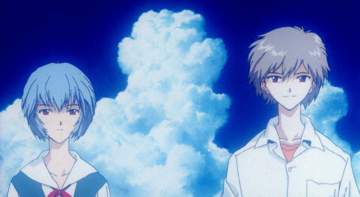
Shinji is not quite all the way there though. "Still, even though the reality itself might not be bad, I could still hate myself." Shinji still thinks of himself as weak, sneaky, and a coward. But an angelic Misato comforts by saying, "Now that you know yourself, you can take care of yourself." It is with these words that all the pieces of the puzzle come together. As Shinji begins to understand his epiphany, the walls of Complementation crack and shatter around him. The summation of the experience of Anno and Evangelion itself comes from Shinji's final realization: "I hate myself. But I could love myself. Maybe my life could have a greater value. That's right! I am no more or less than myself! I am me! I want to be myself! I want to continue existing in this world! I am worth living here!!" I do not think it could be any clearer that Shinji has completely and utterly rejected Complementation. I understand how the people at EvaOtaku could have been tripped up by one of Shinji's lines ("I want to continue existing in this world!"), but it seems rather obvious that Shinji was referring to the real world and not Complementation. The world of Complementation is one where the "I" does not exist, cannot exist. Shinji plainly states, in no uncertain terms, "I want to be myself!" This is the opposite of Complementation, the antithesis of Instrumentality. Being oneself in Complementation is impossible. The words on the card thus take on an entirely more literal feel: the "figure of Complemented Shinji" is such simply because Shinji has yet, at that moment, to return to the real world. But he will. This ending does not show how that happens or what Shinji will find when he gets there, but that is because it is unnecessary. Shinji has found purpose in his existence. That is what truly matters. This conclusion is identical to the one featured in End of Evangelion. Both conclude by Shinji realizing that life, no matter how painful it can be, is still worth living. 12) What's the difference between Third Impact, Human Instrumentality, and Human Complementation? All of these things are more or less synonymous. Third Impact refers to the merging of Adam and Lilith into a single being, and the evolution/destruction of human life. Instrumentality refers to the process by which humans revert back to LCL and become one with each other. Complementation is the result of such a transformation. Thus, one is Complemented through Instrumentality at the end of Third Impact. 13) What was the deal with the Angels and what would happen if they got into Terminal Dogma?
The Angels were after Adam, which was the source of life that had spawned them. Lilith - the mother of humanity - was the one nailed to the cross in Terminal Dogma, not Adam. In a sort of ironic twist, both NERV and SEELE had different reasons for wanting the Angels to believe that Adam lay in Terminal Dogma (although specifically how they "tricked" the Angels is unknown). Adam was reduced to embryonic form at the cost of Second Impact specifically to reduce the chance of an Angel getting into contact with him; the Angels would experience a Complementation similar to the human's version, although all of humanity would be dead. SEELE's goals were the destruction of humanity via Third Impact, and while they would prefer it to happen in a constructive fashion (Instrumentality as it occurred in End of Evangelion) it would be all the same if an Angel came into contact with Lilith and destroyed humanity. NERV wanted the Angels to believe that Adam was in GeoFront to disguise the fact that he really was in GeoFront. The unseemly double-agent Kaji brought more than just Asuka to NERV headquarters - he brought Adam as well. At this point Gendo had Adam grafted onto his hand, so that when the time came he could initiate his own brand of Third Impact. Gendo didn't want to start Third Impact necessarily, but he wanted to hold all the cards if it came to that. None of the Angels figured all of this out, with the exception of Kaworu. He realized once seeing the figure upon the cross that this was not Adam but Lilith. At this point Kaworu also realize that he had been used like a puppet by SEELE, in a bid to destroy humanity. Kaworu then allows himself to be killed by Shinji because he feels that humanity should be the ones to survive. 14) Is there some deep, significant religious meaning in Evangelion? Not particularly. When asked this question, assistant director Kazuya Tsurumaki (who directed Air' while Anno took Sincerely Yours') had this to say: "There are a lot of giant robot shows in Japan, and we did want our story to have a religious theme to help distinguish us. Because Christianity is an uncommon religion in Japan we thought it would be mysterious. None of the staff who worked on Eva are Christians. There is no actual Christian meaning to the show, we just thought the visual symbols of Christianity look cool. If we had known the show would get distributed in the US and Europe we might have rethought that choice." I would have to agree that they did indeed look very cool. 15) Does Evangelion have deeper meaning at all? Hopefully by this point, the answer to that should be obvious. I'd also like to take the time to point out though, Evangelion had an immensely deep meaning for director Anno himself:
"Evangelion is my life and I have put everything I know into this work. This is my entire life. My life itself." Also, at the end of the first manga collection of Evangelion, Anno wrote the following as an introduction to the Evangelion series (original format): The year: 2015. A world where, fifteen years before, over half the human population perished. A world that has been miraculously revived; its economy, the production, circulation, consumption of material goods, so that even the shelves of convenience stores are filled. A world where the people have gotten used to the resurrection -- yet still feel the end of the world is destined to come. A world where the number of children, the future leaders of the world, are few. A world where Japan saw the original Tokyo destroyed, discarded and forgotten, and built a new capital in Nagano Prefecture. They constructed a new capital, Tokyo-2, then left it to be a decoy -- then constructed another new capital, Tokyo-3, and tried to make it safe from attack. A world where some completely unknown enemy called the "Angels" comes to ravage the cities.
They say, "To live is to change." I started this production with the wish that once the production was complete, the world, and the heroes, would change. That was my "true" desire. I tried to include everything of myself in Neon Genesis Evangelion -- myself, a broken man who could do nothing for four years. A man who ran away for four years, one who was simply not dead. Then one thought: "You can't run away," came to me, and I restarted this production. It is a production where my only thought was to burn my feelings into film. I know my behavior was thoughtless, troublesome, and arrogant. But I tried. I don't know what the result will be. That is because within me, the story is not yet finished. I don't know what will happen to Shinji, Misato, or Rei. I don't know where life will take them. Because I don't know where life is taking the staff of the production. I feel that I am being irresponsible. But... But it's only natural that we should synchronize ourselves with the world within the production. I've taken on a risk: "It's just an imitation." And for now I can only write this explanation. But perhaps our "original" lies somewhere within there.
July 17, 1995.
P.S.: 16) What are your final thoughts on End of Evangelion and the series as a whole? There are four basic groups of people who watch Evangelion and formulate opinions upon it. The first group hates Evangelion unconditionally. They see the anime as boring, inconsistent, full of superfluous religious imagery, choked by senseless angst, over-hyped, over-discussed, over-analyzed, and are nauseated by the fact that anyone can enjoy and discuss in-depth the minutiae of such a pretentious piece of bad anime. The second group perfectly complements the first, by being its polar opposite. They create character shrines, offer plot guides, craft episode summaries, draw fanart, write fanfiction, buy merchandise, watch Evangelion every night before going to bed, and unhesitatingly sing the praises for Anno's watershed masterpiece of anime concept and design every chance they get. The third group thought the ride was fairly entertaining and feels as though Evangelion has some depth to it, but is not entirely sure. They look at the two previous groups and cringe inwardly, and then go about their lives happily just knowing that they have seen Evangelion. Why ruin the mood? The fourth group - the one I subscribe to - remains in state of mute curiosity. Sublime reflection, if you will. Did Evangelion have meaning? Yes. Evangelion was Anno's inner turmoil with life burned into anime form; the man said so himself. He poured all of his angst, despondency, bitterness, confusion, and anger into Evangelion's characters - and it shows. Just as Shinji and the others were melded into the sea of LCL, so too was Anno's soul laid bare in Evangelion's production. Did Evangelion overuse biblical references and have too much obtuse symbolism? Not really. Anno struggled with a problem that pretty much everyone shares: the lack of an adequate vocabulary to express how one truly feels. Anno did his best with what he knew, the most anyone can ever do. Do I think that Evangelion could have been done better? I do not see how this would have been possible considering what Evangelion is.
It is because Anno had the courage to burn his life into film and Gainax the tenacity to see the project to its completion that I view Evangelion worth experiencing. Sometimes Evangelion is depressing, confusing, full of conflicting emotions, bitter, illogical, sad, vain. Such is life. But the final message that Evangelion conveys is one of hope. That as long as the sun, earth, and moon exist then everything will be all right. That as long as one is alive, then the chance for happiness exists everywhere. The fact Shinji - and Anno by extension - was able to realize his existence had meaning beyond the parameters life imposes upon it, should bring hope to us all. Congratulations to the children of the world, indeed.
If you have a question concerning Evangelion or simply want to discuss/debate the "answers" presented here, send an email. |