Canvassing the Net
Volume 1: MP3s
Version 1.0
Last Updated: 11/19/03
Table o' Contents
- Preface: Canvasing Ethics
- Getting Started
- Method 1: P2P
- Method 2: FTP
- Method 3: Index pages
- Final Thoughts
Disclaimer
Actually following any of the suggestions below is considered naughty by a bunch of people. In fact, you should probably wash your hands after just reading this. If you choose to disregard this warning, then you accept full responsibility in not getting me in trouble.
Preface: Canvassing Ethics
If you have no compunction whatsoever in getting MP3s off the internet, feel free to skip ahead.
One way or another, someone is going to be getting something for nothing. This basic fact was as inevitable in 2000 B.C. as it currently is some four thousand years later. Assuming for the moment that getting something for nothing is inherently wrong - since that something had to be made by someone - why am I even going through all the trouble in educating people on how do this inherently wrong thing?
The short answer is that getting something for free is not inherently wrong. The long answer is economics.
Take a look at the following graph:
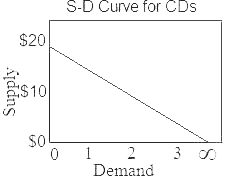
This is a Supply-Demand graph showing the inverse relationship between the cost of, say, music CDs, and the quantity of CDs demanded. For example, this graph shows that when the cost of a CD is $20, no one wants one. As the price lowers to about the $14-$16 range, then the demand for the CD in question raises to one. As long as the price continues to drop, demand continues to increase until it at last hits infinity at price of $0. In other words, as long a CD is costing me nothing to purchase there is no logical reason why I would not get as many as humanly possible. In the traditional academic setting, the professors do not explicitly say that once the curve hits zero demand becomes infinite, but it is relatively safe to assume. Otherwise, if the demand curve continued it course, one would be stating (in this example) that someone would only take more than 4 CDs if they were paid to do so. Which, even if we were talking about exact duplicates of CDs, doesn't make any sense - especially since you could always give away the CDs as gifts, use them as coasters, microwave them, and so on.
Concurrently, America and a lot of other countries operate under laize faire capitalism. What this means is that the government is not going to force you the consumer to buy the things they want you to buy - you make those decisions on your own. Buying things is your own responcibility. So is making sure that you are not getting screwed over by buying, say, two CDs at $20 each when you could have bought them for $10 at the store next door. If your time and convienence are worth more than your money, that is fine. However, if you're willing to spend some time "shopping around" then you are likely to find a place that offers those CDs for less. In any event, it is your own initiative which determines how much you are willing to pay for a particular good.
"Yeah, okay. None of this changes the fact that you are stealing money out of the pockets of musicians!"
No, not at all. Look at this next graph:
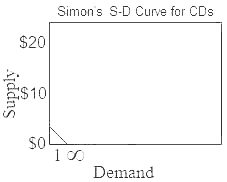
As can be inferred by the title, this is my own personal demand curve for music CDs. The main idea to get here is that I only wish to purchase CDs that fall into the $3-$5 range. Why is the curve so much more shallow than the curve from the first graph? Specifically because I have next to no amount of money, so I must make every single dollar stretch as far as possible. Thus, I will not be buying music CDs for any amount of money greater than $5. No conventional store carries CDs for this price. But, hey, I can "buy" these songs for $0 off of the web. So I do so.
"What? How is this any different than stealing from the artists?"
It is not my job as a consumer to insure that a particular artist is getting any money whatsoever. My job as a consumer is to consume a good, for as low a price I am willing to spend time searching for. How much sleep do you lose over the fact that Malaysian children were paid $0.04 an hour to construct your shoe in a sweatshop? Why are you not concerned with ensuring that those children get paid a proper amount of money for your $200 Air Jordans? Probably for the same reason that you feel no guilt in saving $1.33 by buying shampoo at Wal-Mart instead of K-Mart. Do you ever feel morally compelled to pay more money than you have to? Would it matter if some K-Mart employees were fired because shampoo profits took a big hit in the third quarter? No, it would not matter because all of this is simple economics. If K-Mart knows that Wal-Mart is selling shampoo $1.33 cheaper than they are, then K-Mart can either lower their own shampoo price or they can lose money.
Well, the internet is selling music for $0.00 apiece, as long as you have cable access and a computer. The RIAA et tal, can either try and compete or they can lose money. How could they compete with a price of $0.00? Well, in my particular case they could start by setting the price of a CD or what have you so as to fit on my own demand curve. But really, it is not my job as a consumer to make these sort of decisions for them. Besides, they seem rather content in suing 12-year olds and other such consumers in an attempt to scare everyone else into buying ridiculously priced CDs.
"You're stifling creativity! The artists are not getting anything for you listening to their music!"
Actually, the artists are getting quite a bit from me even though I am not paying them anything directly. They get an audience for their art. They get free advertising, in that I will not only be playing their music constantly, but I will also be telling my friends about particular songs and such. They might be earning a fan who is impressed enough with their music to want to see them in concert - where musicians make 95% of their money anyway. Finally, they are getting an even playing field. When all music costs nearly nothing, the only thing which distinguishes one song from the other is their quality. Now REM must compete with Soul Coughing. Dave Mathews Band with They May Be Giants. Korn with Rammstein. Linkin Park with Benton Falls. Creed with Coldplay. No longer do the underdogs get nothing while everyone else goes for the "safe bets" because they cannot afford to purchase a shitty CD.
All things considered, it's practically a win-win scenario.
Getting Started
If you have no moral qualms with downloading things for free, the only other things you need to get started is a decent computer (with a few open GBs), a cable modem of some sort, and the knowledge of where and what to look for out on the net.
The first thing you want to ask yourself is what you want to download. In this case, that would be music files - if not, you have the wrong kind of guide. Alright, but you must also ask yourself which of the three available methods you wish to use. Although they may all seem similar in effect, they differ quite a bit in execution. I'll outline them below in order of increasing difficulty.
Method 1: P2P
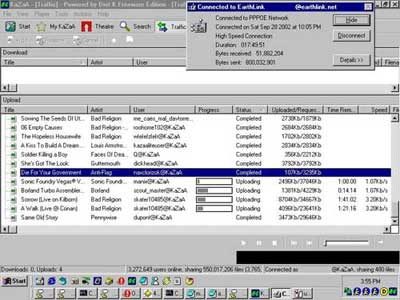
Peer-To-Peer file-sharing is by far one of the easiest and quickest ways to download MP3s, movies, and just about any other form of digital media. Unfortunately, there are a few problems with using P2P:
- It has came under fire recently from RIAA and related industries, making this a potentially dangerous gamble;
- Most of the major players in P2P (Napster, Kazaa, ect) have been strong-armed into becoming paysites;
- These programs are pretty much impossible to use behind a firewall.
If you want the least time-consuming route to mp3s, then P2P is the way to go. As of the time of this writing, one of the very few P2P programs which have not converted into a paysite is Ares. Unfortunately, Ares is nowhere near as popular as Kazaa is (was), and thus your chances of finding the specific mp3 file(s) you want are not particularly good. If you can tolerate paysites though, then Kazaa is still the best place to search for stuff - no one can really argue when faced with 3.4 terrabytes of downloadable data.
Method 2: FTP
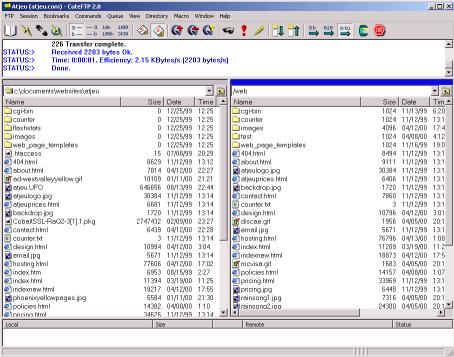
File-Transfer-Protocol is significantly more difficult to get into than P2P. With FTP, one needs to know the location of the FTP, have a username, password, and various other information related to that particular FTP. In other words, a person does not just find FTPs laying around - you have to go find them. Once found, FTPs are basically a virtual disk drive in which you can drag and drop files from the FTP window to your own computer folders. A few minutes later, those files are yours.
I personally have only rudimentary knowledge with FTPs, and do not use them all that much. Luckily for everyone, there are plenty of sites out there that cut most of the time necessary in finding such treasure troves of information. xFTPx, for example, lets you search a random assortment of FTPs for free, with the option of paying money to unlock searching features and such.
Method 3: Index Pages
This last option is the one I have most heavily relied upon since the downfall of Kazaa and the internment behind collegiate firewall. Not only is it free, relatively untraceable, and generally pretty productive, getting mp3s from Index Pages only has two downsides.
- It is time-consuming.
- It is difficult to find specific music files.
If you're willing to live with those two restrictions, the Net is your oyster. Here is how you make that happen.
- Load up Google. Any search engine will work, but Google searches 3.4 billion webpages, increasing the chances of a good match.
- Structuring the search itself is the by far the most important part of finding these Index Pages from amidst all of the other internet flotsam. Let's say you want to find some anime soundtracks. For that, you'd want to enter the following:
"anime" +mp3 +index +parent -sex -list -website
The main two things you will want to notice about the above search string are the identifier and the qualifiers. The identifier is the thing in quotation marks, and determines the body of mp3 you will be searching for. You could really put anything you want in the quotation marks, but I do not necessarily recommend getting any more specific than genres, movie names, bands, and so on. For example, if you wanted to find the Audioslave song I am the Highway and decided to input "I am the Highway," the search results would not include correct matches such as "IamtheHighway," "I_am_the_Highway," "highway," or any other naming convention - only exact matches are found. Therefore, you will be better of by searching for "Audioslave" and then sifting through the results rather than excluding all possible matches that were a character or two off.
The qualifiers are everything other than the word(s) inside the quotes. These basically function as specific filters, and help significantly weed out those websites who wish to capitalize on the traffic generated by people searching for mp3 files. You can add more qualifiers if you want to, but in general it is not a good idea as each qualifier added filters out more and more files that may actually contain mp3s.
- Sift through the results, keeping in mind not to get your hopes up too high - getting good matches does not mean the server is in working order or is not password protected. In other words, don't let yourself be discouraged at first.
- Download and enjoy your files.
I'll visually walk you through a sample search so you know what you're looking for.
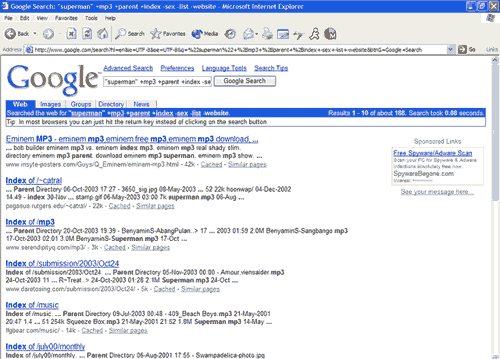
Alright, look at this picture carefully. Note that my search string was for "superman," a song that I've heard once and really enjoyed but I otherwise have no idea which band performs it. And no, it is not the Eminem's Superman - I already have that. Anyway, the results I want to be looking for all start with "Index of ..." There seems to be some ones with promise, so let's see where the second link takes me...
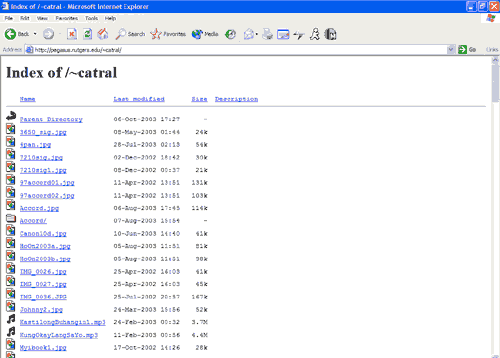
...nowhere apparently. Scrolling down revealed only an abundance of pictures, and some non-mp3 folders. Although this particular link was a bust, you can still enjoy perusing around this person's Index page if you're into that sort of thing. Indeed, sometimes you can read other people's journal entries, papers, browse their vacation photos, attempts at art, and a variety of other materials impossible to quantify. After all, if these people wanted to keep such things secret, they wouldn't have put them on the internet. Anyway, clicking on "Parent Directory" will take you up one step in the Index folder, and to the main webpage in this case...
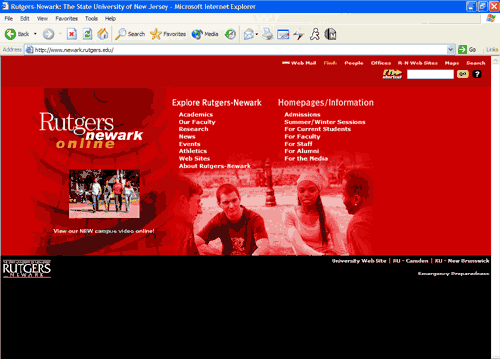
This is what everyone else normally sees when they come to this particular webpage. Do you see how accessing a webpage's Index files would be disadvantageous for the webmaster? By going through their Index files you bypass all the clever javascript, flash animation, advertising, and related uselessness on your way to the thing you go to these sites for in the first place: the content.
Back to the search. Now, looking at the next link below the one I clicked on, do you see how it holds a much higher probability of containing the mp3s I want? Let's seem if my suspicions are correct...
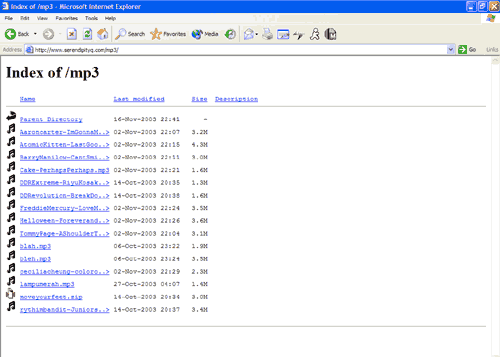
Score! Note the little music symbol on the left, and the standard mp3 file sizes on the right. I have just found some free mp3s.
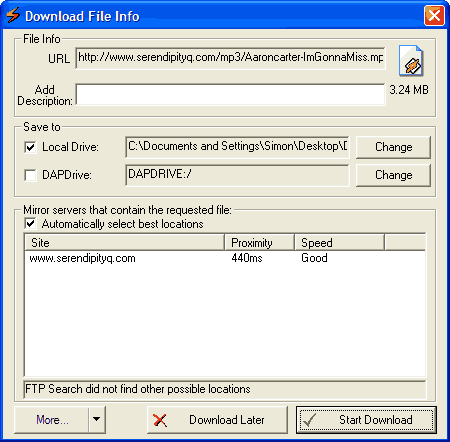
In general, you will find downloading files directly off of Index pages fairly stable and speedy.
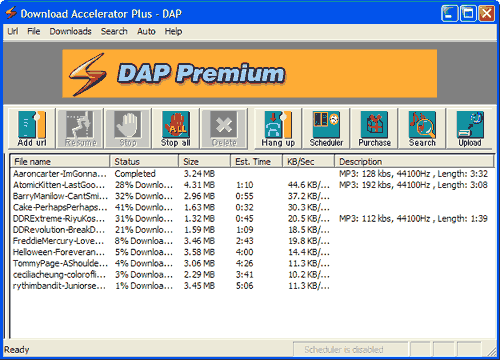
None of these songs ended up being Superman, but I'm going to go ahead and download them all anyway. While it may be morally questionable for me to download them all simeltaneously, I sleep at night knowing that having these songs anywhere close to the internet is technically illegal. I'm merely stealing from thieves, essentially.
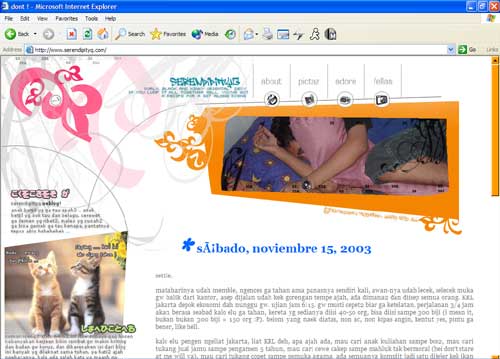
This is the actual webpage that the Index belonged to. Note the fact that there are no links whatsoever to music files. In other words, if you were looking for mp3s and happened across this page, you would not have any indication whatsoever that the webmaster distributes his favorite mp3s to his friends behind the scenes. Anyway, back to square one...
Oh? The next link has the words submission followed by a date in its title. What are the odds that it will have the file I want? Actually...
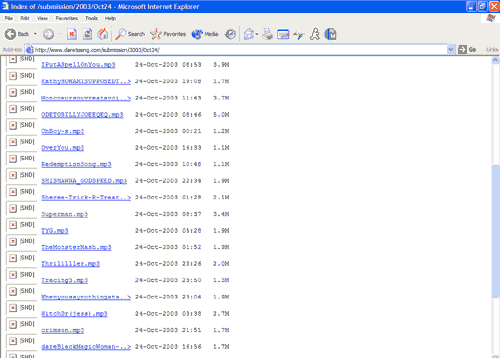
...pretty damn good! As I expected though, it isn't the true song - just some karaoke. That was sort of entertaining in of itself to listen to, but more importantly I found out what band plays the song via the Winamp song title that appeared: Tony Tiber. Or, maybe that's just the guy doing the karaoke. In any event, let's go back to square one and try the next link down from that.
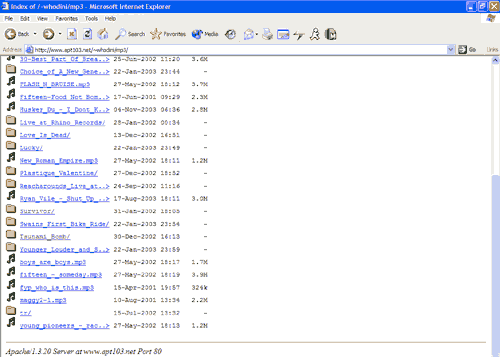
More false alarms, but take a look at what else I found in this particular Index file: a Tsunami Bomb folder. Inside contains a number of Tsunami Bomb mp3s, which I immediately started downloading. I did not set out to look for Tsunami Bomb, but I found some anyway. This is one of the pluses that comes by having to sift through some negative links - occasionally you find exactly what you were not looking for.
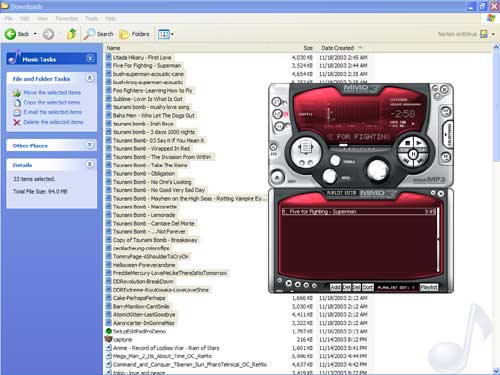
Sweet, sweet success. Turns out that a normal Google search for "Superman -Eminem +lyrics" reveals a number of possibilities, which then were finally reduced to the true band: Five For Fighting. I made the band name the identifier and eventually found a good recording of the song.
This entire little episode took roughly an hour. While that is an eternity in this cable modem P2P-age, look at what I was able to accomplish. First, I actually got the exact song I was looking for and the band's name. But look at that picture again - I also got almost 100 MBs of unrelated music files. Some of those will be deleted as chaff, but I did find some Tsunami Bomb and some other songs I was meaning to download at one point and simply forgotten. What's more, I did all of this behind a firewall and with complete impunity from the RIAA. The best way to score mp3s is thusly made clear.
Final Thoughts
Before publishing this guide, I asked myself several times why I thought it necessary to go through the trouble of writing it. After all, the more people who know of this technique, the more people there will be destroying servers by downloading 1 GB of data in less than 12 hours, right? What's the point, if others abuse this method until it is unusable by everyone? Why not just shut up and enjoy the free ride?
I feel that this whole thing is really just a social commentary of sorts.
On the one hand, you have established industries of people - the RIAA, major record labels, bands, muscians, and artists - all trying to make money. They make this money through the existing framework of the American economy: swindle the customer of as much hard-earned cash as possible. In this setting, the actual quality of the product is totally irrelevent to the pricing scheme. $18 CDs are routinely released that contain only one or two songs of any sort of artistic merit, and the bands and RIAA are fully aware of this phenomenon. The true artists, the people who are merely trying to support themselves on their art, must compete with the manufactored musical sensations of our time, the RIAA tools contrived for the sole purpose of parting fools from their money. The songs are catchy because they were scientifically created that way, hyped out the ass on cultural news troughs where the youth of the nation go to feed their personal insecurities. This is litgitimate American Business, with a capital B. But technology is fickle goddess, and what she freely gives she can freely take away.
File-sharing is not so much about stealing songs from multi-national conglomerates in a vain effort to "Fuck the system," to borrow a phrase, as it is exerting a measure of control over our lives as consumers that has never been granted before. "I don't have to buy music I don't like anymore. I am empowered." This desire is further exacerbated by technology abstracting the entire process to the point in which it requires almost zero effort to enact. Stealing clothes and other merchandise is a fairly serious endeavor that threatens capture or even physcial harm. Ripping a CD? With the right software it takes all of ten minutes to complete. Now you have a bunch of mp3 files staring at you on the screen. Click. Control-C. Control-V. That mp3 file has just been duplicated. Seemingly in violation of the Second Law of Thermodynamics, you have just created something from nothing. And what's an mp3 file anyway? Just an ordered string of zeros and ones, no different than any other file on your computer. So what if it is kept in a folder that just happens to be accessable from the internet, by anyone across the entire globe? Music really isn't a tangible thing, like a book or movie. Music is more like an idea, one that should be freely expressed. It should almost be a crime to not share such ideas, yes?
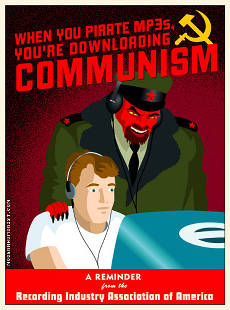 The abstraction computers, and the internet in general, brings the process is never enough to fully justify one's actions though - stealing is stealing, no matter the form. However, it is almost sickening the fashion in which the RIAA wishes to react to this apparent disaster. File-sharing is far beyond a simple meme (a self-replicating idea) at this point, and a violent crackdown on the consumers of the medium is only going to make the problem worse. The genie is officially out of the bottle, and trying to squeeze him back in is only going to piss him off.
The way I see things, the RIAA can either choose a proactive responce, or a reactive one. A proactive approach would involve changing the nature of the industry itself - instead of being the oak which breaks in the wind, be the bamboo which bends with it. Allow artists to sell their art on an individual basis, for whatever price they wish to set. Programs such as iTunes are steps in the right direction, but each $0.99 song still goes to support the RIAA's decaying artifact of a business model, one unable to support itself in this dynamic age. Yes, jobs will need to be cut, but no one ever said survival would be completely painless. Thus far, the RIAA has dedicated itself to a reactive policy, which involves trampling individual liberty in pursuit of misplaced ideals. Forcing the problem underground is not going to make it go away, as then it tends to fester more. Attempting to appeal to the morals of the average citizen with talking props dressed in clothes and accessories more expensive than most people's cars, is similarly a losing battle. For every rock star that whines about how he earned $1 million less this year than the last, there is a file-sharer whose resolve is steeled in making sure he never gives that star another dime. Put simply, not only are the RIAA's methods irrational, they are also counter-productive.
So where am I admist all of this? I am a sign of inevitability. File-sharing is not going away, not matter how many P2P programs are corrupted in pursuit of the all-mighty dollar. For every Kazaa which falls, a FTP rises to fill the void. For every lawsuit which ruins a life needlessly, there is an embittered college student which leads others to an easier way of downloading files. I do not claim that my actions are justified in a greater context, in a greater war of wills. I am merely a member of Generation Y, a product of an internet culture which defies corperate logic with the profound thought of getting something for nothing. A people who cannot conceive of a future in which e-mail is taxed, when ISPs no longer offer unlimited bandwidth transfers, where downloading files requires a legally-binding electronic signiture. Using weapons of the past to fight the wars of the future is folly at best, sophistry at worst.
The only way to beat us then, is to join us. Sink or swim. Bend or break. Evolve or die. Until the RIAA recognizes this basic tenet, there is no possible way to stem the tide of file-sharers. Continuing to fight is only going to make the fall that much more painful. Make no mistake, the RIAA will fall at its current rate. It is inevitable.
|
