
Quick Links
Dr Raymond Whitby
DPhil, B.Sc. (HONS), MRSC, MIoN
Address |
School of Pharmacy and Biomolecular Sciences |
|
Office |
407 | |
Tel |
+44 (0) 1273 678778 | |
Fax |
+44 (0) 1273 677196 | |
|
|
r.whitby  brighton.ac.uk brighton.ac.uk |
Brief Resume
Ray graduated in 1997 from the University of Bradford with a 2:1 (Hons) in Chemistry with Pharmaceutical and Forensic Science. He spent 18 months working with Duracell in Holland, developing a prototype-recycling machine for used batteries. He completed his doctorate under Prof Sir Harry Kroto at the University of Sussex on "Nanocomposites of Carbon & Tungsten Disulphide" in 2002. He spent 6 months working at the Bio-Nanotechnology Electronics Research Centre at Toyo Univeristy and is now an RCUK Academic Fellow at the University of Brighton.
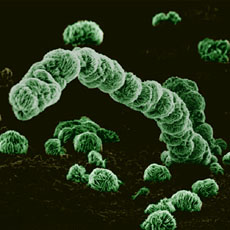
Novel forsterite (Mg2SiO4) nanocrystals, full article available from RSC website (click here)
Primary focus was to develop novel materials that have potentially useful properties. This has led to the production of a binary phase of layered nanotubes, where MWCNs are sheathed by WS2. It has been found that the number of WS2 layers can be controlled through the degree of deposition of the tungsten oxide precursor. We have produced the first single-walled WS2 nanotube (see Figure 1), which, despite being a coat, can be used to verify the LDOS theory and conduct I-V measurements for single-walled WS2 nanotubes. The WS2-C composite materials are currently being explored for metal ion intercalation in rechargeable batteries.
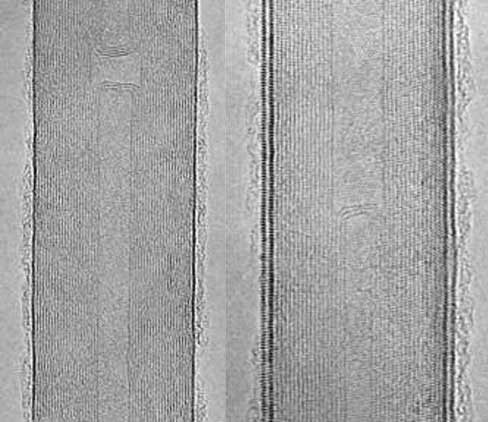
Figure 1, HRTEM images of a single- and double-walled WS2-coated MWCN
This approach has been used to produce WS2-coated SWCN bundles, which have resulted in the first conical form of WS2 and WS2-nanoflasks (see Figure 2), and NbS2-coated MWCNs (by Y.Q. Zhu). We hope to further the carbon nanotube coating series to include YBa2Cu3O7-d and incorporate the nanocomposites into polystyrene to produce high-temperature superconducting plastics. Other research interests involve the development of nanocomposites that exhibit photovoltaic, Schottky diode & capacitor effects.
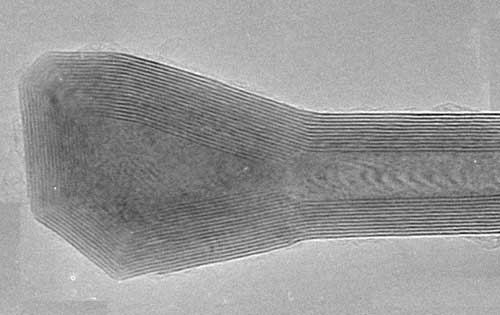
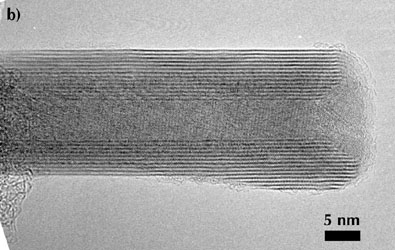
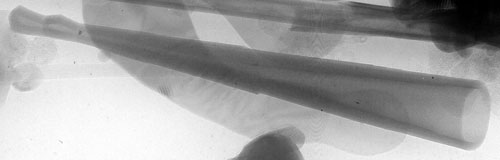
Figure 2, TEM images of a WS2 nanoflask & nanocone.
In an attempt to remove the underlying template, we have discovered that the WO3 coatings frequently collapse and after sulphidisation, yield coalesced WS2 structures with interesting bonding geometries (see Figure 3). Additional structures found in this sample also revealed unique morphologies. Nanoflasks may prove useful as nanoscale (bio-) chemical reactors. Figure 4 reveals an intermediate phase structure of WO3-x-WS2 nanotube, supporting previously proposed growth models by Reshif Tenne.
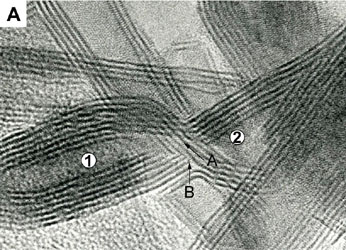
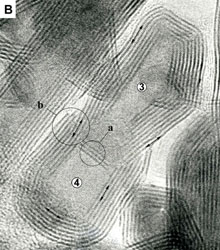
Figure 3, TEM images of coalesced WS2 nanostructures.
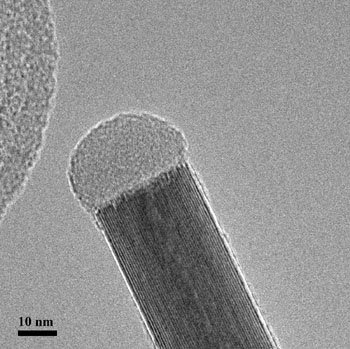
Figure 4, TEM image of a polyp WO3-x-WS2 nanotube.
Collaboration efforts with the Bio-Nano Electronics Research Centre at Toyo University in Japan has led to the development of a process which can potentially recycle carbon dioxide (CO2). The associated nanotechnology impact was also the creation of amorphous carbon columns on the substrate (Figure 5) from the UV dissociation of CO2 at its ciritcal point. Critical CO2 was also useful for the spontaneous formation of nanostructures through doping the reactor with C60 (Figure 6).
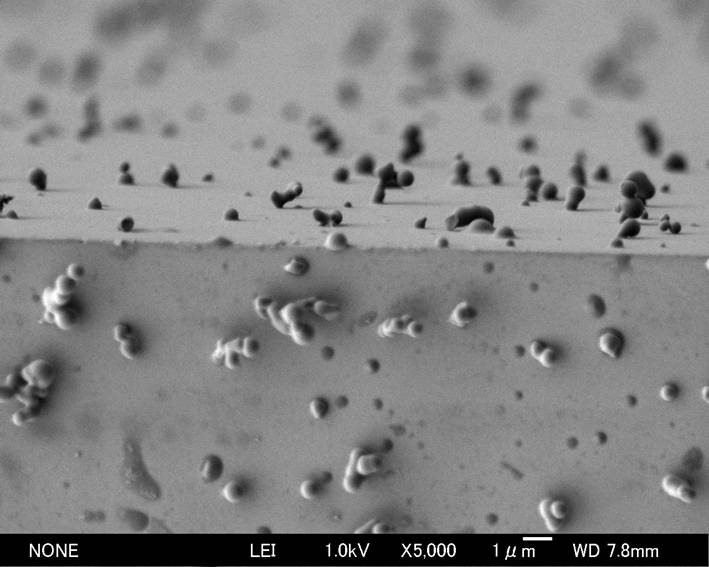
Figure 5, SEM image of carbon from dissociation of supercritical CO2
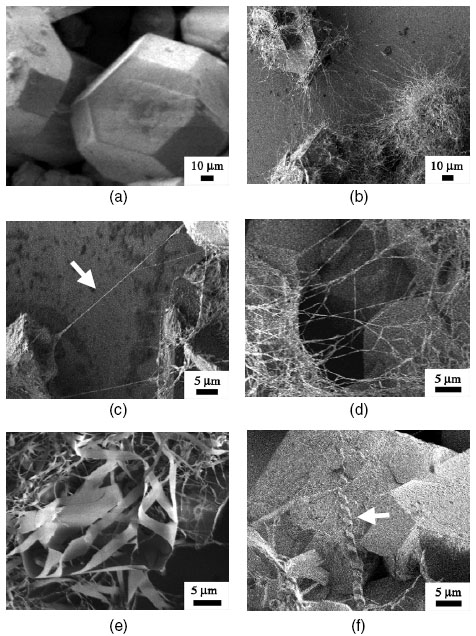
Figure 6, SEM images of nanostructures from self-ordering of C60 in supercritical CO2
Ray is currently establishing a nanotechnology research group at the University of Brighton.
Research Interests
- Nanoscale architecture
- Material properties of nanotube-polymer composites
- TEM simulation of nanotubes
- Fabrication of modified nanocarbons for life science interface
- Rational chemical synthesis of single-walled nanotubes
- Embedded nanoparticles in cryopolymers for water filtration & purification
- Surfactantless carbon nanotube bucky paper systems
- Toxicology and biocompatibility of carbon nanotubes and modified CNTs
- Recycling of carbon dioxide with UV lasers
- Generation of delocalised fulvic acids on oxidised carbon nanotubes
Publications
Authored Publications
1. R.L.D. Whitby, K.S. Brigatti, I.A. Kinloch, D.P. Randall, T. Maekawa, "Novel Mg2SiO4 Structures", Chem. Comm., 21, 2396, (2004). Abstract: We describe the formation of novel, leaf-like Mg2SiO4 structures, via iodine vapour transport of magnesium onto quartz substrates.
2. R.L.D. Whitby, W.K. Hsu, Y.Q. Zhu, H.W. Kroto, D.R.M. Walton, "Novel Nanoscale Architectures: Coated Nanotubes and other Nanowires", Phil. Trans. R. Soc. Lond. A, 362, 2127-2142 (2004). Abstract: Research has demonstrated that the structure and properties of a nanoscale system are inextricably linked. The advent of nanoscale research in 1991 relied upon nanoscale material production through random formation techniques, such as arc discharge, and the inherent properties and morphology of the system were therefore difficult to control. This article reviews some of the methods and ideas that have developed since the inception of nanotechnology, leading to fine control over the morphology of nanoscale systems and highlighting settle interesting nanoscale architecture.
3. R.L.D. Whitby, W.K. Hsu, C.B. Boothroyd, K.S. Brigatti, H.W. Kroto, D.R.M. Walton," WS2 layer formation on multi-walled carbon nanotubes" Appl. Phys. A-Mater. Sci. Process., 76, 527 (2003). Abstract: Time-dependent powder X-ray-diftraction analyses reveal that the conversion Of WO3 into WS2 on carbon nanotube surfaces in the presence of H2S is a one-step process. The W layers grow simultaneously along the tube in the radial and axial directions.
4. R.L.D. Whitby, W.K. Hsu, C.B. Boothroyd, H.W. Kroto, D.R.M. Walton, "WS2/C Nanocomposites Reviewed", New Diamond and Frontier Carbon Technology, 13, 7 (2003). Abstract: Whilst generating nanotubes with modified material properties, multiwalled carbon nanotubes (MWCNs) were found to be capable of acting as templates for WS2 nanotube growth. The MWCNs, coated with WO, by heating a mixture of MWCNs and a tungsten oxide precursor, i.e., H2WO4 were then sulphidised at 900degreesC in order to convert the WO, into WS2 layers.
5. R.L.D. Whitby, W.K. Hsu, H. W. Kroto, D.R.M. Walton, "Tungsten disulphide coated multi-walled carbon nanotubes, review of the synthesis and characterisation", Physical Sciences, Engineering and Technology -Recent Research Developments in Applied Physics, Vol. 5 (2002) Part II. Abstract: The Sussex Nanoscience & Nanotechnology Centre has developed a novel method for the creating tungsten disulphide (WS2) nanotubes on the surface of multi-walled carbon nanotubes (MWCNs). The procedure allows for part control of the deposition mechanism, whereby it is now possible to generate single-walled WS2 nanotube coatings for MWCNs.
6. R.L.D. Whitby, W.K. Hsu, T.H. Lee, C.B. Boothroyd, H.W. Kroto, D.R.M. Walton, "Complex WS2 nanostructures", Chem. Phys. Lett., 359, 68 (2002). Abstract: A range of elegant tubular and conical nanostructures has been created by template growth of (WS2)(n) layers on the surfaces of single-walled carbon nanotube bundles. The structures exhibit remarkably perfect straight segments together with interesting complexities at the intersections, which are discussed here in detail in order to enhance understanding of the structural features governing tube growth.
7. R.L.D. Whitby, W.K. Hsu, H.W. Kroto, D.R.M. Walton, "Conversion of amorphous WO3-x into WS2 nanotubes", Phys. Chem. Chem. Phys., 4, 3938 (2002). Abstract: Removal of the carbon template from WS2-coated multi-walled carbon nanotube ( MWCN) composites, produced WS2 nanotubes with intriguing microstructures. TEM characterisation shows that the intermediate phases of amorphous WO3-x-WS2 nanostructures, support the previously proposed growth model for WS2 nanotubes on MWCNs
8. R.L.D. Whitby, W.K. Hsu, C.B. Boothroyd, H.W. Kroto, D.R.M. Walton, "WS2 coated MWCNs", Chem. Phys. Lett., 359, 121 (2002). Abstract: Multi-walled carbon nanotubes (MWCNs), coated with ordered WS2 mono- or multi-layers, are generated by pyrolysing H2S/N-2 over MWCNs thinly coated with WO3. High-resolution transmission electron microscopy (HRTEM) reveals the presence of hexagonal WS2 arrays in the tube surface, consistent with the WS, simulated structure.
9. R.L.D. Whitby, W.K. Hsu, P.K. Fearon, N.C. Billingham, I. Maurin, H.W. Kroto, D.R.M. Walton, C.B. Boothroyd, S. Firth, R.J.H. Clark, D. Collison, "Tungsten disulphide coated multi-walled carbon nanotubes", Chem. Mat., 14, 2209 (2002). Abstract: Novel binary-phase WS2-C nanotubes were generated by pyrolyzing WO3-coated multiwalled carbon nanotubes in an H2S/N-2 atmosphere at 900 degreesC. The WS2 coating acts as an anti-oxidizing agent.
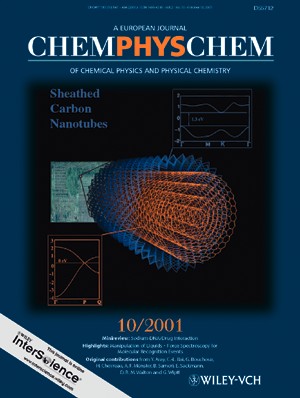
10. R.L.D. Whitby, W.K. Hsu, C.B. Boothroyd, P.K. Fearon, H.W. Kroto, D.R.M. Walton, "Tungsten disulphide sheathed carbon nanotubes", ChemPhysChem, 2, 620 (2001). (Front Cover) Abstract
11. R.L.D. Whitby, W.K. Hsu, C.B. Boothroyd, P.C.P. Watts, H.W. Kroto, D.R.M. Walton, "WS2-coated single-wall carbon nanotube bundles", Appl. Phys. Lett., 79, 4574 (2001). Abstract: Single-walled carbon nanotubes (SWCNs) encapsulated in multiwalled WS2 nanotubes are produced by pyrolyzing a mixture of WO3-x and SWCNs in N-2/H2S atmosphere.
Co-Authored Publications
1. K. Matsumoto, C. Sato, Y. Naka, A. Kitazawa, R.L.D. Whitby, N. Shimizu, "Neurite outgrowths of neurons with neurotrophin-coated carbon nanotubes", J. Biosci. Bioeng., 103, 216-220 (2007). Abstract: Multiwalled carbon nanotubes (CNTs) coated with neurotrophin were used to regulate the differentiation and survival of neurons. Neurotrophin (nerve growth factor [NGF] or brain-derived neurotrophic factor [BDNF]) was covalently bound to CNTs modified by amino groups using a 1-ethyl-3-(3-dimethylaminopropyl) carbodiimide hydrochloride (EDC) reagent. The CNTs coated with NGF or BDNF promoted the neurite outgrowths of neurons in the same manner as soluble NGF and soluble BDNF. By enzyme-linked immunosorbent assay (ELISA), we demonstrated that neurotrophin-coated CNTs carry neurotrophin. These results suggest that neurotrophin-coated CNTs have biological activity and stimulate the neurite outgrowths of neurons.
2. T. Fukuda, K. Ishii, S. Kurosu, R.L.D. Whitby, T. Maekawa, "Formation of clusters composed of C60 molecules via self-assembly in critical fluids", Nanotechnology, 18, 145611 (2007). Abstract: Fullerenes are promising candidates for intelligent, functional nanomaterials because of their unique mechanical, electronic and chemical properties. However, it is necessary to invent some efficient but relatively simple methods of producing structures composed of fullerenes for the development of nanomechatronic, nanoelectronic and biochemical devices and sensors. In this paper, we show that various structures such as straight fibres, networks formed by fibres, wide sheets and helical structures, which are composed of C60 molecules, are created by placing C60-crystals in critical ethane, carbon dioxide and xenon even though C60 molecules do not dissolve or disperse in the above fluids. It is supposed, judging by the intermolecular potentials between C60 and C60, between C60 and ethane, and between ethane and ethane, that C60-clusters grow with the assistance of solvent molecules, which are trapped between C60 molecules under critical conditions. This room-temperature self-assembly cluster growth process in critical fluids may open up a new methodology of forming structures built up with fullerenes without the need for any ultra-fine processing technologies.3. C. Gao C, Y.Z. Jin, H. Kong, R.L.D. Whitby, S.F.A. Acquah, G.Y. Chen, H.H. Qian, A. Hartschuh, S.R.P. Silva, S. Henley, P. Fearon, H.W. Kroto, D.R.M. Walton, "Polyurea-functionalized multiwalled carbon nanotubes: Synthesis, morphology, and Raman spectroscopy", J. Phy. Chem. B, 109, 11925-11932 (2005). Abstract: An in situ polycondensation approach was applied to functionalize multiwalled carbon nanotubes (MWNTs), resulting in various linear or hyperbranched polycondensed polymers [e.g., polyureas, polyurethanes, and poly(urea-urethane)-bonded carbon nanotubes]. The quantity of the grafted polymer can be easily controlled by the feed ratio of monomers. As a typical example, the polyurea-functionalized MWNTs were measured and characterized in detail. The oxidized MWNTs (MWNT-COOH) were converted into acyl chloride-functionalized MWNTs (MWNT-COCl) by reaction with neat thionyl chloride (SOCl2). MWNT-COCl was reacted with excess 1,6-diaminohexane, affording amino-functionalized MWNTs (MWNT-NH2). In the presence of MWNT-NH2, the polyurea was covalently coated onto the surfaces of the nanotube by in situ polycondensation of diisocyanate [e.g., 4,4 '-methylenebis(phenylisocyanate)] and 1,6-diaminohexane, followed by the removal of free polymer via repeated filtering and solvent washing. The coated polyurea content can be controlled to some extent by adjusting the feed ratio of the isocyanato and amino groups. The structure and morphology of the resulting nanocomposites were characterized by FTIR, NMR, Raman, confocal Raman, TEM, EDS, and SEM measurements. The polyurea-coated MWNTs showed interesting self-assembled flat or flowerlike morphologies in the solid state. The signals corresponding to that of the D and G bands of the carbon nanotubes were strongly attenuated after polyurea was chemically tethered to the MWNT surfaces. Comparative experiments showed that the grafted polymer species and structures have a strong effect on the Raman signals of polymer-functionalized MWNTs.
4. V. Stolojan, S.R.P. Silva, M.J. Goringe, R.L.D. Whitby, W.K. Hsu, D.R.M. Walton, H.W. Kroto, "Dielectric properties of WS2-coated multiwalled carbon nanotubes studied by energy-loss spectroscopic profiling", App. Phy. Lett., 86, art no. 063112 (2005). Abstract: We investigate experimentally the electronic properties of the coating for multiwalled carbon nanotubes covered in tungsten disulfide (WS2) of various thicknesses. Coatings of thicknesses between 2 and 8 monolayers (ML) are analyzed using energy-loss spectroscopic profiling (ELSP), by studying the variations in the plasmon excitations across the coated nanotube, as a function of the coating thickness. We find a change in the ELSP for coatings above 5 ML thickness, which we interpret in terms of a change in its dielectric properties.
5. Y.Z. Jin, Y.Q. Zhu, R.L.D. Whitby, N. Yao, R. Ma, P.C.P. Watts, H.W. Kroto, D.R.M. Walton, "Simple approaches to large-scale tungsten oxide nanoneedles", J. Phys. Chem. B, 108, 15572 (2004). Abstract: In this paper, a systematic study of large-scale production of highly crystalline W18O49 nanoneedles with high aspect ratios using a simple tungsten metal reacting with water at 800-1000 degreesC has been described. By altering the W source and other experimental conditions, we have generated W18O49 crystals with diverse morphologies, and needles with desired dimensions are achieved. The quality nanoneedles provide ideal samples for further property investigations. Possible growth mechanisms are discussed.
Abstracts & Proceedings
1. R.L.D. Whitby, "Approaches towards nanoscale architecture", 4th International Symposium on Bioscience and Nanotechnology, 11 (2006).
2. R.L.D. Whitby, "Nanoscale architecture", 3rd International Symposium on Bioscience and Nanotechnology, 13 (2005).
3. R.L.D. Whitby, "Nanoscale Architecture", Mechanical Engineering Congress, 3-1, 146 (2003).
4. V. Stolojan, M.J. Coringe, S.R.P. Silva, R.L.D. Whitby, D.R.M. Walton, W.K. Hsu, H.W. Kroto, "Spatially resolved analysis of the electronic properties of WS2-coated carbon nanotubes using EELS in a TEM", Proceedings Seventh Applied Diamond Conference, Third Frontier Carbon Technology, A35, (2003).
5. R.L.D. Whitby, W.K. Hsu, C.B. Boothroyd, P.K. Fearon, H.W. Kroto, D.R.M. Walton, "Binary Phase of Layered Nanotubes", Materials Research Society, Symposium Proceedings, 706, Z7.6.1 (2002).
6. R.L.D. Whitby, H.W. Kroto, D.R.M. Walton, "Novel Nanoscale Materials", Proceedings of 2nd Symposium on Frontier Carbon Technology", 55 (2002).
7. T. Drewello, T. Brown, R. Whitby, M.A. Trikoupis, J.K. Terlouw, P.R. Birkett, "Laser-induced aza-heterofullerene formation", Abstr. Pap. Am. Chem. Soc., 221, 201 (2001).
Highlighted Research
1. "Clean technologies clean up", Channel Magazine, May-June 2007
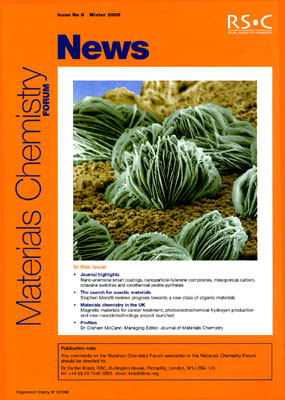
2. Materials Chemistry Forum Newsletter, 8, (Winter 2005). (Front cover)
3. "Forsterite synthesis revisited", Chem. Eng. News, 82, 32, (2004).
Patents
WO 02/088024 A1 - Nanotubes.
Abstract: "The invention provides a nanotube coated with a metal sulphide, selenide or telluride at 5% of the external surface of said nanotube being coated."
Other Interests
