 |
| Stonehenge - Building Stage - Period Three - (c. 2550 - 1600 BC) |
| Stonehenge's Period three building stage was the longest and had the most changes done of all the periods. The origional three subphase scheme of period three was drawn up by Professor Richard Atkinson who was the leading investigator of Stonehenge in the 1950s and 1960s. Archaeologists don't fully agree on how many 'subphases' there were during this period and recently they feel like there were no fewer then six. Unfortunetly, we may never know how many subphases, but certainly this period was the busiest of them all. |
| Subphase A - Period III |
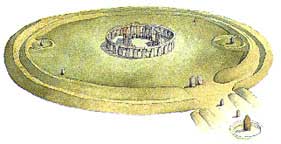
| General consensus is the first erected stones were those of the bluestones. They were set up in two cncentric circles made up of at least 82 bluestone Menhires (large, rough - hewn standing stones). These stones weighed about 5 tons each and were 6 feet apart - 35 feet fron the centre. Supposedly the bluestone came from Preseli Moutnains southwestern Wales. It is also felt that the Altar Stone was placed during this subphase. |
 |
| Subphase B - Period III |
| About 100 years later the bluestones were dismantaled and the Stonehenge as we see it today started to show. A 100 foot diameter circle of 30 sarsen stone (weighing up to 50 tons each) uprights capped by a continious ring of sarsen lentils were erected at the centre of the site. |
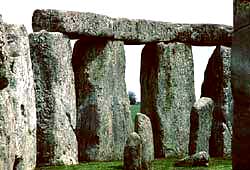 |
| Sarsen is a very hard for of sandstone found particularily in the Malborough Downs some 18 miles to the north. This circle surrounded a horseshoe-shaped setting of 5 sarsen trilithons (formations in which two uprights supported a lentil) with its opening pointing to the northeast side. No other megalithic structure in northeastern Europe displays the precision and architectual refinement that Stonehenge has. |
| Some of the bluestones were shaped, dressed and then reerected in an oval structure within the centre of the sarsen horseshoe. It is also believed that if the Altar Stone wasn't placed in Subphase A, it was probably installed in it's present position at this time. An additional circle of bluestones were set up within the outter sarsen circle. |
| Subphases C and D - Period III |
| Subphase F - Period III |
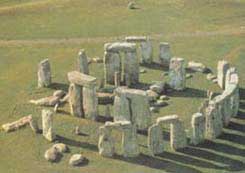
| The completing was two concentric rings of pits about 20 feet apart and dug around the outside of the stones. Lt-Col Hawley discovered them in 1923 and called them Y and Z holes (he considered the Aubrey Holes to be the X holes). It is possible that these holes were dug to take yet another setting of stones but for whatever reason this phase was never carried out. Gerald Hawkins raises a wonderful idea that these holes were used to make Stonehenge a calendar for astronomical events |
 |