 |
| Stonehenge - The Building Stage - Period 1 - (c. 2950 - 2900 BC) |
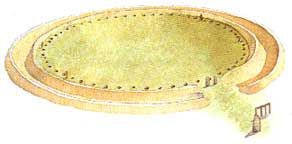 |
| The earliest portion of Stonehenge was built around 2950 - 2900 BC. The periods can be read by a radiocarbon reader by about 100 years by science, but the actual designing of it can't be certain by the stages. The first stage of Stonehenge was basically a circular enclosure outlined by two bangs and a ditch and an enterance from the northeast and a standing stone a bit away from the enterance. The outer circle was made from earth, and even though it's partially destroyed, it was about 380 feet in diameter, 8 feet wide and 2 or 3 feet high. |
| The ditch wasn't uniform in shape or depth and it varied in width from 10 - 15 feet and a depth of 4.5 - 7 feet. Not much effort was taken to keeping the ditch clean. Archeologists have been able to used the varied fragments (picks made of red deer antlers, scoops made of oxen shoulder blades, and some pottery fragments) have been found in the ditch and helped date the construction. |
| Next was the chalkwork of the inner bank of Stonehenge. It was an impressing sight about 6 feet high, about 20 feet wide and had a diameter of 320 feet It was composed of the solid chalk that makes up most of the surface region around Stonehenge. An interesting fact to know is that all of the other Stonehenge type monuments have their bigger encircling banks outside of the quarry ditches; yet Stonehenge has it's bigger banks within the ditch. No one has been able to figure out why Stonehenge was built like this. |
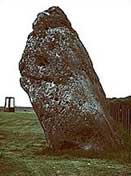 |
| From the center of the circle fasting Northeast is the enterance into Stonehenge. It is about 35 feet wide and is set so that a person standing in the center can see the sun rise on midsummer morning just to the left of the heel stone (picture left). The naturally shaped heel stone is about 20 feet long and 8 feet wide and 7 feet thick. Its lower 4 feet is below the ground and it weighs around 35 tons. It is made of natural sandstone called sarsen which are thought to have come from Malborough Downs, 20 miles to the North of Stonehenge. Currently, the heel stone leans inwards towards the circle at an angle of about 30 degrees from the perpendicular, but it was believed that the stone was standing up straight. Circling the stone about 12 feet from it's bace is a covered ditch filled with chalk. |
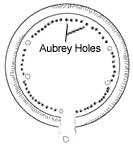 |
| Inside the circle are 56 Aubrey holes (named after their 17th centrury discoverer John Aubrey) which vary from 2.5 feet to 6 feet in width, and 2 to 4 feet in depth. They were spaced quite accuratly in a 288 foot diameter circle with an average centre point for each hole of 19 inches (+/- an inch of two). Probably also dating to this time are the four Station Stones (only two survive) which stand approximatly on the cirlce of Aubrey Holes. They formed a rectangule perpendicular to the midsummer sunrise line of the monument. Of the two still standing, one is naturally shaped while the other one is slightly tooled. There are some contention amoung archaeologists as to when the Station Stones were placed at Stonehenge but general consensus states around Period 1. |