Road to oblivion
It
all started innocently enough during a chance meeting with, K C Momin,
the Tourism Minister of Meghalaya. Discussing various off-the beaten track
destinations in his area, he at one point took a small map and drew a line
along his State’s southern border with Bangladesh and said, “this
is the Border Road, the scenery here is to be been seen to be believed.”
Subsequently, any
time the topic of Meghalaya came up, the yet unseen strip of pitch lining
the hilly international border would be the first thing on my mind, till
the perfect opportunity to experience it first hand came by. My friend
Anne Perry, therapist and sister of a loud name in the Rock n Roll
Hall of Fame was interested in motorcycling in India and checking out the
traditional medicine 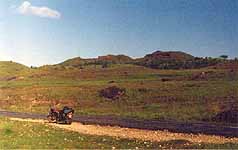 scene.
So gathering all her inner strength to overcome any possible challenge
the country might throw at a first time visitor, she joined me in Guwahati,
safe, sound and sans horror stories bearing those of pesky taxi drivers
in Calcutta airport.
scene.
So gathering all her inner strength to overcome any possible challenge
the country might throw at a first time visitor, she joined me in Guwahati,
safe, sound and sans horror stories bearing those of pesky taxi drivers
in Calcutta airport.
To acquaint her with
the effect Indian roads have on inexperienced derrieres, we first
headed east to Tezpur on a “Machismo,” the chrome and red 350 cc flagship
of the India made and fifties Brit designed Royal Enfield motorcycles.
Here, after spending a couple of days exploring archaic temple ruins, gazing
at the Brahmaputra, meeting a Tantric Buddhist Rinpoche and a musically
gifted pot smoking Hindu Baba, it was time to get down to serious riding—
Border Road of Meghalaya.
To reach the coveted
highway, it first entailed getting to Ranikor, a little known spot figuring
on the tourist map as an angling destination situated at the southern foothill
of the Meghalaya Plateau, reachable via Mawsynram, the world record holder
for highest rainfall. The Minister again helped by providing a document
permitting us stay in all Government Rest Houses in the accommodation 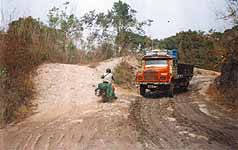 sparse
interiors. To avoid overcrowded highways we opted for a steep, winding
and little used roadway starting a little west of Guwahati connecting to
Mairang, a town approximately 30 km from the State capital Shillong.
sparse
interiors. To avoid overcrowded highways we opted for a steep, winding
and little used roadway starting a little west of Guwahati connecting to
Mairang, a town approximately 30 km from the State capital Shillong.
We reached Mairang
early in the afternoon and were instantly stalled in the traffic thanks
to the combined forces of humanity and soot belching trucks and buses.
A weekly market, and the entire population of the town and all the neighbouring
villages seemed out on the streets. Almost everyone was wrapped in traditional
Khasi checkered shawls, so reminiscent of Mexican ponchos. If fact, sparing
the missing sombreros, the entire place could have well been in rural Mexico,
even the faces seemed Mayan. The people, whether they were striding down
the road or lying atop a pile of sacks on a truck also exhibited the same
laid back posture assigned to Latin Americans alone. To add to the effect,
flamenco guitar strummed from a music shop’s loudspeaker.
The officer authorized
to grant us stay in the Government Rest House was polite but distant. She
thankfully quickly dissolved into smiles and I am sure it wasn’t because
of my observation about her youthful appearance. The Police Chief who came
demanding to see passports at night softened after seeing the Minister’s
letter, weakly explaining that the gentleman was his wife’s distant uncle.
Perched on a hillock
a slight distance from the town, the Rest House balcony offered a panoramic
vista of the surroundings. Although, being at the end of winter the landscape
consisted mostly of parched black earth prepared into rectangular mounds
for growing potatoes. The sky too was overcast with a canopy of clouds
and the colour gray seemed all pervading. Nearby, the pines swayed to the
almost constantly howling winds.
Going
out to the market early the next morning to hunt down any proponents
of the traditional Khasis healing systems we first faced a massive communication
wall as hardly anyone spoke any recognizable strain of English of Hindi.
Luckily we met Anthony, the owner of an electrical store who spoke fluent
English, thanks to the efforts of one Brother Jim who taught him in school.
He was equally enthralled by Anne’s desire to learn about local medicine
and “quack doctors.” By the time we were done, we had two bottles of burn
and sprain lotion, a pack of vine bark sawdust and a bit of the same vine,
supposedly imbibed with anti-jaundice properties.
We next proceeded
to Shillong as we had to obtain a permit for traversing the Border Road
for the BSF (Border Security Force — the paramilitary body responsible
for guarding India’s frontier) HQ there. The road passed through more gray
fields, pine dotted hills and hamlets sporting monolithic menhirs and tombstones
with concrete roosters, symbols of the indigenous Seng Khasi faith.
A traffic bottleneck
almost blocked the approach to Shillong. The cause revealed itself a little
further with hundreds of pedestrians dressed in their brightest finery
thronging to a temple on a hill. The day was Shivaratri. Dumping
our bags at the Youth Hostel, we lost no time in getting to the BSF camp
where the sentry at the gate informed that the concerned officers were
out for lunch. When we returned there was another sentry repeating the
same barrage until the first one reappeared and clarified that the two
chief officers didn’t turn up for the day at all and that left only the
Commandant who was the third in succession.
“Well let me see the
Commandant,” I pushed.
Acha; ap ka koi
ID, Sir (Okay, do you have any id)? I promptly took out a copy of a
magazine, one that features my mug shot along with the monthly column and
stuck it out. The Commandant was courteous and sympathetic, but no, he
couldn’t issue a permit as the area was not under his command.
“You should try meeting
the Commandant of 137”, he offered, at the same time sidestepping my request
for him to have a word with the concerned officer. “It would be much nicer
if you go there personally and speak to him.”
The 137 camp was located
on another hilltop and after repeating the same identity establishing acts
at the gate, I was told that the Commandant was absent.
“It’s Shivaratri
you know”.
We left early the
next morning, still without a pass. Stopping in the neighbouring town of
Mawngap for both gas and breakfast, we ended up chatting several hours
with the owner of the gas station where a month back two attendants were
shot dead by extremists. The drizzling rain and the dark ominous clouds,
courtesy a cyclone in Bangladesh further stalled progress. Once on our
way, we were caught in a cloudburst less than 10 km away.
Oh well, there must
be sunshine after rain... and shine brightly it did, highlighting each
grass blade, darkening the moist asphalt and accentuating pebbles rounded
by water millions of years ago, now trapped in layers of sedimentary rocks
7000 feet above the sea level.
Wasting half an hour
riding around Mawsynram looking for a place to eat and finding nothing
more then a group of aloof teenagers and a thatched club house radiating
loud drum beats, we continued on our way to Ranikor, still a distance of
80 km away. The road became considerably narrower and leaving the undulating
flatland of the Plateau top, started gradually winding downhill. The surroundings
transformed along with the lowering altitude and in no time we were riding
through a lush green subtropical countryside, the houses became bamboo
and thatched once again.
The road continued
skirting along the sides of gorges and towering cliffs, and beyond a point
the sight of a vast plain dominated the southern view, Bangladesh. From
the village of Balat, it was easy riding with the road mostly stretching
through paddy fields for another thirty kilometres.
Despite the nightfall,
it wasn’t difficult either to locate Ranikor’s Inspection Bungalow or its
caretaker, one of the most dour faced examples of the species. He promptly
informed us that all the rooms were booked, even though there were locks
hanging all around.
“I have a letter from
the Minister,” I started vehemently, not entertaining the prospect of being
left without shelter in a place sans any alternate arrangements.
“Okay, talk to the
SDO (Sub Divisional Officer),” he shrugged, leading me to a neighbouring
compound where a group of men were playing badminton. My appearance didn’t
effect any reaction sparing dirty look. So I stepped into the court
and received a curt “Yes, what do you want?” And in the same tone was asked
to get off the court.
The
Minister’s letter again helped settle things and the badminton player quickly
lost all interest in the game, his shoulders stooped as he started explaining
how he was in a fix as the BSF had booked the entire place. When he asked
how long we would be staying I couldn’t resist breaking into a smile and
say— two. He exacted revenge by providing a room with two beds, but one
mattress.
Dinner was a t a roadside
family run eatery with an earthen hearth in the middle. When I asked the
owner about what was available, he first replied, fish. Then turning to
a younger chap helping around, he added something in Khasi for the latter
to translate. The latter fumbled and the old guy burst out cackling and
repeated, “Crane, crane.”
“Duck”, offered the translator
trying to keep his face straight”.
“What are you having?”
asked Anne glancing at my plate, herself forgoing nourishment to assist
digestion. “Exotic water bird!!” I replied.
Ranikor lies nested
in the cleavage of two massive jungle cloaked ranges. Besides flows the
Jadukata, the confluence of the Kynshi and Rilang, several hundred metres
wide despite being winter, its waters incredibly clear and tinged with
shades of blue. Freed from the narrow confining passage of the mountains
it entered the plains of Bangladesh, a few kilometres to the south as a
series of broad arterial streams. The Border Road lay on the other side,
and to continue westwards entailed crossing the river by a paddle boat,
a wooden catamaran ferry in case of a motor vehicle.
First thing in the
morning, we made our way to the BSF outpost, strategically perched
on a hillside overlooking the river in a fresh bid to garner official permission
to traverse the road. Here again the officer in command was away and his
second took charge of dealing with us. Friendly chaps, they explained
that they couldn’t grant permission by themselves, but could radio Shillong
for instructions.
A hour passed awaiting
the hallowed word, spent in an animated discussion with the temporal head
about various counter-terrorism measures. The only uneasy part was that
he kept using the word torture in place of interrogation.
At long last the radio
crackled to life and the message it conveyed was in the negative. The soldiers
were sympathetic and even hinted that they would look the other way, but
we would be on our own at the next outpost. Not a very encouraging proposition!
We spent the day exploring
around, first a massive rocky outcrop at the base of which was a small
enclosure housing an iron trident, the symbol of god Shiva, which we dubbed
“Shiva Station” after Kirtan legend Jai Uttal’s album. Next we checked
out the village across the river, again frantic and overcrowded due to
another weekly market.
On the ferry were
a couple of jeeps, one of them driven by Father Mathews, or Manoj as he
introduced himself. A Claretian missionary, he was in-charge of a school
in Nonghyllam, approximately 25 km away. Inviting us there, he also confirmed
the existence of an alternate road running parallel to the Border Road,
one we had been hearing all around. Yes, it was unpaved, but should be
all right for a motorcycle!
However, unlike the
Border Road that mostly courses along the plains, the other route stretched
over hills via Nonghyllam and joins the former at the border town of Maheskola.
Our minds were made up.
We got on the first
ferry the following morning along with a truck full of BSF personnel. They
proceeded along the Border Road to Maheskola and we turned right to take
the “other” road.
Surfaced with compacted
red earth and gravel, the PWD road (as it was supposedly maintained by
the State’s Public Works Department) starts climbing right away along the
side of a gorge. Progress was slow allowing us to soak in the magnificent
scenery. A little onwards came an unexpected surprise — a freshly paved
virgin track of pitch, except that it lasted no more then a mile, turning
into a sandy pockmarked track allowing no higher than the second gear.
A passenger bus lumbered
by from the opposite direction giving us a bout of confidence, though little
did we realize that it was the last one we would see for a very long time.
Henceforth our sole mechanized companions were India made M A N derived
ex-army Shaktiman trucks, invariably bonnet-less for better
cooling.
Soon water from numerous
streams turned the trail into a track of foot deep slushy grooves of brown
and black mud, thanks to the slipovers of coal trucks that crisscross it
all day. In places there were a few shanties on the road side, at times
we could see fox hole entrances of coal mines. The astonishment caused
by our passage among the local population was successfully neutralized
when we inquired (with saintly expressions) if it was the road to the mission.
The track progressively worsened, bordering in-between torturous
and impossible. Several times Anne got off and walked, occasionally giving
a heave behind.
In one instance the
entire back wheel was submerged in a puddle, in another, passengers from
a Shaktiman following behind helped push the bike over a vertical
hurdle. The last few kilometres to the mission, Anne rode on a truck.
Father
Manoj and his partner Father James were awaiting us, our mud encrusted
appearance eliciting little reaction. They told us that the two hours spent
covering the 25 kilometres was good timing. An oasis in the outback, next
to the Mission compound was a convent belonging to an order called Sisters
of Mary, Help of Christians who ran a medical dispensary and a hostel
for the girls studying in the school.
We declined an invitation
to stay back and attend the consecrating of a new hall and instead followed
their directions about the route which they said continued straight ahead.
We passed two drab, sooty villages, crossed a dilapidated bridge and not
noticing any bifurcations, assumed that we were on the right road, though
a road it completely ceased to be. Just a series of truck tyre tracks meandering
through rugged bush country and to make things worse, the ground was either
sandy or consisted of extensive sandstone slabs.
It was while crossing
a water carved gully that a loud crunching sound emanated from the rear
wheel and the bike stalled. Unable to bear the stress, the axle nut jumped
causing the rear wheel to come off and in the process shred the rubber
cushes joining the hub and the sprocket. Stuck in a desolate no man’s land
with a dysfunctional motorcycle and without the necessary spares there
was nothing to be done but hope to hitch a ride on a passing truck back
to the Mission, after which we would have to make our way to Shillong.
Luckily, in a matter
of minutes a distant rumble hinted of an approaching vehicle. Shortly a
bonnet-less truck appeared around the corner from the direction of Nonghyllam.
The driver stopped when I waved him down and considering that he was moving
in the opposite direction, asked him if he had a nut for the axle instead.
Chances were bleak, nevertheless I hoped to find something that could make
a forced fit so that we could limp back. Taking one look at the thread,
the driver said “number 24” and promptly shooed out all the women passengers
sitting in the cabin. Then lifting up the bench seat started ransacking
in the box underneath, densely packed with nearly every spare and tool
conceivable. Finally, with a proud glare he produced a nut that not only
fitted, but even had the notches for a cutter pin. We also discovered that
having missed a fork we were half way to the town of Nongstoin and not
Maheskola.
The people on the
truck cheered and waved as it pulled away. Proudly written on its bumper
were the words Amazing Grace, the song I was hollering the
night before in Ranikor!
Stuffing back whatever
was left of the rubber pieces and refitting the wheel, we returned to the
Mission where they almost seemed to expect us back. In the next hour I
carved out a new set of cushes from peeling strips of retread rubber of
discarded truck tyres, courtesy a puncture repair shop in the village.
That evening we attended a service in Khasi where we only understood the
endlessly repeated phrase Khublai Maria (thank you Maria—
not difficult if you pickup sprinklings of Khasi and familiar with Catholicism).
It was followed by a cultural programme involving presentations as diverse
as Khasi and Garo girls dancing South Indian dances, to two sleek cads
gyrating expertly to electronic beats. The village comedians put up their
own routine raising loud guffaws from the audience in the thickly packed
hall. Of yes— along with a group of visiting clerics and superiors from
their order, Anne and I were guests of honour.
“Yes, yes, the Lord
moves in mysterious way,” I echoed, after narrating about our days incident
and Amazing Grace in the banquet that followed. At night I slept
in the convent, or more specifically in the dispensary’s empty ward while
Anne was accorded refuge in the Nun’s quarters.
The road we missed
the previous day, true to Father Manoj’s words continued straight ahead
from the Mission, except that we mistook it for the village garbage dump.
It was in a little better shape and even had a freshly paved strip of asphalt
lasting exactly five minutes riding time. Before long it started climbing
again and wound into a dense reserve forest. Besieged by massive trees
and a chorus of jungle sounds, the road became a stone encrusted forest
track, looking distinctly unused. Thankfully the only mechanical gremlin
of the day was a snapped accelerator cable. The number of warnings we heard
about this section alternatively described it as an elephant and
extremist country.
Deep in the jungle,
besetting the sides of the road stood several colossal blocks of rock almost
perfectly cubic in shape, a few seemingly shaped into arches and pillars.
Not remnants of a lost civilization, now swallowed by the vegetation, but
limestone formations carved by Mother Nature. We named them the Atlantean
ruins, sure that Daniken would have make a strong case here. emerging from
the forest we traversed another short asphalt section, ending as abruptly
as it began. Thereafter it was riding on a track bulldozed out of limestone
subjected to years of water erosion and neglect. Reaching the village of
Khunjoi was a welcome break, though for the villagers we were ghosts at
noon.
“No one uses that
road, at all, our village is the last stop for the bus,” they apprised
us. I refrained from clarifying if the bus was a weekly or daily affair,
glad we took the wrong road yesterday.
Conditions didn’t
improve after Khunjoi and meeting a group of peasants on the road carrying
basketloads of ginger on their back, I again asked about the road and distances.
“Take the left arm
of the next fork”, one advised.
Reaching
the bifurcation we found virtue in going the other direction as the left
branch turned out to be a steeply descending trail laid with sizable boulders.
But what made matters more confusing, the other one was so unused that
it had grass growing all over. We accordingly turned back to give the recommended
route a try. Less then a few hundred feet of it and Anne chose to walk,
with good reasons. The gradient kept increasing by the minute and soon
I was performing a circus act in balancing the bike, gunning the engine
to negotiate a rock at a time. Nonetheless I continued, as a fresh string
of engine oil drops running all along its length, indicated that the path
was recently used by another vehicle. Making it downhill took about half
an hour though the distance involved was no more than a mile. Once at the
bottom we discovered that we were on the Border Road, nearby was a barbed
wire fence an unmanned iron gate and a milestone saying Maheskola 25 Km.
We had been shown the shortest trek route to town!!
With all due respects
to the wishes of the BSF there was no way to return up the hill and continue
along the PWD road. Besides, Anne even agreed to chance deportation from
the country if apprehended by a BSF patrol, only none did, even when we
rode into one of their camps by mistake. The scenery?? It was far better
on the other route!!
Ravi J Deka
BACK
[The Assam Tribune]