 |
 Even
if rooted in the word travail", travelling for Ravi J.
Deka
it is a term of
great
allure. Apart from ridding across the entire Indian sub-continent, he
has
sailed
up the brahmaputra, trampled about the Indian borders with Tibet,
Burma
and Bhutan, and loves discovering interesting places in his own back
yard.
|
The following is the reproduction of the article published by www.streetbike.com, one that launched my motorcycling, travel writing career.
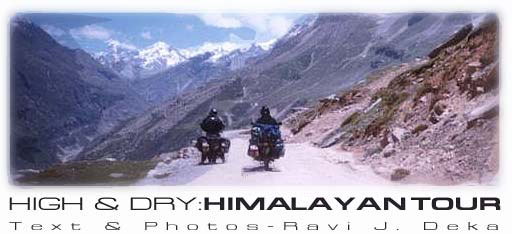 Derek, the fifty six years old Aussi and Capt. Jean Luc Picard look-alike, had our group's first accident. He flew off his bike on a gravel patch upon being confronted by an truck being driven by an aggresive Indian driver. The fall wasn't all that bad, but his obsession with wearing tanktops and shorts was responsible for a few ugly scars on his arms and thighs. He was thus herded into the support van and Chezare the timid Italian, herded out and asked to ride my motorcycle while I took over Derek's somewhat crippled steed. Derek wrote off
the incident
as the Karmic fallout of his being rude to an unpleasant Snake charmer
"Baba" earlier in the morning in Chandigarh, India. "Do any of you
know Pali
?" I was curious. No we don't, they retorted, but Ashokananda knows a
bit,
referring to the absent visionary leader of the international "All
India
Motorbike Pilgrimage on Royal Enfield Bullets", in which we were
participating. Within minutes of
hitting
the road, I learned what it is to be like being the only person in the
group who has any idea about motorcycle mechanics. Alvin's head gasket
blew. "This is what happens when you concentrate on rayers instead of
bike
maintenance!!" I growled, knowing fully that no preventive maintenance
can prevent such an incidence. Alvin meanwhile kept stroking his beard
and muttering in his thick Italian accent, while a few others gave me
dark
inquisitional looks, the kind reserved for heretics. The road to Leh, our next destination, was closed for a couple of weeks due to a broken bridge and a snow drift gone awol. Thus, having nothing to do we aped the Israelis, meditating and holding daily meetings, debating what a pilgrimage is all about. Incidentally, the drivers of the van, which we hired in Delhi to carry our luggage to Leh, got sick of waiting and one day dumped the luggage in our hotel and disappeared along with it. A week later we left for Ladakh on over-loaded bikes, courtesy the missing van, while a few of the pillion riders along with the previous passengers of the van took the bus. The drive through the fir covered hills was exuberanting and marred only by the slipping clutches, a perennial problem of British bikes and perpetually wet boots, soaked by freezing water sprays when crossing the countless streams cutting across the road. Right after the Rohtang Pass we descend to the dreaded "Koksar Nula". The stream was knee deep and about thirty meters wide, the water ice cold and fast flowing with the under water boulders kept shifting all the time. Here we also fished out two Israelis and their bikes out of the water. The two-wheelers refused to start after the bath and feeling sorry for their plight I offered to help. The bikes were probably the sorriest examples of the machines which roll out of the Madras "Royal Enfield" factory. The kind favoured most by Israelis; the sorrier the better !! One started after we dried the points, while the other obstinately refused. A little investigation proved the cylinder to be full of water. They had to be showed how to drain it, before a few kicks brought the bike back to life. We reached
Keylong in the
afternoon. The road was dusty and dense with a heavy traffic of
civilian
and Army trucks which had accumulated over the weeks. There we
discovered
that there was no petrol in town and that there wasn't another gas
station
for over a hundred kilometres in one way and two hundred the other.
Another person who tied up with us in Keylong was a German named "Bo", short for "Bodo". He too was mounted on a "Enfield" and heading towards Leh and joined us finding virtue in the idea of travelling togather. Finally after four days, we got the fuel and were again on our way, but minus the American-Malaysian couple; Teresa and Ami who dropped out due to constrains of health. The road from
Keylong to
Darcha had a mind boggling scenery, specially in Jispa. Running in the
middle of a valley beside the Chandra with snowy peaks on the right and
a rocky meadow and hillocks covered with a dream coat of wild flowers,
to the left. 
We continued uphill and right at the top of the Pass I was stopped again, this time by Bodo who was sitting on his stalled "Shit Motorbike, Bloody machine, etc.". The problem was with a faulty wire which was easy to fix, but the consequences of stopping there was borne by the Israelis who forgetting my warning, killed their engines and got off, hoping to be of some help. The problematic bike refused to start again and finally had to left there, while the two of them followed us on their other bike to our next stop. They later went back and were bailed out by the Army who gave them a lift on one of their trucks. By the time we reached Sarchu, it was already dark. For a place described by tourist brochures and Guidebooks as "full of camping arrangements" Sarchu proper, the area where milestones say "Sarchu 0 km", proved to be single makeshift tent improvised from a parachute, with a sign saying "Sonam Restaurant". The place was
packed, shared
by our bunch with a few other bikers, a couple of truck drivers the
owner
and his family and a resident holy man. Part II GERMANS, ISRAELIS & HOLY MEN We set out early next morning hoping to reach Leh the same day. Five kilometers onwards we met the wacky Israelis again. They got stuck with a puncture the previous day and slept the night in a cave. Lacking proper tools, they were sitting on the road side pondering over their options till my instruments solved their problems. We continued on our way through the bizarre lunar landscape that comprises the Himalayan Desert. The dry cold and rarefied air making every movement an immense effort. Several times we crossed groups of mountain cyclists doing the same route. Pedalling away to glory on their tough mountain cycles, at times they made the same progress as we did as the thin air made Enfields asthmatic and coupled with the gradients, our overall speed wasn't anything remarkable. Besides, whenever we hit an extra rough or muddy patch we had to climb off the motorcycles and push, while the cyclists just lifted their bikes on the shoulders and covered the area on foot. We crossed the next pass, the Lachung La and stopped in a camp called Pang for lunch. Here Derek's bike started acting up and after twenty kilometers, in the middle of a desert plateau, broke down completely. All efforts in
getting it
started failed and seeing no other way we hitched his bike to mine with
a rope and towed him back to Pang. Where, tearing apart the cylinder
head,
we traced the problem to worn valve locks and damaged stems. Nothing
could
be done there and so it was decided that we would proceed the following
day and Derek would try to hitch a lift from a truck or an Army convoy.
The ride to Leh was uneventful but interesting, a refreshing change from my previous routine as undisturbed I rode at my own speed. We crossed the Tanglang La Pass, the world's second highest vehicular road and entered the Indus valley. At Rumtse we met Alwin who stayed back the night in a peasants house waiting for us and Derek. One of the most remarkable things about Ladakh are its inhabited valleys, which are Oasis' of greenery in a dry rocky mountainous desert landscape. A lush biosphere created by a traditional system of irrigation where streams are dammed with rocks and split into canals irrigate the entire valley. Derek reached Leh
on a bus,
while his bike arrived there on the behest of the Indian Army. Here my
fellow Pilgrims organised and participated in a Vipassana meditation
retreat
for ten days. My time in Leh was spend ridding around, attending insipid "Techo parties" and in the garage of the long suffering "Mohan mechanic", Leh's only competent motorcycle mechanic and the only source for spare parts. The crazy Israelis were also permanently stationed there, driving the him nuts with countless problems of their wretched bikes, and their insistence upon being served first. The worst rat
belonging to
an Israeli chap called 'Yanil", who turned up at the mechanic's one
afternoon
demanding that it be repaired. Warily, Mohan asked him his problems,
knowing
from experience that there were bound to be many. Once the retreat was over the participants who voluntarily kept silent, meditated and ate muck for ten days, declared they needed a few days to recharge. So the days were capitalised in exploring the monasteries, many of which were either ill-maintained or grossly commercialised. However, the prize for being the eeriest goes to Spitok, a monastery near the airport. The main shrine which belongs to an esoteric wing of Tibetan Buddhism is supposed to be over a thousand years old and is pitch dark inside, with the statues of the deities kept veiled and the walls covered with weird masks. The ride back to
Manali was
relatively uneventful till the Tanglang-La Pass where it snowed, hailed
and rained at the same time, and lightning flashed by our sides into
the
valley below. Visibility was up to a few meters, the road muddy and
very
slippery. We however got drenched again in a cloudburst in the middle of the fifty eight kilometre desert stretch between the Tanglang-La and Pang. Later, we crossed a group of bikers heading towards Leh and after a few kilometers onwards saw a tall lanky man trying to start a very scrappy Enfield. Stopping and inquiring about his problem, I was apprised that "the bloody bike starts and goes Phooof' and stops". Unable to comprehend what that meant, I tried my luck with it, and true to his words, it did start, go "Phoof" and stopped. I checked the fuel flow and asked him to remove the spark plug. He didn't know what a plug was and I had to show him how to remove it. It was totally corroded and he didn't have a spare one. "How can you be so irresponsible as to embark on such a trip without such elementary spares ?"I demanded. He replied sulkily that there was a strike in Delhi when he started, and all the shops were closed. He didn't explain where he bought his extensive set of tools and the other spares. The bike started after I fitted one of my spare plugs, but revealed symptoms of a very badly tuned system. By this time his companions whom we saw earlier, turned back joined us. Warning them about the weather conditions at the mountain pass, we advised them to return to Pang and start the next day. Thankfully they heeded. In Pang my new
acquaintance
whose name was "Kurt" insisted that I give him a crash course in
motorcycle
maintenance as his bike, a 1968 model had virtually everything wrong.
The
carburettor for one was filled with black muck, to which he offered
"not
cleaned since 1968!!" We reached Manali after a short stay in Keylong, with our progress delayed by the constant breakdowns of the Ford Camper van, belonging to an unsavoury Italian character, who joined up with us in Leh. The wretched van limped to Sarchu and refused to move any further. In the end, a very eccentric and tourist hating Commanding Officer of an Army base across the Baralach La Pass helped out. But, an hour of imploring was needed before the "Dale Carnagi" addict gave in and agreed to think about the case. An Army recovery truck later towed it up the Baralach la from where they coasted down to Keylong.
Financed by his
girlfriend, the Baba carried on a business of peddling Charas (thats
Hassish Indian version). His usual sales
tactic was to join the group of guests sitting on the hotel balcony and
light his '"Chilim" pass it around, before asking
"anybody want good Hash, tell me. I got good Hash.!!" Our stay in Manali was a short one and we continued to Manikaran and Mandi, and then to Dharamsala the current home to the "Dalai Lama". From there we hit the steamy plains of Northern India and proceeded towards Amristar in Punjab... To be continued? Ravi J. Deka
is a freelance
journalist and can be contacted at [email protected]

|
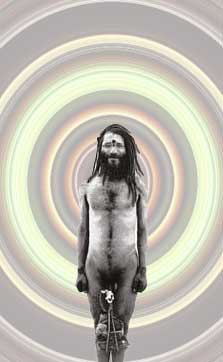 Summer
rains had already started in Manali making it wet, chilly and
unpleasant.
The only recreation was the "Techno Baba". A young Bihari ( from the
Indian state of Bihar) "holy man" living off a fairly attractive, but
perpetually
high Israeli woman staying in our hotel in old Manali. An obedient
egoless
chap, ceaselessly gibed at by the hotel owner and his only employee (a
lazy Nepali lad addicted to chess), who among themselves had an
identity crisis
about their respective roles. They taunted the Baba mercilessly, who
retorted
by grumbling about the bad times which have befallen when holy men are
not respected anymore.
Summer
rains had already started in Manali making it wet, chilly and
unpleasant.
The only recreation was the "Techno Baba". A young Bihari ( from the
Indian state of Bihar) "holy man" living off a fairly attractive, but
perpetually
high Israeli woman staying in our hotel in old Manali. An obedient
egoless
chap, ceaselessly gibed at by the hotel owner and his only employee (a
lazy Nepali lad addicted to chess), who among themselves had an
identity crisis
about their respective roles. They taunted the Baba mercilessly, who
retorted
by grumbling about the bad times which have befallen when holy men are
not respected anymore. 