 |
|
|
|
|
|
|
|
|
|
|
|
|
|
|
|
|
|
|
|
|
 |
|
|
Checking |
|
|
|
|
|
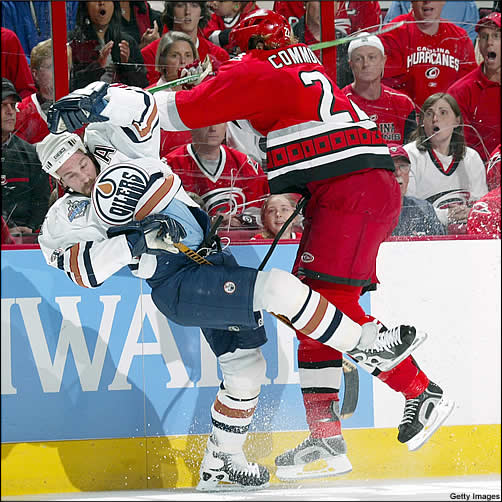
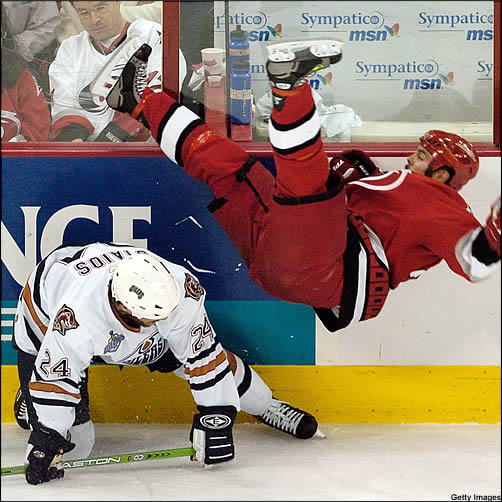
Checking is what makes hockey a "collision sport" as opposed to "contact sports" such as basketball. The game of hockey is rivaled only by football as being the most physical professional team sport. While the object certainly isn't to "tackle" the opposing player, physical checks slow down, take out, or otherwise affect the opposition's ability to play the game and can be called a physical force. The players we talked to had different ideas about what makes an effective check and I couldn't help but try to find out just how much energy is released in a check. |
|
|
|
|
|
|
So how much force is generated in a check? Using a mathematical formula, we can discover how much energy is expended in an open ice hit. The kinetic energy of each player before the collision can be calculated with the equation:
Energy = (1/2)mass x velocity2
The energy after is:
Energy = (1/2)total-mass x final-velocity2
To find the final velocity, you use the fact that the initial momentum (mass x velocity) of both players must equal the final momentum of the players:
(mass player 1 x velocity player 1) + (mass player 2 x velocity player 2) = combined mass x final velocity
Notice that in the above equation we know all the variables except for the final velocity. We solve for this and get:
final velocity = [(mass player 1 x velocity player 1) + (mass player 2 x velocity playe r2)]
combined mass
To find the stoping force, we assumed the collision between the players took about 1/4 of a second. Knowing this, we can look at the change in momentum of either player and use the formula:
force = change-in-momentum
time of impact |
|
|
|
|
 |
|
|
|
|
|
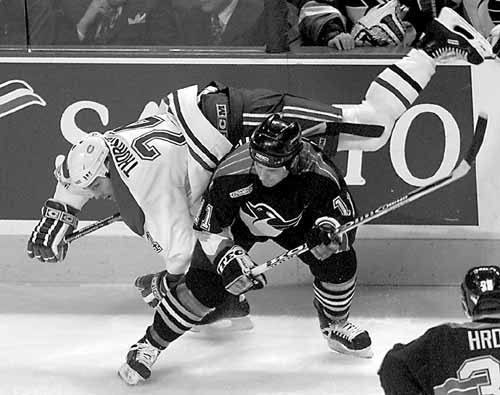
When you think about checking, you think about crushing hits against the board or open ice hits that send players flying through the air. While those types of hits are certainly checks, there are other more subtle types of checks. Poke-checks or stick-checks are when a player uses his stick to "poke" the puck away from another player. Sometimes goalies will use this technique to stop players who are trying to come around the back side of the goal. Back-checking is when a player (usually an offensive one) comes in behind the opposing player to get into the play. This situation usually occurs after a play is broken up in the opposition's end, a breakaway situation develops, and the players rush to their own end to get back into the play. |
|
|
|
|
|
|
 |
|
|
|
|
|
Links: |
|
|
|
|
|
Home |
|
|
|