
Professor Somorjai and his team used new methods developed in the last 10 or 15 years to examine the surface structure and composition of the atoms and molecules that make up the ice. These techniques were developed for high-tech applications--like studying the surface of materials that can be used for magnetic disk drives, for example. Somorjai used these same methods to examine ice. What he found was rather surprising. Somorjai told us, "the structure we determined was an almost impossible structure, indicating that every second water molecule on the surface was missing. Since that was not possible, we decided to go back and understand why [this was the case]." After further study, Somorjai's team found that the "missing" water [or ice] molecule was indeed there-- but it was vibrating so rapidly that it was invisible to the technique they were using. Once Somorjai and his team found this out, they could change the conditions to further study these molecules.
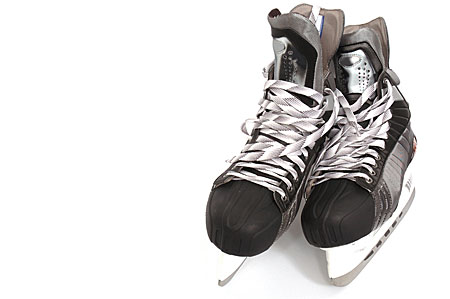
NHL players can reach speeds in excess of 20 miles (32 km) per hour on the ice. Some speed skaters have been clocked at over 30 miles (48 km) per hour! What makes one player faster than another? A combination of strength and mechanics help a skater move efficiently and quickly on the ice. When accelerating, players dig their skates into the ice and lean forward. They are exerting a strong force on the lower part of their bodies by leaning forward. Gravity pulls down on a hockey player's center of mass which "torques" him forward It is important to note that skaters can only lean forward when they are accelerating. If they leaned forward when traveling at a constant speed or decelerating, they would fall over.